
KoreaTechDesk | Korean Startup and Technology News

Sat, February 21, 2026

Sign in

Virtual Demo Day
Menu
  • Home
  • Startup News
    • AI & Big Data
    • AR & VR
    • Blockchain
    • Clean Technology
    • Content & Games
    • Cybersecurity
    • Enterprise & SaaS
    • FinTech
    • Gadgets & Electronics
    • Health & Bio
    • Manufacturing
    • Press Release
    • IoT
    • Marketplaces & E-commerce
    • Robotics
    • Transportation
    • Investments
    • Ecosystem & Lists
  • Governments
    • Artificial Intelligence Industry Cluster Agency
    • Daegu Technopark
    • GANGNAM-GU
    • Gyeonggido Business & Science Accelerator
    • Hwaseong Industry Promotion Agency
    • Invest Seoul
    • Korea Creative Content Agency
    • Korea Internet & Security Agency
    • Korea Information Security Industry Association
    • Korea Institute of Startup & Entrepreneurship Development
    • Korea Tourism Organization
    • Korea Trade-Investment Promotion Agency
    • Ministry of Culture, Sports and Tourism
    • Ministry of SMEs & Startups
    • National IT Industry Promotion Agency
    • Pangyo Techno Valley
    • Seoul Business Agency
    • Seoul FinTech Lab
    • South Gyeongsang Province
    • Seoul Metropolitan Government
  • Events
    • COMEUP
    • Korea Fintech Week
    • K-Content Expo
    • NextRise
    • Try Everything
  • Interviews
    • Investors’ interviews
    • Founders’ interviews
  • Programs
    • Asan Voyager
    • CAPA Global Program
    • Campus Town Program
    • SGSC Global Bootcamp
    • Gangnam-gu Global Roadshow
    • Global SaaS Marketplace Support Project
    • LAUNCHPAD
    • COMEUP STARS 120
    • K-Startup Grand Challenge
    • TIPS X beSUCCESS Global Project
    • SFL Global Program
    • KTO Global Showcase
    • Yonsei Univ Global Class
    • KOSME Global Program
  • Partner With Us
    • Press Release
    • Startup Scouting
    • Business Agencies
    • Global Mentorship Program
    • Investment Opportunities
    • K-Scouter Program
  • Lists
  • Home
  • Startup News
    • AI & Big Data
    • AR & VR
    • Blockchain
    • Clean Technology
    • Content & Games
    • Cybersecurity
    • Enterprise & SaaS
    • FinTech
    • Gadgets & Electronics
    • Health & Bio
    • Manufacturing
    • Press Release
    • IoT
    • Marketplaces & E-commerce
    • Robotics
    • Transportation
    • Investments
    • Ecosystem & Lists
  • Governments
    • Artificial Intelligence Industry Cluster Agency
    • Daegu Technopark
    • GANGNAM-GU
    • Gyeonggido Business & Science Accelerator
    • Hwaseong Industry Promotion Agency
    • Invest Seoul
    • Korea Creative Content Agency
    • Korea Internet & Security Agency
    • Korea Information Security Industry Association
    • Korea Institute of Startup & Entrepreneurship Development
    • Korea Tourism Organization
    • Korea Trade-Investment Promotion Agency
    • Ministry of Culture, Sports and Tourism
    • Ministry of SMEs & Startups
    • National IT Industry Promotion Agency
    • Pangyo Techno Valley
    • Seoul Business Agency
    • Seoul FinTech Lab
    • South Gyeongsang Province
    • Seoul Metropolitan Government
  • Events
    • COMEUP
    • Korea Fintech Week
    • K-Content Expo
    • NextRise
    • Try Everything
  • Interviews
    • Investors’ interviews
    • Founders’ interviews
  • Programs
    • Asan Voyager
    • CAPA Global Program
    • Campus Town Program
    • SGSC Global Bootcamp
    • Gangnam-gu Global Roadshow
    • Global SaaS Marketplace Support Project
    • LAUNCHPAD
    • COMEUP STARS 120
    • K-Startup Grand Challenge
    • TIPS X beSUCCESS Global Project
    • SFL Global Program
    • KTO Global Showcase
    • Yonsei Univ Global Class
    • KOSME Global Program
  • Partner With Us
    • Press Release
    • Startup Scouting
    • Business Agencies
    • Global Mentorship Program
    • Investment Opportunities
    • K-Scouter Program
  • Lists
Home Trends

Women’s Share in Korea’s Startup Workforce Has Doubled in a Decade: What Changed Inside the Ecosystem?

by Daehyun Song
February 21, 2026
in Trends
0

A decade ago, Korea’s venture ecosystem looked like a familiar story: male founders, male-heavy teams, and a pipeline built around manufacturing-era assumptions. The latest official survey data suggest that model is slowly loosening. Women are still a minority among founders, yet their share has nearly doubled in ten years. The more revealing signal sits inside hiring and job structure, where the venture sector’s shift toward software and IT services is reshaping who enters, who stays, and who gets stable roles.

Korea Venture Survey 2024: Female Founders Rise to 9.7%

Korea’s Venture Business Detailed Status Survey shows a clear change in founder gender composition over the past decade. In 2014, venture-company founders were 94.7% male and 5.3% female. By 2024, the split moved to 90.3% male and 9.7% female.

Employment structure shifted alongside founder composition. Male employment in venture firms rose from 525,484 in 2014 to 579,899 in 2024, a 10.4% increase. Female employment grew faster, rising from 191,541 to 248,478, up 29.7%.

That pushed women’s share of the venture workforce from 26.7% to 30.0% over ten years.
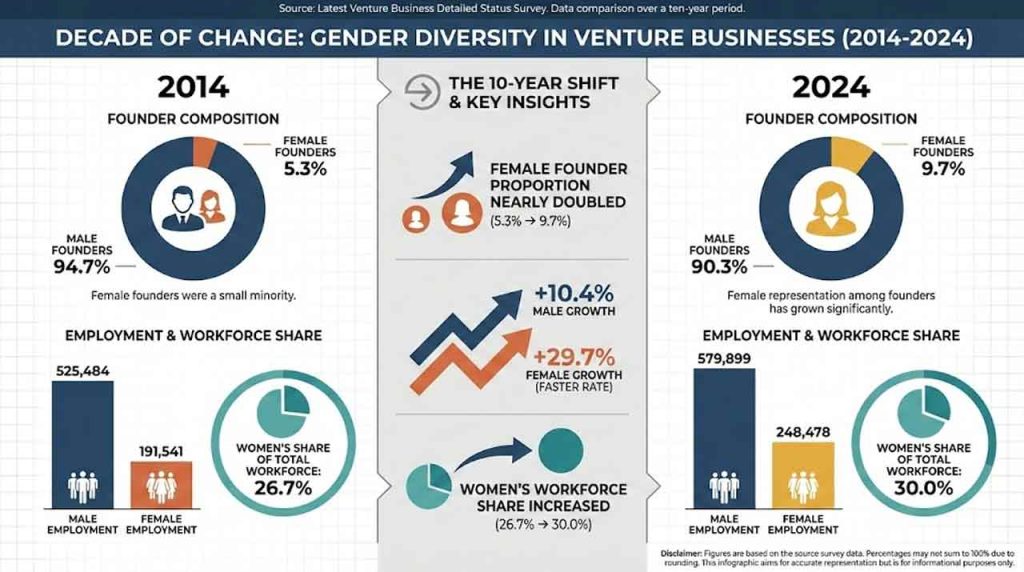
Women’s founder share in Korea’s startup workforce rose from 5.3% to 9.7% in 10 years, driven by a shift from manufacturing to IT services, reshaping talent and growth.

An industry official tied the trend to industrial change inside the venture sector, saying:

“As the venture ecosystem has shifted from a manufacturing-centered base to software and information technology–based services, job functions have diversified, and the inflow of female talent has increased.”

IT Services Shift Reshapes Korea Startup Talent Pipeline

This founder ratio matters, yet the employment numbers explain more about how the ecosystem is evolving. Hiring is where industrial structure turns into lived reality.

The survey suggests women are entering the venture labor market faster than men as the sector’s center of gravity moves toward software and IT-based services. That shift tends to expand role diversity, especially in functions that scale through product iteration, service design, data operations, customer success, and enterprise delivery.

The founder pipeline still skews heavily male at 90.3%. Yet the workforce signal looks different. A 30.0% female share inside venture firms is not parity, but it indicates that talent composition is changing at the operating level even before it fully changes at the ownership level.

Regular vs Non-Regular Jobs Reveal Labor Tension in Startups

The most uncomfortable tension in the data is not founder share. It is job quality and where risk sits.

Regular employment grew for both genders, yet the pace diverged. Male regular employees rose from 510,208 in 2014 to 550,525 in 2024, up 8.8%. Female regular employees increased from 180,417 to 234,542, up 30% over the same period.

Non-regular employment moved in a different direction. Male non-regular employment rose by 62.8% over ten years, while female non-regular employment increased by 25.3%. Women’s share among non-regular workers fell from 42.1% in 2014 to 35.9% in 2024.

That mix complicates the easy narrative. Women gained more ground in regular roles, yet the venture sector still expanded non-regular work sharply among men. The picture that emerges is a labor market under pressure to stay flexible as it transitions toward service-heavy growth, even while it professionalizes parts of the workforce.
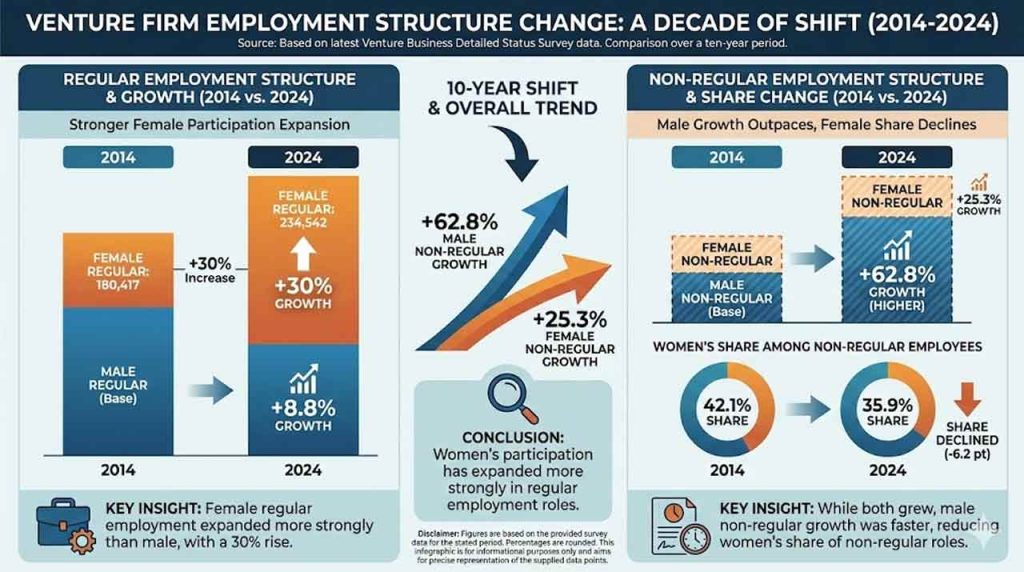
Women’s founder share in Korea’s startup workforce rose from 5.3% to 9.7% in 10 years, driven by a shift from manufacturing to IT services, reshaping talent and growth.

What the Data Shows About Gender Progress — and Its Limits

These survey results enable a grounded conclusion: women’s participation in Korea’s venture ecosystem is rising in founders and employment, and the shift correlates with the sector’s move toward software and IT services.

The data does not prove causality. It also does not reveal which industries within venture firms are driving the founder change, nor does it show how capital allocation behaves. Women entrepreneurship’s share rising to 9.7% is meaningful, yet it still leaves women as a small fraction of those who control strategy, equity, and board influence.

The numbers also do not capture the lived barriers that shape who becomes a repeat founder, who raises institutional rounds, and who exits. Those outcomes require separate data.

Still, the decade trend is hard to dismiss. It signals a venture ecosystem that is slowly rewriting its internal demographics alongside its industrial base.

Why Korea’s Venture Gender Shift Matters to Global Investors

Korea is often discussed as a capital-efficient, hardware-capable, export-driven innovation market. The survey highlights another feature global stakeholders should price in: the venture ecosystem’s labor base is evolving as software and IT services expand.

International founders evaluating Korea should read this as a talent signal. A larger female share in venture employment can broaden leadership pipelines, especially in product-led and service-led ventures that rely on cross-functional execution.

Investors also should treat the 9.7% founder share as an early indicator, not a finish line. Deal flow composition rarely shifts overnight. It shifts when talent inflows, stable roles, and repeatable operational careers create more founders who can credibly raise capital.

At the same time, policymakers should see the structural lever in the data. Industrial composition does matter. When venture activity moves toward software and IT services, workforce diversity can change even without a single headline policy intervention.

A Structural Workforce Shift Inside Korea’s Startup Economy

The tempting story is celebration. The more useful story is diagnosis.

Women’s founder share rising from 5.3% to 9.7% reflects progress, but it also underlines how far the ecosystem still has to go. The deeper signal is that Korea’s venture firms are hiring differently as the sector shifts away from manufacturing-centered models and toward software and IT services.

That change is less visible than a fund launch or a policy speech. It is also more durable, because it alters who gets experience inside high-growth companies. Over time, that experience becomes the raw material of new founders.

Key Takeaway on Korea’s Female Founders 2024

  • Korea’s Venture Business Detailed Status Survey shows female founders rose from 5.3% in 2014 to 9.7% in 2024, while male founders fell from 94.7% to 90.3%.
  • Women’s share of venture-firm employment increased from 26.7% to 30.0% over the decade.
  • Female employment in venture firms grew 29.7% over ten years, compared with 10.4% growth for men.
  • Female regular employment rose 30% over the decade, outpacing 8.8% growth for male regular employment.
  • Women’s share among non-regular workers declined from 42.1% in 2014 to 35.9% in 2024, while male non-regular employment rose sharply.
  • An industry official linked the trend to a shift in the venture ecosystem away from manufacturing and toward software and IT service models, which diversified roles and increased inflows of female talent.

– Stay Ahead in Korea’s Startup Scene –
Get real-time insights, funding updates, and policy shifts shaping Korea’s innovation ecosystem.
➡️ Follow KoreaTechDesk on LinkedIn, X (Twitter), Threads, Bluesky, Telegram, Facebook, and WhatsApp Channel.

Tags: Female employmentfemale founders in South Korea venture companiesfemale founders KoreaFemale startupsKorea venture ecosystem workforce compositionKorea venture startup gender statistics 2024manufacturing to software transition South Korea economyregular vs non regular employment Korea startupsSouth Korea IT services startup growthVenture Business Detailed Status Survey KoreaWomenwomen employment share Korea startup sectorWomen EntrepreneurWomen entrepreneursWomen Startup Founderswomen's entrepreneurship
Previous Post

Why Korea’s Open Innovation Demand Just Spiked: Startups Move Closer to Core R&D

Next Post

From IEEPA to Section 122: How America’s Tariff Shift Reshapes Risk for Korean Export-Driven Startups

Next Post

From IEEPA to Section 122: How America’s Tariff Shift Reshapes Risk for Korean Export-Driven Startups

MOST READ ARTICLE OF THE WEEK

1.
With Korbit Acquisition, Mirae Asset Tests How Far Korea Will Let Finance Meet Crypto
15 Feb 2026
2.
In Korea’s Gaming Sector, New Titles Decide Survival — and Global Markets Decide Scale
15 Feb 2026
3.
Startup for All: Korea Is Testing a New Model Where Startup Policy, Media and Private Capital Move Together
15 Feb 2026
4.
Korea’s Anti-Broker Reform Now Proceeds to Enforcement Mode
15 Feb 2026
5.
Korea’s Youth Employment Slide Deepens, Raising Questions for an AI-Led Startup Economy
16 Feb 2026
Register for Event

[the_ad id=”18508″]

List Article

1.
6 Reasons Why Seoul Is Poised to Become a Top 5 Global Economic Hub by 2030
20 Aug 2024
2.
Top Co-working Spaces for Startups & Companies to Explore in South Korea
3 Apr 2024
3.
Top Accelerators in South Korea Shaping Startup Success
29 Nov 2023
4.
Top Korean Venture Capital Firms Backing Startup Success
26 Oct 2023
5.
Top Apps for Seamless Korean to English Translation
14 Aug 2023

Similar Articles

Trends

Korea’s Startup Risk Has Changed: Profitability and IPO Credibility Now Decide the Price

More
Trends

Korea’s Youth Employment Slide Deepens, Raising Questions for an AI-Led Startup Economy

More
Trends

KIBO’s Record Loan Repayments Signal Rising Stress in Korea’s Startup Credit Pipeline

More

Topics

Menu
  • AI & Big Data
  • AR & VR
  • Blockchain
  • Clean Technology
  • Content & Games
  • Cybersecurity
  • Enterprise & SaaS
  • FinTech
  • Gadgets & Electronics
  • Health & Bio
  • IoT

Program

Menu
  • Asan Voyager
  • CAPA Global Program
  • SGSC Global Bootcamp
  • LAUNCHPAD
  • COMEUP STARS 120
  • K-Startup Grand Challenge
  • TIPS X beSUCCESS Global Project
  • SFL Global Program
  • KTO Global Showcase
  • Yonsei Univ Global Class
  • KOSME Global Program

About

Menu
  • About Us
  • all articles
  • Terms of Use
  • Privacy
  • Cookie-policy
  • twitter

Subscribe and be informed first hand about actual Korean startup news.

All the day’s headlines and highlights, direct to you every morning.

Contact us : [email protected]

Topics

Menu
  • AI & Big Data
  • AR & VR
  • Blockchain
  • Clean Technology
  • Content & Games
  • Cybersecurity
  • Enterprise & SaaS
  • FinTech
  • Gadgets & Electronics
  • Health & Bio
  • IoT

Program

Menu
  • Asan Voyager
  • CAPA Global Program
  • SGSC Global Bootcamp
  • LAUNCHPAD
  • COMEUP STARS 120
  • K-Startup Grand Challenge
  • TIPS X beSUCCESS Global Project
  • SFL Global Program
  • KTO Global Showcase
  • Yonsei Univ Global Class
  • KOSME Global Program

About

Menu
  • About Us
  • all articles
  • Terms of Use
  • Privacy
  • Cookie-policy
  • twitter

Subscribe and be informed first hand about actual Korean startup news.

All the day’s headlines and highlights, direct to you every morning.

© 2023 Koreantech News & Media Korea Zrt. All rights reserved.

Our Spring Sale Has Started

You can see how this popup was set up in our step-by-step guide: https://wppopupmaker.com/guides/auto-opening-announcement-popups/

Our Spring Sale Has Started

You can see how this popup was set up in our step-by-step guide: https://wppopupmaker.com/guides/auto-opening-announcement-popups/

We hope you enjoy our content, May you please give us Feedback regarding our website!

Single Post Feedback

dgdfgfdgdf

What you think about Koreatechdesk, Share your idea with us!

feedback popup

Invitation submission has been closed

Insert/edit link

Enter the destination URL

Or link to existing content

    No search term specified. Showing recent items. Search or use up and down arrow keys to select an item.