

South Korea’s scrutiny of dominant digital platforms has moved into a sharper phase. Prosecutors have conducted search and seizure operations at the offices of lodging reservation platforms Yanolja and Yeogi Eottae over advertising programs that bundled discount coupons funded by partner businesses.
The investigation follows earlier regulatory penalties and raises new questions about how platform promotion models distribute economic risk between operators and smaller partners. For Korea’s startup ecosystem, the case highlights how companies that began as disruptive startups are now operating under increasing governance expectations as their market influence expands.
Prosecutors Launch Searches Into Korea’s Top Lodging Platforms
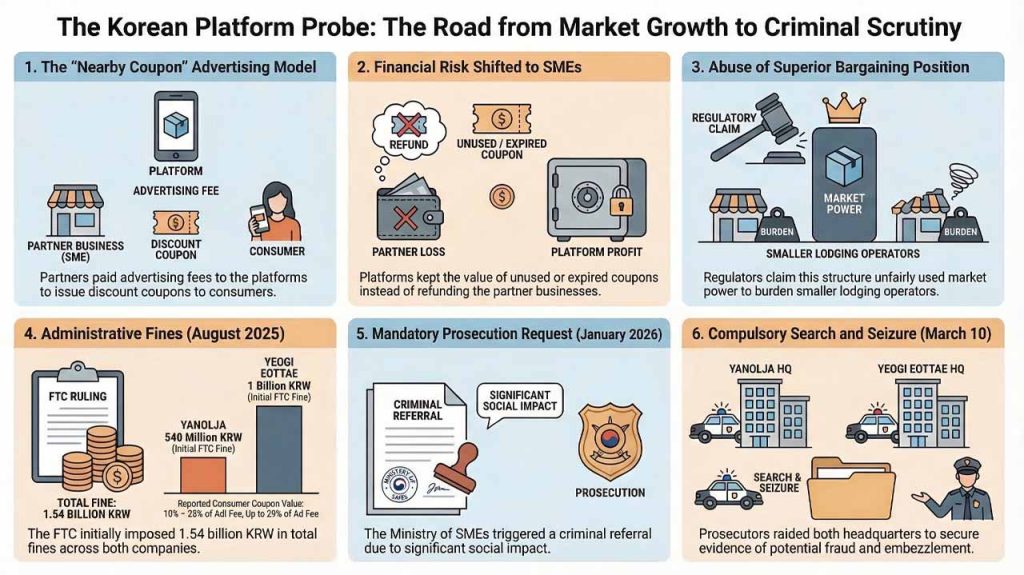
South Korean prosecutors have launched a compulsory investigation into two of the country’s largest accommodation reservation platforms, Yanolja and Yeogi Eottae (Good Choice Company).
According to multiple local media reports citing the legal community, the Fair Trade Investigation Department of the Seoul Central District Prosecutors’ Office, led by Chief Prosecutor Na Hee-seok, conducted search and seizure operations on March 10.
Investigators were dispatched to:
- Yanolja’s headquarters in Seongnam, Gyeonggi Province
- Yeogi Eottae’s headquarters in Gangnam, Seoul
Authorities are seeking materials related to advertising coupon programs that may have violated South Korea’s Fair Trade Act.
The two companies are widely regarded as the first- and second-largest players in Korea’s online lodging reservation market, making the investigation particularly significant for the country’s digital travel platform sector.
Advertising Coupon Programs at the Center of the Probe
The investigation focuses on advertising products sold to partner lodging businesses that combined premium listing exposure with consumer discount coupons.
Under these programs, lodging operators purchased advertising placements designed to increase visibility in the platforms’ apps. Discount coupons were issued to consumers as part of those promotions.
The cost of issuing those coupons was borne by the lodging businesses through advertising fees.
How the Coupon Advertising Worked
According to the reports cited in the investigation:
Yanolja
- Sold an advertising product called “Nearby Coupon Advertising.”
- Participating lodging businesses received placement in a “first-come coupon” category within the app.
- Consumers were offered coupons equivalent to 10% to 25% of the advertising fee.
Unused coupons were reportedly extinguished once the advertising contract period ended.
Yeogi Eottae
- Sold advertising products such as reward-type coupon promotions.
- Participating businesses were displayed prominently near the top of the platform interface.
- Consumers received coupons worth up to 29% of the advertising cost.
Coupon validity periods were reportedly set to one day, meaning unused coupons expired the same day.
Where the Dispute Emerged
The legal concern centers on what happened when the coupons were not fully used.
According to the allegations cited in the reports, the platforms extinguished unused coupons without refunding their value.
Because the coupon costs were already paid by partner lodging businesses through advertising fees, unused coupons effectively transferred the financial burden of unredeemed promotions to those businesses.
Authorities are examining whether this structure constituted an abuse of superior bargaining position, a violation under Korea’s Fair Trade Act.
More than 2,500 lodging businesses may have been affected, according to one report.
The Case Had Already Drawn Regulatory Penalties
The dispute had previously been investigated by Korea’s Fair Trade Commission (FTC).
In August 2025, the regulator imposed administrative penalties:
- 540 million KRW fine on Yanolja
- 1 billion KRW fine on Yeogi Eottae
The FTC concluded that the practices involved the abuse of transactional superiority toward partner businesses.
Both companies have filed administrative lawsuits challenging the penalties, meaning the regulatory case is still under legal review.
Why the Case Escalated to Criminal Investigation
The investigation expanded after intervention from the Ministry of SMEs and Startups (MSS).
In January 2026, the ministry requested that the Fair Trade Commission refer the case to prosecutors using Korea’s Mandatory Prosecution Request System.
Under this system, if the ministry determines that SME damage or social impact is significant, it can request criminal referral even when the competition regulator has not pursued prosecution.
Once such a request is made, the FTC is legally required to refer the case to prosecutors.
This mechanism moved the case beyond administrative penalties and into criminal investigation territory.
Legal Experts Say the Investigation Could Broaden
Legal observers cited in Korean reporting say prosecutors may also review potential criminal charges beyond competition law.
Possible areas of investigation discussed include:
- Fraud, if the coupon expiration structure was not clearly explained when the advertising products were sold.
- Embezzlement or breach of trust, if coupon funds paid by partner businesses were not properly settled.
These possibilities have been mentioned by legal experts but have not been confirmed as charges.
Prosecutors are currently examining whether the transaction structure itself violated the Fair Trade Act.
The Investigation Coincided With Yanolja’s New AI Strategy
The timing of the investigation adds an unusual contrast for Yanolja.
Earlier on March 10, the company announced a new corporate vision called “Yanolja 3.0.” The strategy positions Yanolja as a global travel technology company built around artificial intelligence.
The company described the initiative as the next stage of its development after:
- “Yanolja 1.0,” which focused on early survival
- “Yanolja 2.0,” which centered on mobile transformation
The new strategy emphasizes three core values:
- sincerity toward customers
- leadership through technology
- a unified organizational structure
Yanolja also reorganized its leadership structure in December, appointing separate CEOs for:
- business strategy and management
- enterprise solutions
- consumer platform
CEO Lee Soo-jin stated,
“AI is changing industry standards far more powerfully and rapidly than the mobile transition.
The purpose of Yanolja’s technological innovation is to make travel ten times easier and more convenient for everyone around the world.”
What the Case Signals for Korea’s Startup Ecosystem
The investigation reflects a broader transition within Korea’s technology sector.
Platforms such as Yanolja began as startup challengers within fragmented offline industries. Over time, they evolved into dominant digital infrastructures connecting large networks of small businesses and consumers.
And that shift has brought greater regulatory scrutiny.
Platform economics are becoming a policy focus
Advertising and promotion models that transfer financial risk to smaller partners are drawing attention from regulators. Coupon-based promotions are common across global digital platforms, but regulators increasingly examine how the costs and benefits are distributed.
Enforcement is expanding beyond administrative penalties
The Yanolja and Yeogi Eottae case illustrates how regulatory disputes can escalate into criminal investigations, especially when authorities believe they expose significant damage to SMEs.
Startup platforms face new governance expectations
Companies that scaled quickly during Korea’s mobile platform boom now operate at a level where regulators assess them as market infrastructure rather than emerging startups.
That shift can reshape the regulatory environment for the next generation of digital platforms.
Why Global Founders and Investors Are Watching
Korea remains one of Asia’s most dynamic startup ecosystems, particularly in sectors such as travel technology, commerce platforms, and AI-driven services.
At the same time, the country has strengthened regulatory oversight around platform competition and fair-trade practices.
Global founders entering the Korean market increasingly need to consider:
- how partner revenue structures are designed
- how promotional costs are allocated
- how regulators interpret “superior bargaining position” in digital platform markets.
These issues are now becoming central to the governance of large technology platforms operating in Korea.
Shaping The Future of Korea’s Platform Partnerships
The investigation into Yanolja and Yeogi Eottae began as a dispute over coupon-based advertising practices. Yet, it now sits at the intersection of platform economics, SME protection, and the evolving governance of Korea’s digital economy.
As early-generation startup platforms mature into dominant market infrastructure, regulatory expectations are shifting as well. The outcome of this case will not only affect two of Korea’s largest travel platforms but also shape how future platform businesses structure relationships with the partners that power their ecosystems.
Key Takeaways on Yanolja and Yeogi Eotta Escalating Case
- Prosecutors searched Yanolja and Yeogi Eottae on March 10 over advertising coupon practices.
- The case follows earlier fines imposed by Korea’s Fair Trade Commission.
- The investigation escalated through the Mandatory Prosecution Request System used by the Ministry of SMEs and Startups.
- Authorities are examining whether the platforms abused superior bargaining power toward partner lodging businesses.
- The case highlights growing scrutiny of platform economics as Korean startup platforms mature into major digital infrastructure.
– Stay Ahead in Korea’s Startup Scene –
Get real-time insights, funding updates, and policy shifts shaping Korea’s innovation ecosystem.
➡️ Follow KoreaTechDesk on LinkedIn, X (Twitter), Threads, Bluesky, Telegram, Facebook, and WhatsApp Channel.
🤝 Looking to connect with verified Korean companies building globally?
Explore curated company profiles and request direct introductions through beSUCCESS Connect.