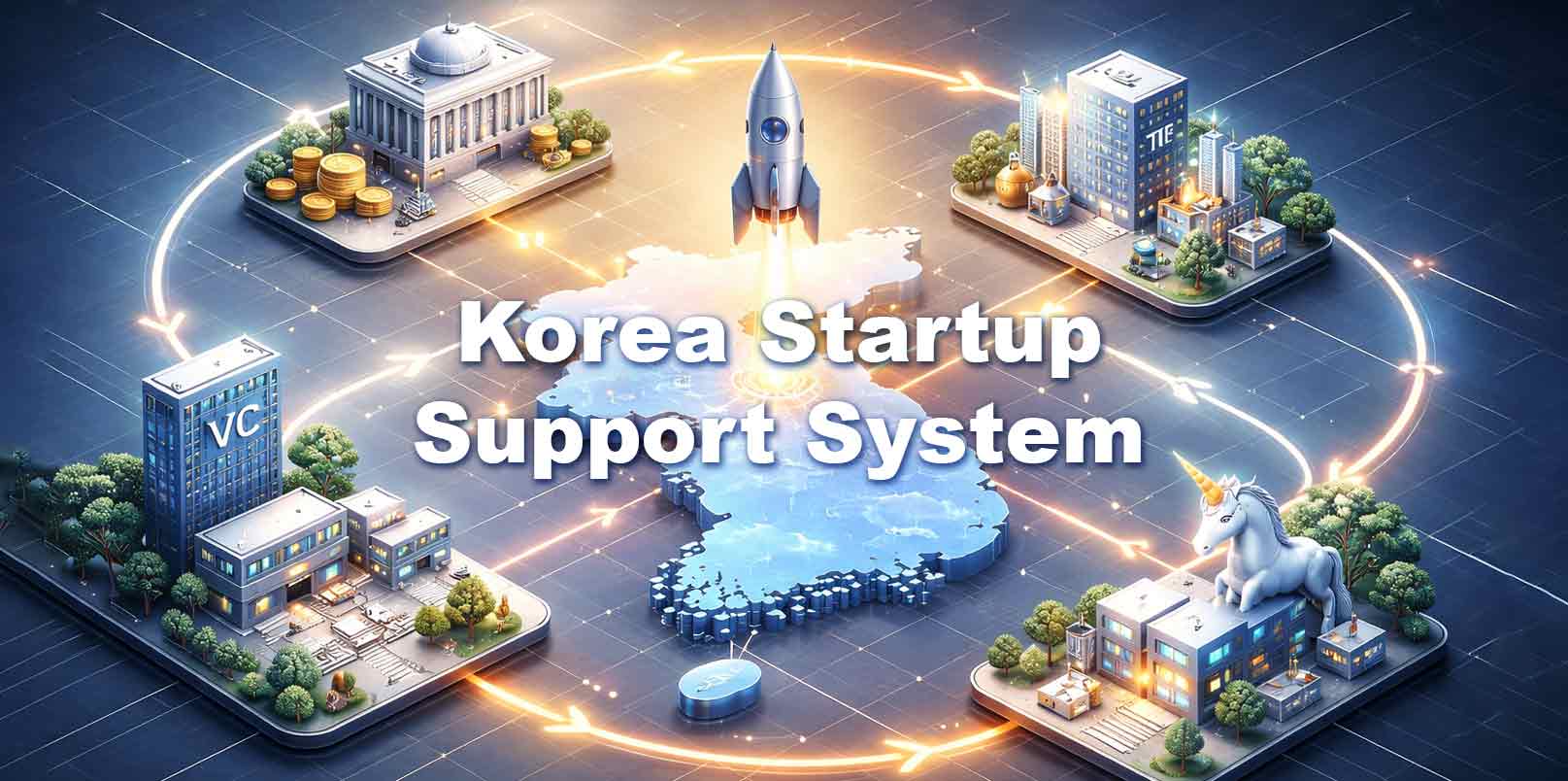
Korea’s startup ecosystem is often described as well-funded, policy-driven, and structurally organized. Yet for foreign founders and investors, it can feel complicated to decode.
Programs such as TIPS, the Korea Fund of Funds, and Baby Unicorn frequently appear in headlines. Ministries publish announcements. Venture capital activity is backed by public capital at scale.
Still, the system behind these acronyms rarely appears in one coherent explanation.
Why Korea’s Startup Support System Feels Complex
Multiple ministries are involved in shaping policy and deploying capital. National and regional governments operate parallel initiatives. Some programs provide grants, others channel funds through venture capital firms, and others function as selection designations rather than direct funding.
For international readers, the fragmentation creates confusion. Is the government investing directly in startups? Do programs require private backing first? Are foreign founders eligible?
Understanding how the pieces connect is more important than memorizing each acronym. This guide maps how Korea’s startup support system actually works, based on official program descriptions and institutional documentation.
Here’s how startups typically move through Korea’s support pipeline.
Who Runs the Korea’s Startup Ecosystem?
Ministry of SMEs and Startups (MSS)
The Ministry of SMEs and Startups (MSS) is the central policy authority shaping Korea’s startup strategy.
According to the official government portal, MSS’s 2026 budget stands at KRW 16.5233 trillion, with significant allocations toward venture investment, startup packages, and contributions to the Korea’s Fund of Funds (KFoF), also known as “Mother Fund,” Korea’s public fund-of-funds vehicle.
MSS designs major initiatives such as TIPS and the Global Unicorn Project, including the Baby Unicorn track. The ministry also sets the policy direction and channels public capital into the ecosystem.
Korea Venture Investment Corp. (KVIC)
KVIC manages the Korea Fund of Funds, commonly referred to as the KFoF or “Mother Fund”.
Rather than investing directly into startups, the Fund of Funds supplies capital to private venture funds. Those venture funds then select and invest in startups, becoming a core policy instrument in Korea’s venture promotion framework.
For 2026, Korea announced plans to create KRW 4.4 trillion in venture funds, supported by KRW 2.1 trillion in Fund of Funds contributions. This structure illustrates how public capital mobilizes private venture investment on a scale.
Accelerators and TIPS Operators
Private accelerators and venture firms play a screening role. Under the TIPS model, MSS-selected operators identify promising startups first. Public support follows private selection.
This hybrid structure embeds market discipline into public funding decisions.
Local Governments
Provincial and municipal governments operate their own startup hubs and programs, often aligned with national policy but tailored to regional industrial clusters. These local initiatives complement central programs rather than replace them.
The Startup Journey: How the Pipeline Works
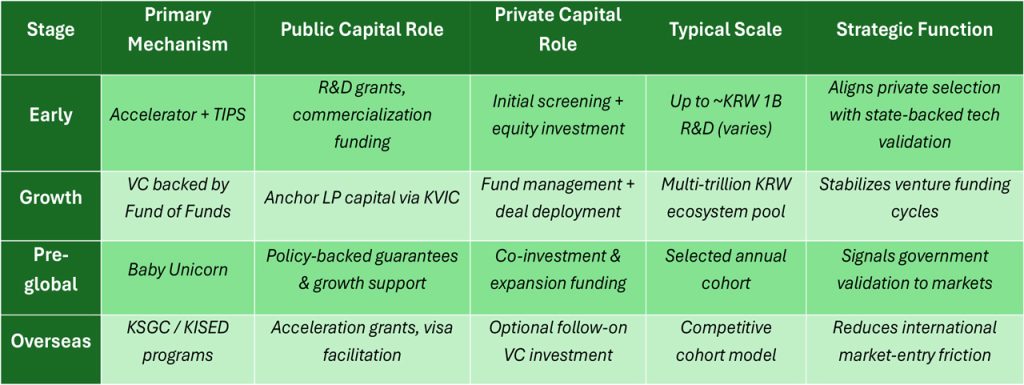
Korea’s support system functions as a staged funnel rather than a single grant scheme.
1. Idea and Early Validation
Startups typically begin with accelerator support or seed investment from angels or early-stage VCs. Entry into the TIPS program often depends on securing backing from a recognized operator.
TIPS can provide up to KRW 1 billion in combined support over three years, including KRW 100 million in angel investment and up to KRW 500 million in R&D funding.
This stage blends private investment with public R&D support.
2. Investment and Scaling
As startups mature, they may attract venture funds, backed by the Korea Fund of Funds.
This is a critical point in the pipeline. Public capital does not replace private capital. It de-risks it. Venture firms manage the funds, make independent investment decisions, and drive governance.
The Fund of Funds thus influences the ecosystem indirectly, shaping capital availability rather than picking individual companies.
3. Recognition and Scale-Up Designation
Programs such as Baby Unicorn operate as both financial support and signaling mechanisms.
Hundreds of companies have been selected under the Global Unicorn framework since 2019. Baby Unicorn participants may receive competitiveness enhancement funding and access to special guarantee support.
However, selection does not guarantee unicorn status. It identifies firms considered scalable under defined criteria.
4. Overseas Expansion
For foreign startups entering Korea, or Korean startups expanding outward, programs such as the K-Startup Grand Challenge provide acceleration, workspace, and settlement support.
The program provides visa assistance, incorporation guidance, and Korean intern matching to address language and operational barriers.
This stage focuses less on R&D and more on integration into the domestic market.
Major Programs Explained Simply
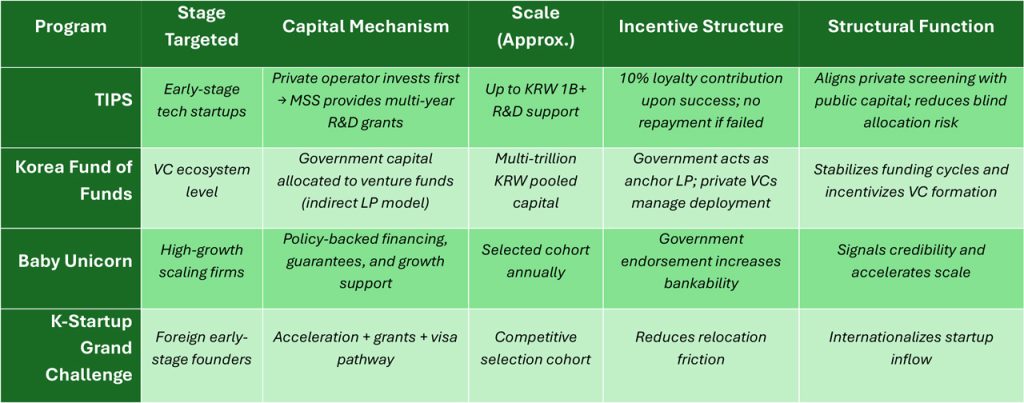
TIPS Program Explained: Standard, Scale-Up, and Global Tracks
The Tech Incubator Program for Startups (TIPS) operates as a public–private partnership between the Ministry of SMEs and Startups (MSS) and certified private operators, typically venture capital firms or accelerators.
Under the model, private operators first invest in and select promising startups. Once selected, MSS provides structured government support aligned with the startup’s development stage.
The program now operates through multiple tracks:
1. Standard TIPS
Designed for early-stage, technology-based startups.
Provides multi-year R&D funding and commercialization support.
Startups repay 10% of R&D grants as a loyalty contribution upon commercial success. No repayment is required if the business fails.
2. Scale-Up TIPS
Targets growth-stage companies that have demonstrated market traction.
Focuses on accelerating commercialization, global market entry, and larger-scale R&D.
3. Global TIPS
Supports startups aiming for overseas expansion from the outset.
Includes funding structures and strategic support tailored to international market entry.
This tiered structure embeds market validation into public funding. Private operators assume early screening risk, while public capital reinforces companies that have already secured private-sector backing. The model reduces blind state allocation and aligns government support with investor conviction.
Korea Fund of Funds for Startups
The Korea Fund of Funds does not invest directly into startups. It allocates capital into venture funds managed by private firms, and these firms then invest in startups.
This structure amplifies private capital while distributing risk. And in 2026, the government announced plans to mobilize approximately KRW 4.4 trillion in venture funds through this mechanism.
Baby Unicorn Program Korea
The Baby Unicorn program operates within the broader Global Unicorn strategy.
Selected companies receive scale-up support and financial instruments designed to strengthen competitiveness. The program acts as a credibility marker within the domestic ecosystem.
K-Startup Grand Challenge
The K-Startup Grand Challenge is a government-backed program designed to attract overseas startups to establish a presence in Korea. It is operated under national startup policy frameworks and administered through designated agencies.
Through this program, selected startups receive structured acceleration, workspace support, prize funding tied to performance, assistance with incorporation, visa processes, and settlement in Korea.
Unlike R&D-focused programs such as TIPS, the K-Startup Grand Challenge is primarily a market-entry platform. Its objective is to help foreign startups localize, test the Korean market, and connect with domestic investors and corporate partners.
Korea Startup Support at a Glance
Where Foreign Founders Usually Get Confused
At first glance, Korea’s startup system looks centralized. In reality, it operates through several layers. MSS sets policy direction. KVIC manages public capital through venture funds. Private operators screen startups under programs such as TIPS. Local governments run their own initiatives alongside national ones. The structure is coordinated, but not singular.
Language adds another layer of complexity. Many announcements and application details are released first in Korean. English portals exist, yet practical nuances often require familiarity with local processes.
Eligibility rules are not uniform. Some programs require backing from accredited venture capital firms. Others require a Korean entity or local incorporation before application. These distinctions are not always obvious in headline summaries.
Another common misunderstanding concerns how money flows. The government does not typically invest directly in startups at every stage. A significant portion of capital is deployed through private venture funds backed by public sources.
Clarity about these mechanics prevents misplaced expectations. The system rewards preparation, local partnerships, and an understanding of how institutional pieces connect.
Why Korea Built the System This Way
Korea’s startup framework did not emerge by accident. It reflects a deliberate attempt to balance public intervention with market discipline.
Government capital enters early, when risk is highest and private investors may hesitate. Yet the state does not usually pick companies directly. Venture firms, accelerators, and designated operators remain responsible for screening and execution.
The Fund of Funds model channels public resources into privately managed venture capital. TIPS links government R&D support to startups already backed by professional investors. Programs such as Baby Unicorn add recognition and financial tools at later stages, reinforcing scale rather than substituting for market validation.
The result is a staged system. Public funding lowers structural risk. Private actors drive selection and governance. Growth is guided, but not centrally controlled.
In this sense, Korea’s startup support architecture mirrors its broader industrial approach: coordination at the policy level, competition at the company level.
How Foreign Founders Can Navigate Korea’s Government Startup Programs
- Government-backed capital is significant, but it is mediated through private actors. Therefore, relationships with operators and VCs matter a lot.
- Selection into programs such as TIPS or Baby Unicorn often strengthens credibility in subsequent fundraising.
- Foreign founders must assess eligibility carefully. Incorporation structure and local presence can influence access.
- The Korea Fund of Funds expands venture liquidity, which can indirectly benefit later-stage fundraising.
- Korea’s system is structured, not ad hoc. Understanding the pipeline increases the probability of successful entry.
Why Korea’s Startup Support System Matters in the Asia-Pacific Venture Landscape
In the end, Korea’s startup support system is neither a simple grant machine nor a purely market-driven environment. What exists instead is a layered structure where public capital reduces early risk, private investors make selection decisions, and dedicated programs guide companies through distinct stages of growth and expansion.
For international founders and investors, the real value lies in understanding how these elements interact. Government funding rarely operates in isolation. It is designed to work alongside venture firms, accelerators, and market signals. Capital flows through institutions. Selection matters. Timing matters even more.
That is why success in Korea does not depend on memorizing program names. It depends on seeing the architecture behind them.
And while this map does not remove complexity, it gives you the structural lens needed to navigate it.
Quick Reference: How Korea Funds and Scales Startups
- MSS shapes the national startup policy with a multi-trillion-won annual budget.
- The Korea Fund of Funds channels public capital into private venture funds rather than investing directly in startups.
- TIPS combines private operator selection with government R&D support.
- Baby Unicorn functions as both financial assistance and ecosystem signaling.
- K-Startup Grand Challenge supports foreign startups entering Korea through structured acceleration and settlement services.
- Korea’s system operates as a staged pipeline from validation to scale and global expansion.
🤝 Looking to connect with verified Korean companies building globally?
Explore curated company profiles and request direct introductions through beSUCCESS Connect.
– Stay Ahead in Korea’s Startup Scene –
Get real-time insights, funding updates, and policy shifts shaping Korea’s innovation ecosystem.
➡️ Follow KoreaTechDesk on LinkedIn, X (Twitter), Threads, Bluesky, Telegram, Facebook, and WhatsApp Channel.