
Corporate R&D rarely announces when it is losing confidence in itself. It simply starts looking outward. In Korea, that shift is now measurable. Applications from large companies to collaborate with startups through the government’s open innovation program have surged by more than 30 percent in a year. The headline is recruitment. The deeper story is how Korean corporations are recalibrating their core R&D strategy.
Korea Public-Private Open Innovation Program Sees 30–40% Jump in Corporate Demand
The Ministry of SMEs and Startups (MSS) announced that it will recruit startups from February 20 to March 19 for its “Public-Private Cooperative Open Innovation (Strategic Task Resolution Model).”
This year, 90 demand-side companies applied to participate, up from 68 the previous year, a 32.4 percent increase. The number of submitted collaboration tasks rose from 94 to 126, up 39.4 percent.
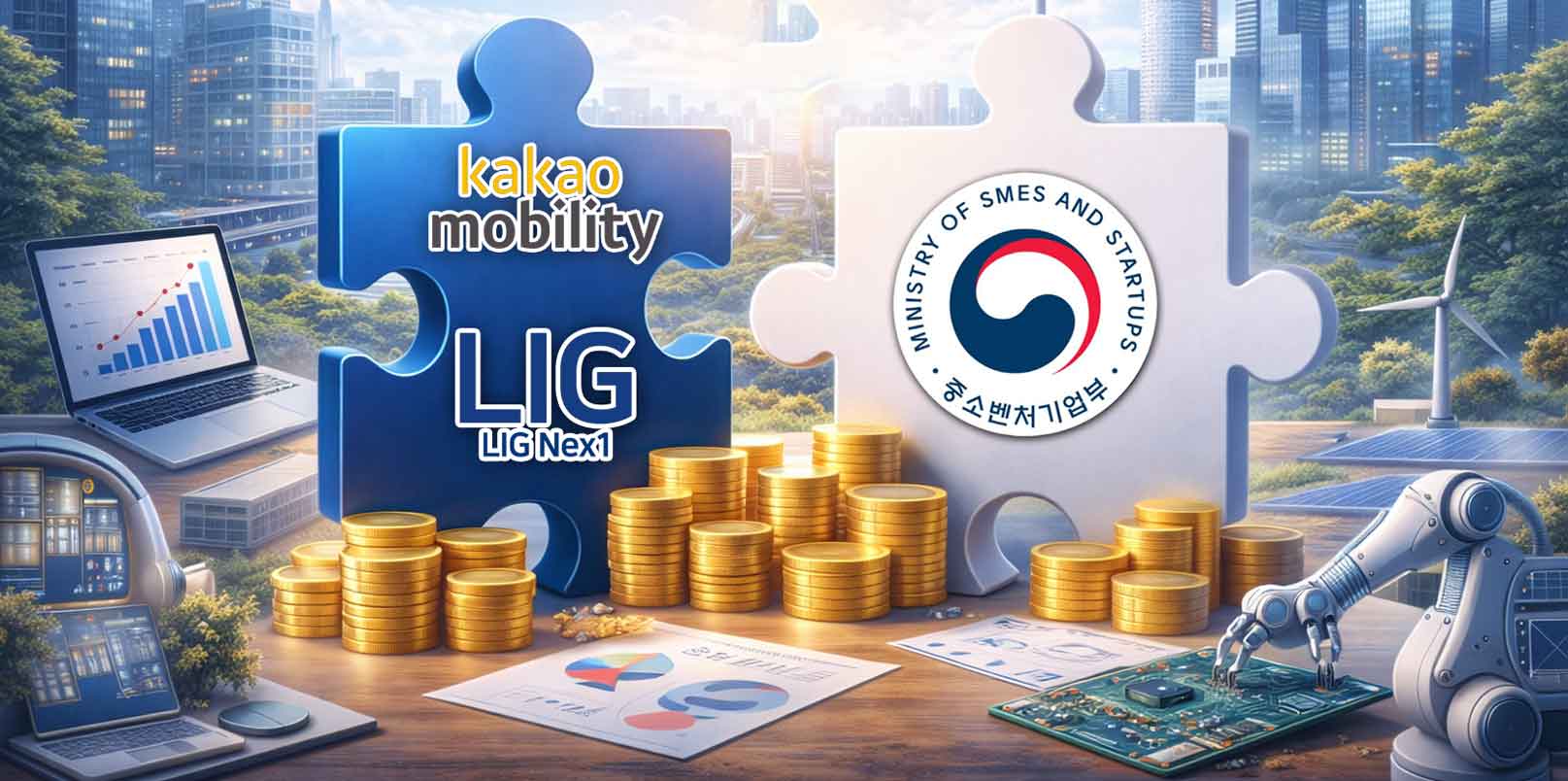
Following evaluation procedures conducted since late December, MSS selected 30 strategic tasks proposed by companies and institutions including Kakao Mobility, LIG Nex1, and Korea Water Resources Corporation. Approximately 30 startups will be chosen to execute these projects.
Selected startups will receive up to KRW 140 million in commercialization funding, KRW 20 million higher than last year’s cap. They may also gain access to proof-of-concept infrastructure, data, and specialist personnel provided by participating corporations. Follow-up R&D and commercialization funding may be linked to high-performing collaborations.
Cho Kyung-won, Director General for Startup Policy at MSS, stated,
“Open innovation enables large corporations to strengthen competitiveness through early adoption of innovative external technologies, while startups gain opportunities to secure data and infrastructure and explore new markets.
MSS will serve as a collaborative platform centered on startups, connecting large, mid-sized, and small enterprises, as well as public institutions, in joint innovation.”
Venture-Client Strategy Gains Ground as Corporate R&D Models Shift
The scale of demand increase suggests more than administrative expansion. According to MSS, the rise reflects growing corporate interest in adopting startup technologies through open innovation rather than relying solely on internal R&D.
Amid high interest rates, investment contraction, and geopolitical uncertainty, companies are adjusting their R&D posture. The “venture client” model, in which corporations act as early customers of startup technology instead of acquiring or building it internally, is gaining traction.
Global data cited by MSS reinforces this direction. A survey of the world’s top 100 innovation-driven companies found that 41 percent plan to increase open innovation budgets in 2026, while only 14 percent expect reductions.
Korea’s program now spans mobility, defense technology, infrastructure, telecommunications, retail, and construction, reflecting multi-sector adoption rather than isolated experimentation.
The Friction: Are Startups Becoming Core Innovators or Outsourced Problem Solvers?
The demand surge does not automatically translate into structural empowerment for startups.
The Strategic Task Resolution Model remains project-based. Startups are matched to predefined corporate tasks. Funding is capped at KRW 140 million, and selection is limited to roughly 30 firms per cycle.
This raises a practical question. Are startups moving closer to corporate core R&D strategy, or are they absorbing specific innovation risks that corporations prefer not to carry internally?
The program provides infrastructure access and potential follow-up R&D linkage. Yet ownership structures, procurement integration, and long-term contracts remain outside the immediate scope of the announcement.
If open innovation remains episodic, startups may secure references and pilot projects without securing durable strategic roles.
What the MSS Model Enables — and What It Still Cannot Guarantee
The expanded open innovation framework includes three tracks:
- Strategic Task Resolution,
- Private Selection and Recommendation, and
- Mutual Autonomous Exploration.
The second track allows corporations such as Hyundai Motor (Zero1NE) and Samsung Electronics (C-Lab Outside) to recommend startups from their own programs for government-linked follow-up support. This deepens integration between corporate accelerators and public funding mechanisms.
The structure enables faster proof-of-concept validation, potential early revenue streams for startups, and a lower barrier to enterprise market entry. It also lowers internal R&D burden for corporations navigating uncertain macroeconomic conditions.
What it does not guarantee is scale. Thirty strategic projects do not transform the entire innovation system. Nor does increased demand automatically ensure equitable bargaining power for startups within corporate partnerships.
The model reduces friction at the entry point. It does not eliminate asymmetry.
Korea’s Increasing Demand for External Tech Partners
For international founders considering South Korea as a test market, the open innovation demand increase signals an ecosystem that is actively searching for external technology partners.
The venture client model in South Korea now operates with direct government mediation and financial support, reducing early collaboration risk. For B2B deep-tech startups, particularly in AI, infrastructure, mobility, and defense-adjacent technologies, this creates structured entry channels.
Investors should view the demand increase as evidence that Korean conglomerates and public institutions are reallocating innovation budgets outward. That shift may create more predictable enterprise contracts for startups positioned as technology suppliers.
However, foreign startups entering through open innovation channels must understand the constraints. Projects are structured around corporate-defined needs. Success depends on integration capability and execution discipline as much as technical novelty.
The opportunity is real. So is the negotiation complexity.
Korea’s R&D Center of Gravity Is Moving, Quietly
The headline number is 90 demand firms and 126 tasks. The more revealing detail is what those numbers imply. Corporations are signaling that internal R&D alone no longer feels sufficient under current economic and geopolitical conditions.
Open innovation in Korea is no longer a side program. It is edging closer to core strategy.
Whether startups become strategic partners or remain modular suppliers will depend less on application cycles and more on how collaboration contracts evolve after the pilot stage.
That is the test ahead.
Key Takeaway on Korea’s Open Innovation Program 2026
- Applications from demand-side companies to Korea’s Public-Private Open Innovation program rose from 68 to 90, up 32.4 percent year over year.
- Submitted collaboration tasks increased from 94 to 126, up 39.4 percent.
- MSS selected 30 strategic tasks involving firms such as Kakao Mobility, LIG Nex1, and Korea Water Resources Corporation.
- Selected startups may receive up to KRW 140 million in funding plus access to corporate infrastructure and data.
- The surge reflects growing adoption of the venture client model as corporations adjust R&D strategies.
- The program lowers collaboration barriers but does not automatically guarantee long-term strategic integration for startups.
– Stay Ahead in Korea’s Startup Scene –
Get real-time insights, funding updates, and policy shifts shaping Korea’s innovation ecosystem.
➡️ Follow KoreaTechDesk on LinkedIn, X (Twitter), Threads, Bluesky, Telegram, Facebook, and WhatsApp Channel.
🤝 Looking to connect with verified Korean companies building globally?
Explore curated company profiles and request direct introductions through beSUCCESS Connect.