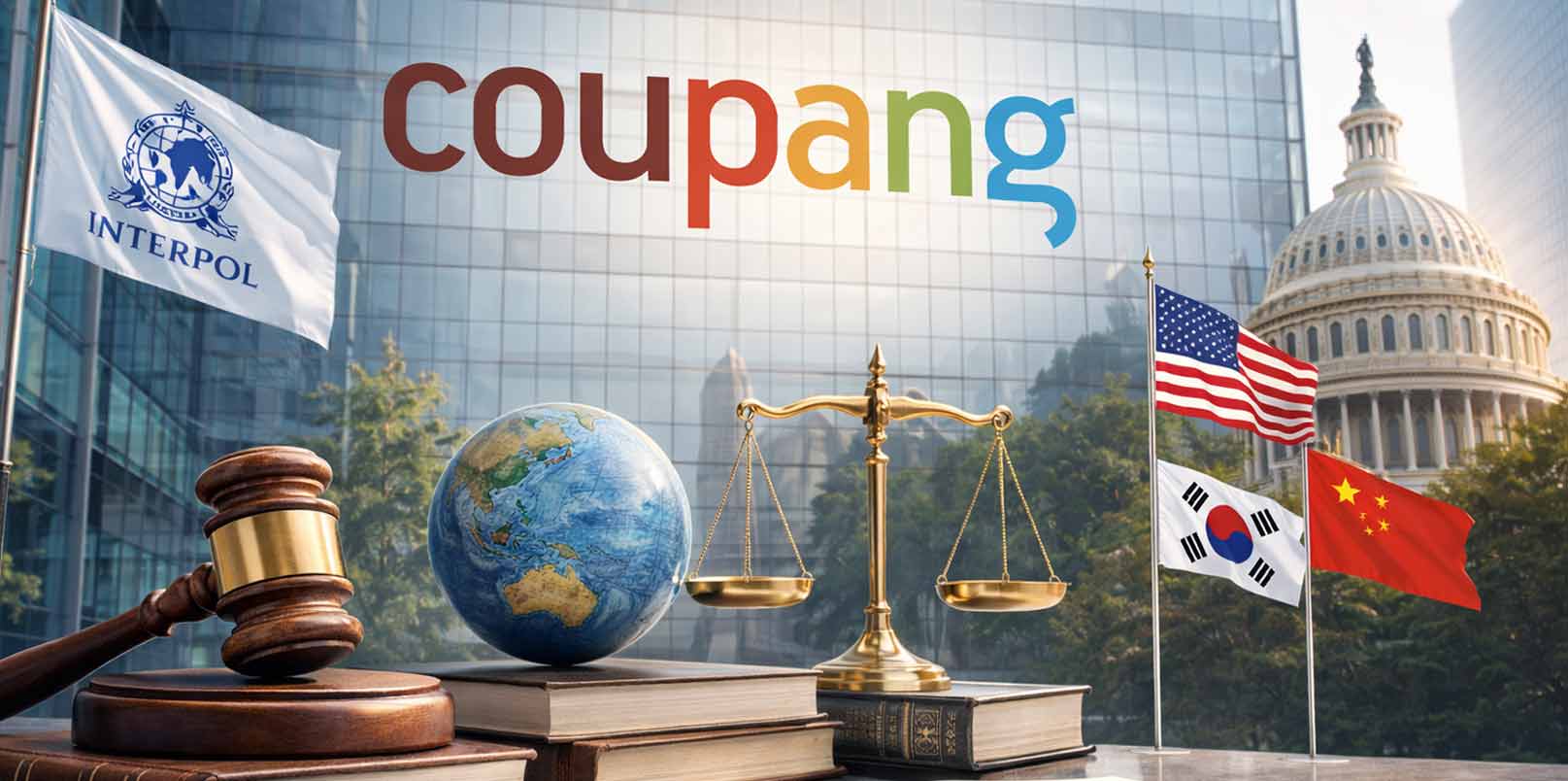
Three months after South Korea launched its investigation into the Coupang data breach, the core legal facts are largely established. What remains unresolved is enforcement. With the main suspect abroad, U.S. congressional scrutiny rising, and investor-state dispute filings expanding, the case is no longer confined to corporate liability. It now tests how far Korea can project digital law across borders in a global platform economy.
Three Months into the Coupang Data Breach Investigation 2026
According to the Seoul Metropolitan Police Agency, the Comprehensive Coupang Investigation Task Force has narrowed its remaining focus to securing the interrogation of a Chinese national suspect identified as Mr. A.
Earlier, the government’s joint public-private investigation team confirmed that 33,673,817 records of Coupang user information were leaked over a seven-month period in 2025. The data included names and email addresses. The suspect allegedly accessed approximately 148 million delivery list pages containing phone numbers, delivery addresses, and partially masked apartment entry passwords.
Police requested that Interpol issue a Red Notice for the suspect. As of February 18, authorities reported that no substantive response had been received.
Investigators also identified deficiencies in Coupang’s internal security controls during the breach. Authorities continue to examine whether the company failed to comply with a data preservation order issued by the Ministry of Science and ICT.
Coupang executives have been summoned for questioning. Harold Rogers, Interim CEO of Coupang Korea, and former CEO Park Dae-jun appeared before police in connection with allegations related to self-conducted investigations and suspected perjury under the Act on Testimony and Appraisal Before the National Assembly.
Chairman Kim Bom-seok of Coupang Inc. has not appeared publicly in the investigation. Complaints related to alleged industrial accident concealment have been filed with both the Ministry of Employment and Labor and the police. Authorities have requested entry notification measures from the Ministry of Justice due to his overseas stay.
Why Extradition and ISDS Are Reshaping the Case
The central legal challenge now lies in enforcement beyond Korean jurisdiction.
Police have repeatedly stated their intent to prosecute the suspect under domestic law. However, there is no precedent of China complying with South Korea’s extradition request for its own nationals. This makes the prospect of repatriation uncertain.
At the same time, the investigation has drawn international attention. The U.S. House Judiciary Committee has requested that Interim CEO Rogers appear at a hearing scheduled for February 23. The Committee has indicated that it intends to examine whether the Korean government’s response to Coupang has been appropriate.
Meanwhile, shareholder investment firms have submitted Notices of Intent under the Investor-State Dispute Settlement mechanism pursuant to the Korea–U.S. Free Trade Agreement. Reports indicate that three additional investors recently joined the dispute.
These developments do not alter the domestic facts of the breach. They do expand the institutional environment in which enforcement now operates.
Stakeholder Positions and Institutional Friction on Coupang Data Breach in 2026
Coupang previously claimed that it conducted an internal investigation under the direction of the National Intelligence Service. The agency denied involvement. The National Assembly subsequently filed complaints against company officials.
In the United States, current and former political figures have expressed concern regarding the investigation. Prime Minister-level explanations have emphasized that the matter is governed by Korean law and is not a trade action.
Police have indicated that they may consider additional summons for executives depending on developments, including issues related to alleged industrial accident concealment.
At present, the most consequential variable is procedural rather than technical. The facts of the data leak are largely documented. The question is whether the suspect can be brought within Korea’s legal reach.
Coupang Data Breach Investigation 2026: Jurisdiction as a Startup Risk Variable
For Korea’s startup ecosystem, this stage of the Coupang data breach investigation 2026 highlights a structural issue distinct from regulatory tightening.
Korea has recently reinforced digital platform regulation enforcement and expanded privacy oversight authority. The Coupang data breach has resulted in regulatory shifts and platform accountability. What now emerges is a separate layer of risk: cross-border enforceability.
Many Korean startups operate distributed development teams, outsource engineering across Asia, or store infrastructure in foreign jurisdictions. The Coupang case illustrates how enforcement capacity can be constrained when critical actors reside outside national borders.
Notices filed under the Korea–U.S. Free Trade Agreement’s ISDS mechanism further internationalize what began as a domestic enforcement matter. Foreign investor dispute exposure in South Korea’s tech sector can intersect with domestic enforcement processes. While arbitration notices do not determine legal outcomes, they raise the diplomatic and financial stakes of regulatory action.
Global founders entering Korea now face a compliance environment that extends beyond domestic statutes. Cross-border operational structures can directly shape legal exposure.
Meanwhile, investors are confronting the same reality. Jurisdictional alignment now carries as much weight as cybersecurity architecture, since enforcement friction can alter timelines, reputational risk, and diplomatic sensitivity.
Korea’s digital platform governance has now entered a phase where sovereign authority interacts directly with international legal frameworks.
Future Outlook: Enforcement Credibility in a Borderless Economy
The next phase of the Coupang case hinges on whether South Korea can secure meaningful procedural progress regarding the suspect abroad.
If extradition remains unresolved, the case may evolve into a long-term test of how Korea applies digital law in transnational contexts. The U.S. House Judiciary Committee hearing and ISDS filings ensure that international scrutiny will continue.
Policymakers now face a broader strategic question that reaches past one company. The issue is whether enforcement credibility can hold when platform operations and personnel stretch across multiple jurisdictions.
At the same time, startups and venture investors confront a more practical takeaway. Cross-border growth introduces legal asymmetry, and enforcement tools rarely scale at the same speed as digital platforms.
Korea’s ambition to be a trusted digital economy now rests not only on regulatory strength, but on its capacity to operationalize that regulation beyond its territory.
Key Takeaway on Coupang Investigation After Three Months
- The Seoul police have largely completed fact-finding in the Coupang data breach investigation 2026, with the main suspect located abroad.
- A Red Notice request to Interpol has not yet produced a response.
- China has no precedent of extraditing its nationals to South Korea, complicating enforcement.
- The U.S. House Judiciary Committee has requested Coupang’s Interim CEO to appear at a hearing.
- Shareholder investment firms have filed ISDS notices under the Korea–U.S. FTA, expanding international legal exposure.
- The case now highlights Korea cross-border enforcement challenges within digital platform regulation enforcement.
- For global founders and investors, jurisdictional alignment has emerged as a critical risk factor in the South Korea tech sector.
– Stay Ahead in Korea’s Startup Scene –
Get real-time insights, funding updates, and policy shifts shaping Korea’s innovation ecosystem.
➡️ Follow KoreaTechDesk on LinkedIn, X (Twitter), Threads, Bluesky, Telegram, Facebook, and WhatsApp Channel.
🤝 Looking to connect with verified Korean companies building globally?
Explore curated company profiles and request direct introductions through beSUCCESS Connect.