
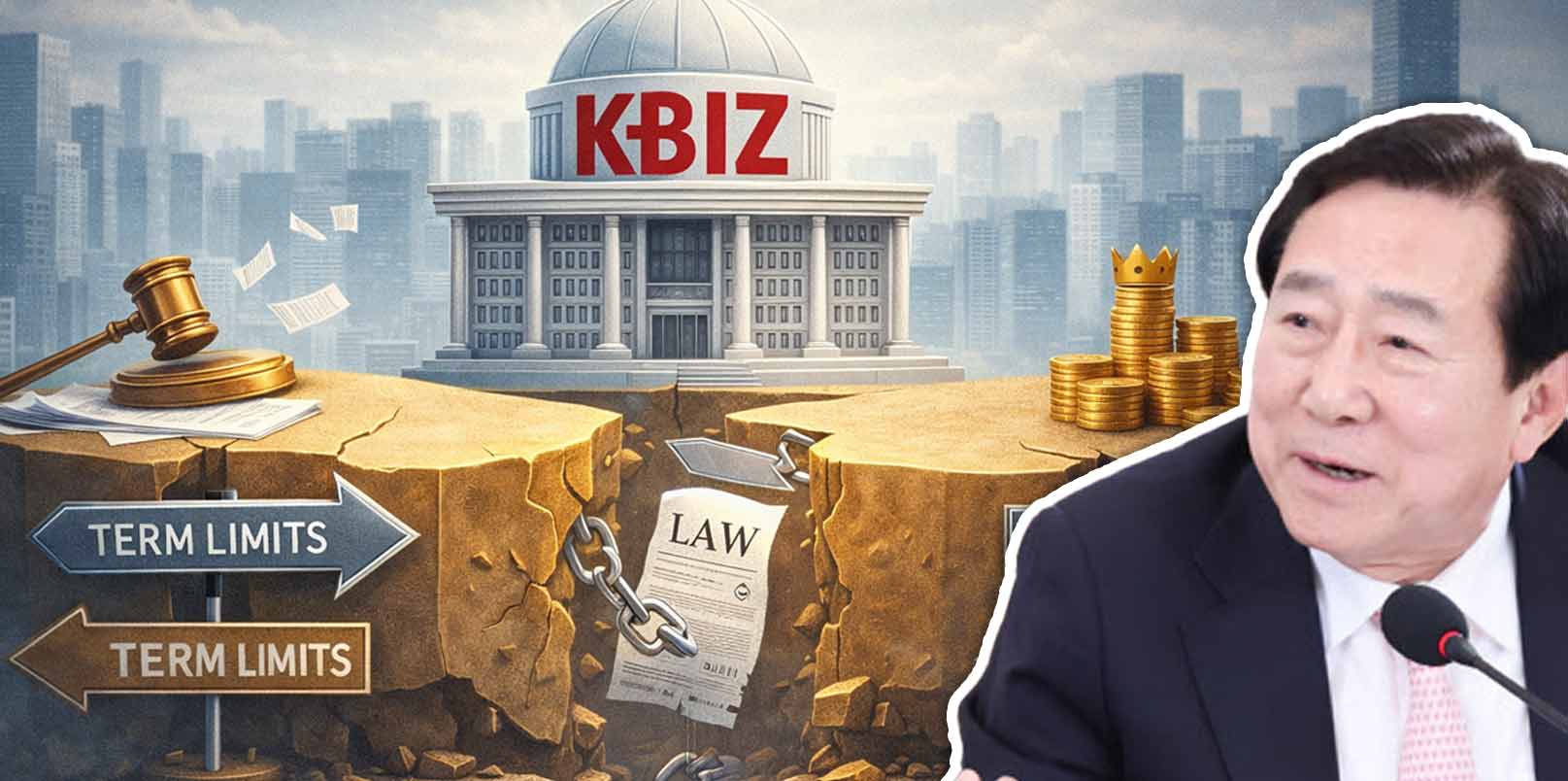
South Korea’s main SME umbrella organization is facing an internal governance debate that is beginning to attract national attention. The Korea Federation of SMEs (KBIZ) recently discussed removing term limits for cooperative chairpersons and federation executives following a legislative amendment proposal in the National Assembly.
While the proposal is framed as an operational reform, the debate is exposing deeper tensions about leadership concentration, institutional transparency, and governance stability inside Korea’s SME representation system.
KBIZ Briefing Sparks Controversy After February General Assembly
According to Korean media reports, the Korea Federation of SMEs held its regular general assembly on February 26 in Yeouido, Seoul, approving five formal agenda items before closing the meeting.
Immediately after the assembly ended, members reportedly held a separate briefing session discussing a proposed amendment to the Small and Medium Enterprise Cooperatives Act. The bill was introduced in late 2025 by Democratic Party lawmaker Jung Jin-wook.
The proposed amendment includes provisions that would remove term limits for:
- the KBIZ chairman
- cooperative chairpersons within member organizations
- federation executives
Under the current legal framework:
- The KBIZ chairman may serve one additional consecutive term.
- Cooperative chairpersons and presidents may serve two additional terms.
The amendment would revise those provisions by removing the numerical limits and allowing reappointment rules to be determined through organizational bylaws instead of national legislation.
During the post-meeting discussion, participants reportedly conducted a show-of-hands vote to gauge support for the proposal, and at least two attendees openly expressed opposition. Some members also raised concerns about the procedural legitimacy of holding such a discussion after the official meeting had already concluded.
Why KBIZ Leadership Says the Reform Is Necessary
Federation executives reportedly argued that the reform is driven by practical governance challenges inside the cooperative network.
According to explanations shared during the discussion session, some regional or sector-specific cooperatives struggle to find candidates willing to serve as chairperson, creating operational risks for the organizations.
In those situations, term limits can restrict leadership continuity and make it difficult to maintain stable governance structures.
Supporters of the amendment argue that leadership renewal can still occur through democratic elections among cooperative members. They also claim that transparency risks associated with long-term leadership could be addressed through stronger governance mechanisms such as external audits and greater disclosure of financial information.
Internal Critics Warn of Power Concentration
Despite those arguments, opposition within the organization appears significant.
Critics argue that term limits function as a minimum institutional safeguard against long-term power concentration inside cooperative structures. The restriction was originally introduced through a 2018 legal amendment aimed at improving transparency and preventing the privatization of authority within cooperatives.
Opponents also warn that weakening leadership rotation could intensify internal conflicts and reduce the visibility of minority voices within cooperative governance.
Some participants additionally questioned the process of discussing the issue outside the formal agenda of the general assembly. One member reportedly asked why a show-of-hands vote was conducted if the discussion was not an official agenda item.
Chairman Kim Ki-mun’s Position Adds Political Sensitivity
The debate carries additional political weight because the amendment would also remove the reappointment limit for KBIZ Chairman Kim Ki-mun.
Kim previously served as the federation’s 23rd and 24th chairman between 2007 and 2015. He returned to the role in 2019 and currently serves as the 26th and 27th chairman.
If he completes his current term, which ends in February 2027, his cumulative tenure will reach 16 years, making him the longest-serving chairman in KBIZ history under the current framework that allows non-consecutive terms.
According to reports from the briefing session, Kim indicated that he does not intend to pursue another term, although some observers believe his position could shift depending on political developments surrounding the amendment.
Why This Governance Debate Matters for Korea’s Startup Ecosystem
At first glance, the KBIZ governance debate may appear confined to the traditional SME sector. In reality, the organization plays a central role in shaping Korea’s policy dialogue on entrepreneurship, industrial development, and SME support programs.
KBIZ represents thousands of small and medium-sized enterprises across sector-based cooperatives. Its policy positions often influence discussions with the Ministry of SMEs and Startups (MSS) and the National Assembly on regulatory frameworks affecting SMEs and startup companies.
Governance credibility inside such institutions carries broader implications for the startup ecosystem.
Global investors and international founders increasingly look at governance transparency within industry associations when evaluating the reliability of public-private partnership systems. Institutional stability inside SME representation bodies can affect how effectively policy initiatives translate into operational support for emerging companies.
The current debate therefore highlights a broader tension visible across many innovation ecosystems. Institutions must balance leadership continuity and operational stability with safeguards that maintain accountability and prevent concentration of authority.
Legislative Outcome Remains Uncertain
The amendment bill that triggered the debate is currently awaiting review by the relevant standing committee of the National Assembly.
KBIZ officials have emphasized that even if the law changes, the federation could still impose term limits through internal bylaws, which would require approval from the Minister of SMEs and Startups, the supervising authority for the organization.
The legislative process and internal governance discussions will determine whether the proposal evolves into a structural reform or remains a contested policy idea.
Strategic Outlook for Korea’s SME Governance
The KBIZ controversy reflects a deeper structural question about governance inside institutions that represent large segments of the SME economy.
Leadership continuity can provide institutional stability and policy consistency. Yet systems without clear rotation mechanisms risk weakening accountability and reducing institutional legitimacy.
For Korea’s innovation ecosystem, the outcome of this debate will serve as a signal about how governance reforms inside legacy SME organizations adapt to the expectations of a more globally connected entrepreneurial environment.
Key Takeaways on KBIZ Term Limit Debate
- The Korea Federation of SMEs (KBIZ) discussed removing term limits for cooperative chairpersons and federation executives following a legislative amendment proposal.
- The bill was introduced in late 2025 by Democratic Party lawmaker Jung Jin-wook and is currently awaiting review in the National Assembly.
- Supporters argue term limits can disrupt cooperative management when leadership candidates are scarce.
- Critics say removing the limits could weaken safeguards against power concentration and reduce leadership rotation.
- The issue carries additional attention because it would also remove the reappointment limit affecting KBIZ Chairman Kim Ki-mun.
- The debate reflects broader governance tensions inside Korea’s SME representation system and may influence policy credibility within the country’s startup ecosystem.
– Stay Ahead in Korea’s Startup Scene –
Get real-time insights, funding updates, and policy shifts shaping Korea’s innovation ecosystem.
➡️ Follow KoreaTechDesk on LinkedIn, X (Twitter), Threads, Bluesky, Telegram, Facebook, and WhatsApp Channel.
🤝 Looking to connect with verified Korean companies building globally?
Explore curated company profiles and request direct introductions through beSUCCESS Connect.