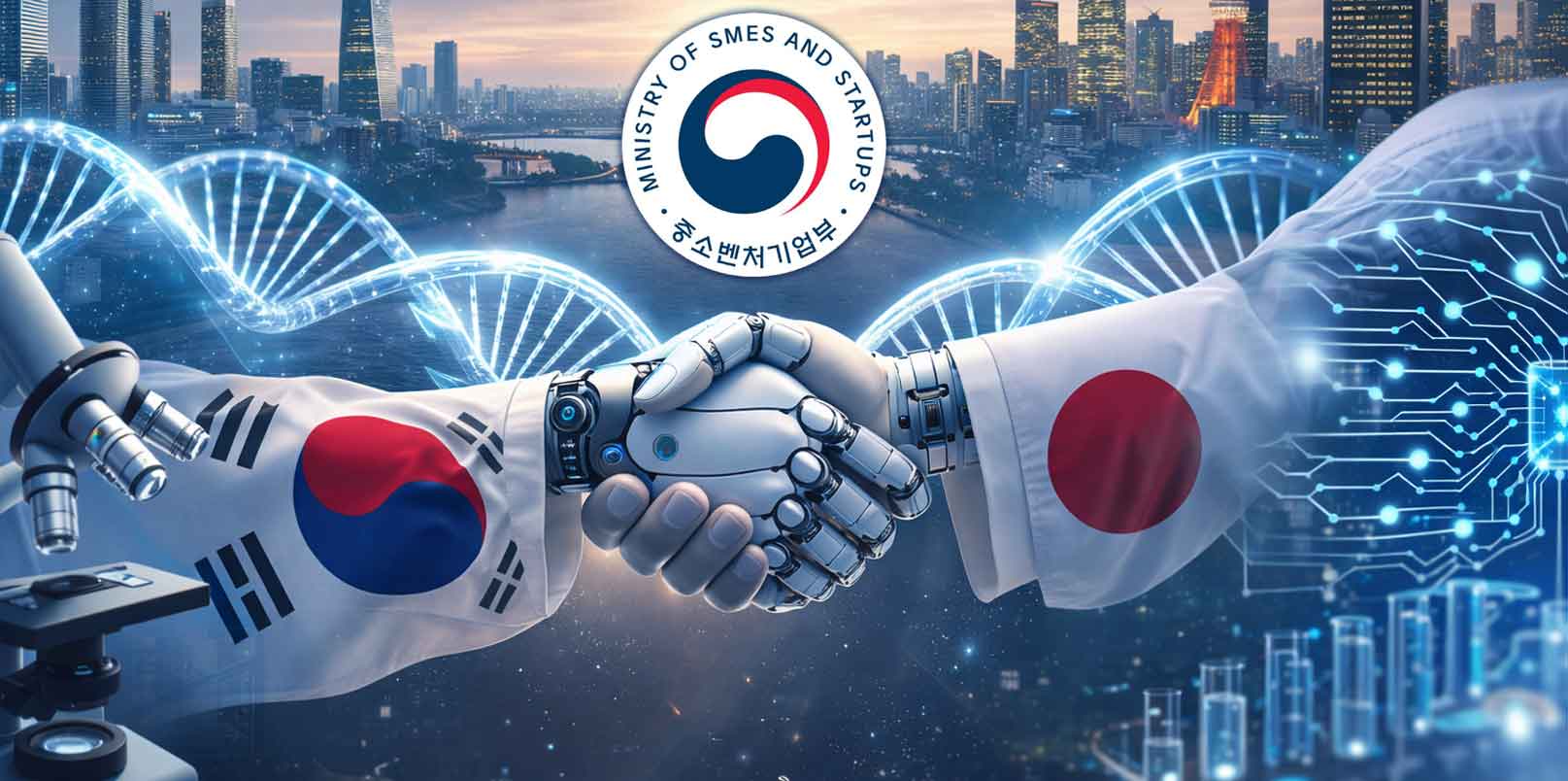
Korea is moving beyond one-off programs, formalizing startup expansion into Japan through institutional linkages. The latest high-level visit by the Ministry of SMEs and Startups signals a shift toward hub-to-hub cooperation in biotech and AI. For global founders and investors watching Northeast Asia, this development reflects how Korea is structuring cross-border commercialization pathways.
Korea Aligns Songdo and Tokyo Through Hub-Level Cooperation
On February 25, First Vice Minister Noh Yong-seok of Korea’s Ministry of SMEs and Startups (MSS) visited Shonan Health Innovation Park (Shonan I-Park) in Fujisawa and CIC Tokyo to discuss structured cooperation between startup hubs in both countries.
The visit follows the Korea–Japan shuttle diplomacy framework and was positioned as a high-level follow-up focused on strengthening innovation collaboration in biotech, AI, and deep tech.
At Shonan I-Park, Vice Minister Noh met CEO Toshio Fujimoto to discuss plans related to the K-Bio Lab Hub under development in Songdo, Incheon, at Yonsei University’s International Campus. Shonan I-Park, established by Japanese pharmaceutical company Takeda, operates as a global open innovation platform and currently hosts 10 Korean bio ventures under overseas demonstration support programs.
Both sides discussed pursuing program-centered cooperation before the K-Bio Lab Hub’s completion in 2028. After completion, cooperation may expand to shared research equipment and resident space. They also discussed holding the Korean preliminary round of the Innovation Tiger biotech program in Songdo.
In Tokyo, Vice Minister Noh met CIC CEO Tim Rowe to review collaboration between CIC Tokyo and the K-StartHub under development in Seoul’s Hongdae district. The K-Startup Center, opened at CIC Tokyo in May 2024, currently houses 24 Korean startups.
Discussions included phased networking and investment linkage programs in AI, beauty and fashion, and content and culture sectors.
Why the Hub Linkage Matters Beyond Diplomatic Symbolism
The cooperation centers on physical and programmatic infrastructure, and that distinction matters.
Shonan I-Park functions as a pharmaceutical open innovation cluster where startups engage directly with major Japanese drugmakers. The Innovation Tiger biotech program connects Asian startups with global pharmaceutical companies and venture capital participants. In 2025, 79 companies from Korea, Japan, and Taiwan participated, and 16 advanced to the final round. A Korean company, MediMap Bio, placed first.
CIC Tokyo operates as part of a global startup hub network with centers across the United States, Japan, and Europe. The Tokyo site hosts more than 300 companies and supports corporate-startup collaboration through shared workspace and networking platforms.
Korea’s approach, based on the official discussions, is to anchor its domestic hubs to these established ecosystems rather than replicate them independently.
Korea–Japan Startup Cooperation Around Economic Security and Commercialization
Vice Minister Noh stated
“Cooperation between Korean and Japanese startups forms an important foundation for advancing collaboration encompassing economic security and science and technology.
We will expand cooperation between innovation hubs in sectors such as bio, AI, and deep tech to support the global expansion of Korean startups and promote the co-growth of both startup ecosystems.”
He added that the ministry would strengthen support mechanisms so that joint research and development can lead to commercialization outcomes.
In meetings with resident Korean bio ventures at Shonan I-Park, companies requested policy support that helps local demonstration results translate into joint R&D and subsequent commercialization with Japanese pharmaceutical firms.
How the Hub-to-Hub Model Could Reshape Korea’s Cross-Border Startup Expansion
The move signals a structural evolution in Korea Japan startup cooperation.
First, it formalizes a hub-to-hub model. Rather than supporting isolated market entry efforts, the ministry is linking K-Bio Lab Hub Songdo and K-StartHub Seoul with Shonan I-Park biotech collaboration and the CIC Tokyo K-Startup Center.
Not only that, but it also reflects recognition that commercialization in biotech and AI often depends on proximity to corporate partners and investor networks. Access to pharmaceutical companies at I-Park or corporate collaborators through CIC may reduce entry friction for Korean startups pursuing cross-border startup expansion in Japan.
What’s more, the strategy aligns with Korea’s broader positioning in bio and AI deep tech sectors, where regulatory environments, pilot validation, and industrial partnerships play a critical role in scaling.
For global investors, the structured presence of Korean startups within established Japanese hubs offers clearer visibility into deal flow emerging from the Korean ecosystem. For international founders evaluating Korean AI startup market entry Japan pathways, the integration suggests that Songdo and Hongdae hubs are being designed as outward-facing platforms.
The cooperation centers on institutional linkages rather than new financial instruments. Discussions focused on program integration, shared infrastructure, and commercialization pathways. The practical impact will depend on how effectively resident startups convert these frameworks into joint R&D and market outcomes.
A Test of Execution, Not Announcement
The real measure of this pipeline will be the real outcome, and the key indicators will include how many resident companies convert demonstration projects into joint R&D contracts, how many Innovation Tiger participants secure follow-on partnerships, and whether K-Bio Lab Hub Songdo becomes a recurring node in Asia-Pacific biotech collaboration.
If the hub-to-hub linkage produces repeatable commercialization pathways, it may strengthen Korea’s position within the Asia-Pacific startup ecosystem and deepen cross-border venture capital engagement between Korea and Japan.
Yet if outcomes remain limited to networking and pilot programs, the structural ambition will remain only symbolic.
For now, Korea is anchoring its domestic startup infrastructure to established Japanese innovation hubs. The next phase depends on measurable execution.
Summary: What Global Founders and Investors Should Track Next
- Korea is linking K-Bio Lab Hub Songdo and K-StartHub Seoul with Shonan I-Park and CIC Tokyo.
- Cooperation focuses on biotech and AI sectors under Korea Japan startup cooperation frameworks.
- 10 Korean bio ventures operate at Shonan I-Park; 24 Korean startups reside at CIC Tokyo.
- Program-first collaboration may expand to shared infrastructure after 2028.
- The strategic test is whether joint R&D and pilot projects translate into commercialization and sustained cross-border startup expansion in Japan.
– Stay Ahead in Korea’s Startup Scene –
Get real-time insights, funding updates, and policy shifts shaping Korea’s innovation ecosystem.
➡️ Follow KoreaTechDesk on LinkedIn, X (Twitter), Threads, Bluesky, Telegram, Facebook, and WhatsApp Channel.
🤝 Looking to connect with verified Korean companies building globally?
Explore curated company profiles and request direct introductions through beSUCCESS Connect.