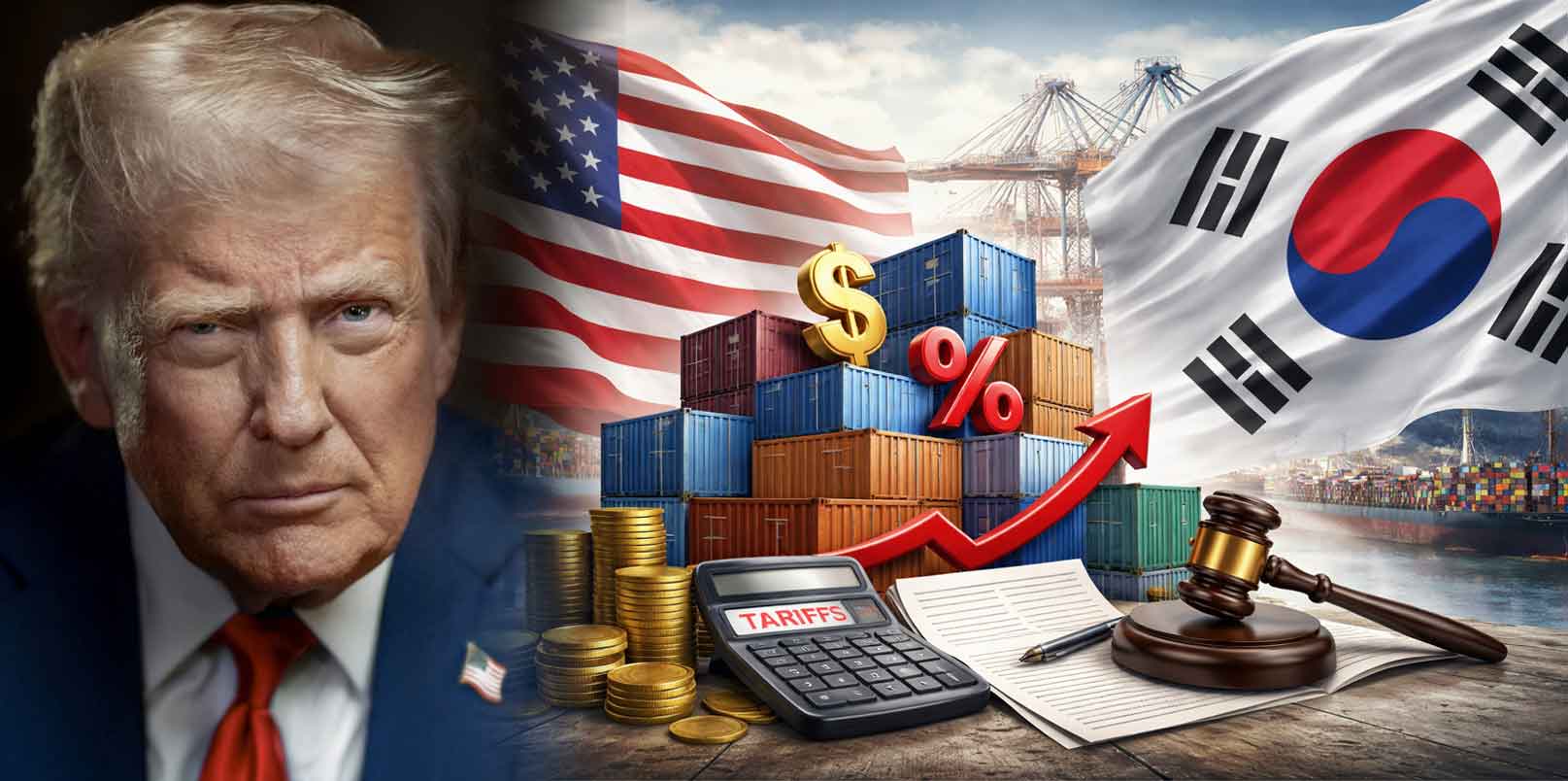
The U.S. Supreme Court has struck down one of President Donald Trump’s most aggressive trade tools. Yet within hours, a new tariff path emerged. For Korean startups building export-driven growth strategies, the legal reset in Washington does not remove risk. It reshapes it. The question now is not whether tariffs exist, but how stable the rules behind them really are.
Supreme Court Strikes Down IEEPA Tariffs
On February 20, 2026, the U.S. Supreme Court ruled 6–3 that tariffs imposed under the International Emergency Economic Powers Act were unlawful. Chief Justice John Roberts wrote that IEEPA does not authorize the president to impose tariffs, noting that Congress holds constitutional authority over taxation.
The ruling invalidated country-specific “reciprocal” tariffs and other levies tied to national emergency declarations, including measures applied to major trading partners.
In response, President Trump announced he would sign an executive order under Section 122 of the Trade Act of 1974 to impose a 10 percent global tariff. He said the measure would likely take effect within three days.
Section 122 allows temporary tariffs of up to 15 percent for a maximum of 150 days to address balance-of-payments concerns. It is more limited than IEEPA in duration and scope.
Trump also referenced potential use of Section 232 of the Trade Expansion Act and Section 301 of the Trade Act as alternative authorities.
Why the Legal Basis of U.S. Tariffs Now Matters
The Court’s decision did not reject tariffs in general. It rejected the use of IEEPA as the legal foundation.
Roberts wrote that the president must identify clear congressional authorization to impose tariffs of broad scope and duration. The ruling leaves intact other statutory pathways, though those routes carry procedural constraints and time limits.
Reports also confirm that tariffs imposed under IEEPA represented roughly half of current monthly tariff collections. U.S. Customs data cited in court filings show more than USD 130 billion had been collected under the challenged measures.
The decision did not clarify how refunds might be handled. Justice Brett Kavanaugh, in dissent, acknowledged that returning collected funds could become complicated. President Trump indicated the matter may be litigated for years.
This introduces a new variable into global trade: legal durability.
Trump Moves to Section 122 and Section 301
President Trump described the ruling as “very disappointing” and said stronger authorities remain available. He stated that countries celebrating the decision “will not be dancing for long.”
U.S. Trade Representative Jamieson Greer said Section 301 investigations rest on solid legal footing. Treasury Secretary Scott Bessent indicated alternative tariff authorities could preserve overall tariff revenue levels.
The administration emphasized that only the IEEPA pathway was invalidated, not presidential tariff authority more broadly.
What the U.S. Tariff Shift Means for Korean Export Startups
South Korea remains deeply exposed to U.S. market access across hardware, advanced manufacturing, mobility systems, semiconductors, and defense-related supply chains.
The immediate tariff rate may shift. Yet the deeper issue is policy volatility.
Korean startups building U.S.-facing revenue models now face three structural pressures:
- First, temporary tariffs under Section 122 are limited to 150 days unless extended. That introduces timing risk in pricing, contract negotiation, and supply commitments.
- Second, potential Section 301 investigations create sector-specific exposure. The statute targets what the U.S. defines as unfair or discriminatory trade practices. This can affect selected industries without broad announcement cycles.
- Third, refund uncertainty complicates importer relationships. U.S. buyers may delay procurement decisions until legal clarity improves.
For software-first startups with minimal physical export exposure, the impact is muted. Yet, for robotics, AI hardware, EV components, industrial automation, and materials startups, the risk profile changes.
This is not theoretical. Tariffs under IEEPA previously reached up to 50 percent for some trading partners. Section 122 caps authority at 15 percent and 150 days, but the legal pivot signals ongoing experimentation within U.S. trade policy.
Cross-border venture capital also adjusts under uncertainty. Investors factor in trade friction when underwriting export-heavy startups. That influences valuation, capital allocation, and U.S. expansion strategy.
Global Venture Capital Faces Renewed Trade Uncertainty
The Supreme Court ruling reinforces constitutional limits on executive tariff authority. It also confirms that trade policy can swing quickly within statutory boundaries.
Global founders now face a new layer of market access risk shaped by judicial interpretation. In Seoul, policymakers are reminded that export diversification is no longer optional. Venture funds must reassess portfolio exposure to regulatory swings tied to U.S. trade law.
The legal basis of tariffs has moved beyond technical debate. It now shapes strategic planning.
What Comes Next for U.S. Tariff Policy
President Trump has signaled that a 10 percent global tariff under Section 122 will move ahead, with additional investigations under Sections 232 and 301 likely to follow. The Supreme Court did not address tariff refunds, leaving room for prolonged litigation.
The larger signal is structural. The legal tool has changed, but the trade posture remains. For Korean startups reliant on U.S.-bound hardware exports, tariff risk should now be treated as a recurring operating condition, not a one-off disruption. What matters next is structural flexibility, not short-term reaction.
Key Takeaway on U.S. IEEPA Tariff Impact on Korean Export Startups
- The U.S. Supreme Court ruled that IEEPA does not authorize presidential tariffs.
- More than $130 billion in IEEPA tariff revenue may face legal disputes.
- Trump announced a 10 percent global tariff under Section 122 of the Trade Act of 1974.
- Section 122 limits tariffs to 15 percent and 150 days without congressional extension.
- Alternative authorities such as Sections 232 and 301 remain available.
- Korean export-driven startups face renewed contract, pricing, and procurement risk in the U.S. market.
- Trade policy volatility now includes judicial risk alongside executive decision-making.
🤝 Looking to connect with verified Korean companies building globally?
Explore curated company profiles and request direct introductions through beSUCCESS Connect.
– Stay Ahead in Korea’s Startup Scene –
Get real-time insights, funding updates, and policy shifts shaping Korea’s innovation ecosystem.
➡️ Follow KoreaTechDesk on LinkedIn, X (Twitter), Threads, Bluesky, Telegram, Facebook, and WhatsApp Channel.