South Korea is testing whether artificial intelligence can improve how government support reaches small businesses. By opening public datasets to AI startups, the Ministry of SMEs and Startups is moving beyond digital administration toward algorithm-assisted policy delivery. The question is no longer simply how much support is available, but how precisely and efficiently it can be matched to those who need it.
Six AI Startups Selected in OpenData X AI Challenge
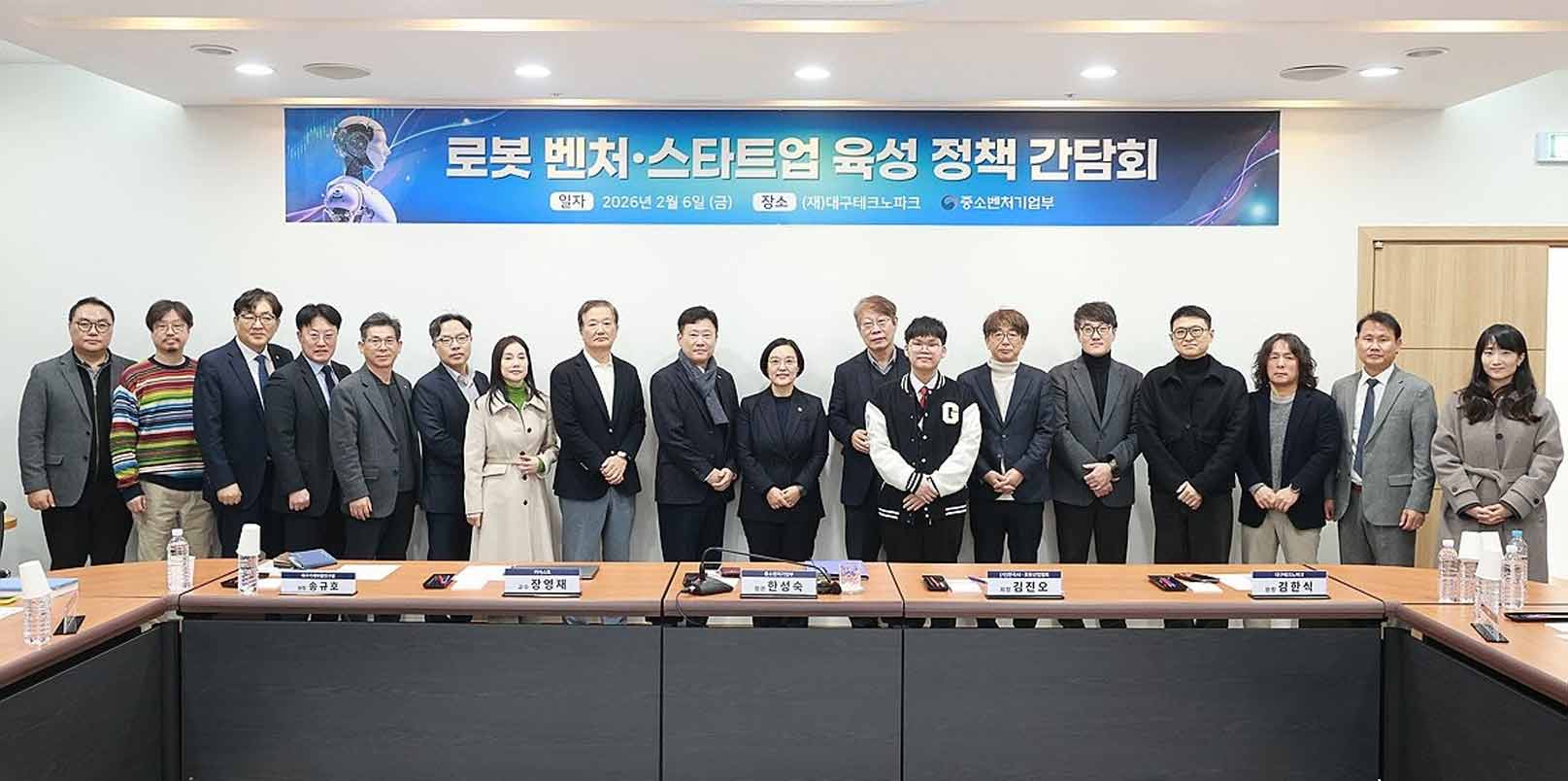
On February 12, the Ministry of SMEs and Startups (MSS) held a communication roundtable at the Global Startup Center in Gangnam, Seoul, with six startups selected through the “OpenData X AI Challenge.”
The challenge was designed as a proof-of-concept initiative that combined public-sector datasets with private AI technology to develop practical solutions for small and medium-sized enterprises (SMEs) and small business owners.
A total of 124 AI startups applied after recruitment began in November last year. Following document screening, expert evaluation, and user testing, two companies were selected in each of three categories:
- Customized government support program recommendation: PersonaAI and Lumos
- Customized consulting for small business owners: Heum and MyMeta
- SME growth and risk prediction: Ambigen and Clotho
Selected teams received full datasets from institutions including the Korea Technology and Information Promotion Agency for SMEs and the Small Enterprise and Market Service. Each team was provided KRW 10 million in support to develop its AI model.
The ministry stated that selected companies will receive follow-up assistance in startup commercialization, R&D, professional workforce support, and access to policy financing such as loans and guarantees.
From Digital Administration to AI-Assisted Policy
The OpenData X AI Challenge reflects a broader attempt to use public data not only for transparency but for operational improvement. Public institutions opened field-level datasets to AI startups with the explicit goal of solving real-world challenges faced by SMEs and small business owners.
In the support recommendation category, startups developed platforms that allow business owners to upload company profiles or business histories and receive tailored recommendations for relevant government programs.
In the consulting category, solutions addressed issues such as commercial area analysis, tax-related support, and financial monitoring.
In the growth and risk prediction category, AI models focused on forecasting SME performance and identifying potential risks.
The initiative also revealed structural constraints as some government datasets could not be fully disclosed. Participants noted gaps in data reflecting actual small business management conditions, and several teams indicated that development timelines were tight.
These limitations form part of the policy experiment itself.
Data Limits, Infrastructure Gaps, and Policy Expectations
Minister Han Seong-sook acknowledged both progress and constraints.
“There were limitations because some data provided by public institutions could not be disclosed,” she said. She also noted that “the needs of SMEs and small business owners could have been defined more specifically and clearly.”
She added that the ministry will “continue policy support so that AI technology can lead to tangible results in the field.”
Seo Beom-seok, a team leader at SK Broadband who participated as an evaluator, commented on the data structure:
“While government data was provided, there was insufficient data reflecting the management conditions of small business owners. For a more complete service, a government-level framework for collecting such data is necessary.”
Startup representatives emphasized usability and inclusion. Kim Kyung-jin, CEO of Lumos, said his company incorporated regional SME office programs to ensure that provincial firms would not be excluded. PersonaAI’s leadership stressed the importance of building tools that could be used “easily and quickly” without additional training.
Infrastructure constraints were also raised, including latency issues related to the use of government servers.
OpenData X AI Challenge: Testing AI as Policy Infrastructure
For Korea’s startup ecosystem, the initiative serves two functions.
First, it positions AI startups not only as private-sector innovators but as policy infrastructure partners. Selected companies are being integrated into government data environments, gaining access to institutional datasets and follow-up commercialization support. That creates reference cases tied directly to public-sector implementation.
Second, it signals a shift in how SME policy may be delivered. Minister Han referenced the current structure in which support programs often operate on a first-come, first-served basis, comparing it to competing for concert tickets. The implication is that AI could introduce more structured allocation or matching mechanisms.
The scale of SME participation in Korea’s economy makes this experiment consequential. According to the ministry, 124 AI startups competed in the challenge, underscoring the depth of domestic AI capacity engaging with public-sector use cases.
Globally, governments are exploring AI governance frameworks and regulatory guardrails. Korea’s approach here is pragmatic: begin with controlled, proof-of-concept deployments in SME policy domains, then evaluate operational feasibility. The reference to the AI Basic Act during the roundtable suggests that governance compliance will increasingly intersect with service deployment.
For founders and investors, this initiative illustrates an emerging market in GovTech and policy-linked AI services. As for policymakers abroad, it offers a model in which open data is not merely published but operationalized through startup collaboration.
The experiment remains early-stage. Its success will depend on data completeness, infrastructure scalability, and whether these solutions move beyond pilot deployment.
From Pilot to Policy Engine?
The OpenData X AI Challenge does not yet represent a structural overhaul of SME policy. For now, it is a controlled test.
However, the ministry has indicated that it will reflect field-level feedback and refine related policies so that AI startups can accumulate real-world references and scale.
If sustained, this approach could gradually shift SME support from reactive administration toward predictive, data-driven allocation. That would require deeper data integration and clearer definition of policy demand signals.
For now, Korea has taken a measurable step: it has placed AI startups inside the machinery of SME policy and invited them to improve it.
Key Takeaway on OpenData x AI Challenge
- Six AI startups selected through Korea’s OpenData X AI Challenge after competition among 124 applicants.
- Public datasets from SME-related agencies were opened to develop AI tools for support program matching, consulting, and growth risk prediction.
- Selected firms receive commercialization, R&D, and policy financing support from the Ministry of SMEs and Startups.
- Officials acknowledged data disclosure limits and gaps in business-condition data, highlighting structural challenges.
- The initiative signals Korea’s attempt to turn public data into operational AI tools for SME policy delivery, positioning AI startups as GovTech partners.
– Stay Ahead in Korea’s Startup Scene –
Get real-time insights, funding updates, and policy shifts shaping Korea’s innovation ecosystem.
➡️ Follow KoreaTechDesk on LinkedIn, X (Twitter), Threads, Bluesky, Telegram, Facebook, and WhatsApp Channel.