KoreaTechDesk | Korean Startup and Technology News

Mon, February 23, 2026

Sign in

Virtual Demo Day
Menu
  • Home
  • Startup News
    • AI & Big Data
    • AR & VR
    • Blockchain
    • Clean Technology
    • Content & Games
    • Cybersecurity
    • Enterprise & SaaS
    • FinTech
    • Gadgets & Electronics
    • Health & Bio
    • Manufacturing
    • Press Release
    • IoT
    • Marketplaces & E-commerce
    • Robotics
    • Transportation
    • Investments
    • Ecosystem & Lists
  • Governments
    • Artificial Intelligence Industry Cluster Agency
    • Daegu Technopark
    • GANGNAM-GU
    • Gyeonggido Business & Science Accelerator
    • Hwaseong Industry Promotion Agency
    • Invest Seoul
    • Korea Creative Content Agency
    • Korea Internet & Security Agency
    • Korea Information Security Industry Association
    • Korea Institute of Startup & Entrepreneurship Development
    • Korea Tourism Organization
    • Korea Trade-Investment Promotion Agency
    • Ministry of Culture, Sports and Tourism
    • Ministry of SMEs & Startups
    • National IT Industry Promotion Agency
    • Pangyo Techno Valley
    • Seoul Business Agency
    • Seoul FinTech Lab
    • South Gyeongsang Province
    • Seoul Metropolitan Government
  • Events
    • COMEUP
    • Korea Fintech Week
    • K-Content Expo
    • NextRise
    • Try Everything
  • Interviews
    • Investors’ interviews
    • Founders’ interviews
  • Programs
    • Asan Voyager
    • CAPA Global Program
    • Campus Town Program
    • SGSC Global Bootcamp
    • Gangnam-gu Global Roadshow
    • Global SaaS Marketplace Support Project
    • LAUNCHPAD
    • COMEUP STARS 120
    • K-Startup Grand Challenge
    • TIPS X beSUCCESS Global Project
    • SFL Global Program
    • KTO Global Showcase
    • Yonsei Univ Global Class
    • KOSME Global Program
  • Partner With Us
    • Press Release
    • Startup Scouting
    • Business Agencies
    • Global Mentorship Program
    • Investment Opportunities
    • K-Scouter Program
  • Lists
  • Home
  • Startup News
    • AI & Big Data
    • AR & VR
    • Blockchain
    • Clean Technology
    • Content & Games
    • Cybersecurity
    • Enterprise & SaaS
    • FinTech
    • Gadgets & Electronics
    • Health & Bio
    • Manufacturing
    • Press Release
    • IoT
    • Marketplaces & E-commerce
    • Robotics
    • Transportation
    • Investments
    • Ecosystem & Lists
  • Governments
    • Artificial Intelligence Industry Cluster Agency
    • Daegu Technopark
    • GANGNAM-GU
    • Gyeonggido Business & Science Accelerator
    • Hwaseong Industry Promotion Agency
    • Invest Seoul
    • Korea Creative Content Agency
    • Korea Internet & Security Agency
    • Korea Information Security Industry Association
    • Korea Institute of Startup & Entrepreneurship Development
    • Korea Tourism Organization
    • Korea Trade-Investment Promotion Agency
    • Ministry of Culture, Sports and Tourism
    • Ministry of SMEs & Startups
    • National IT Industry Promotion Agency
    • Pangyo Techno Valley
    • Seoul Business Agency
    • Seoul FinTech Lab
    • South Gyeongsang Province
    • Seoul Metropolitan Government
  • Events
    • COMEUP
    • Korea Fintech Week
    • K-Content Expo
    • NextRise
    • Try Everything
  • Interviews
    • Investors’ interviews
    • Founders’ interviews
  • Programs
    • Asan Voyager
    • CAPA Global Program
    • Campus Town Program
    • SGSC Global Bootcamp
    • Gangnam-gu Global Roadshow
    • Global SaaS Marketplace Support Project
    • LAUNCHPAD
    • COMEUP STARS 120
    • K-Startup Grand Challenge
    • TIPS X beSUCCESS Global Project
    • SFL Global Program
    • KTO Global Showcase
    • Yonsei Univ Global Class
    • KOSME Global Program
  • Partner With Us
    • Press Release
    • Startup Scouting
    • Business Agencies
    • Global Mentorship Program
    • Investment Opportunities
    • K-Scouter Program
  • Lists
Home Trends

Stable Factory Jobs Shrinking, Wage Gaps Widen: Startups May Feel the Pressure Next

by Daehyun Song
February 23, 2026
in Trends
0

Korea’s manufacturing sector remains a backbone of its SME-driven economy. Yet new employment data signals structural strain. Stable factory jobs are shrinking, youth participation is falling, and wage gaps between large firms and smaller employers are widening. For startups and global investors evaluating Korea’s ecosystem in 2026, this is not simply a labor statistic but a competitiveness signal.

Korea Manufacturing Employment Decline 2026: What Data Shows

According to data released on February 22 by the National Data Center through the Korea Statistical Information Service (KOSIS), manufacturing employment declined again in 2025.

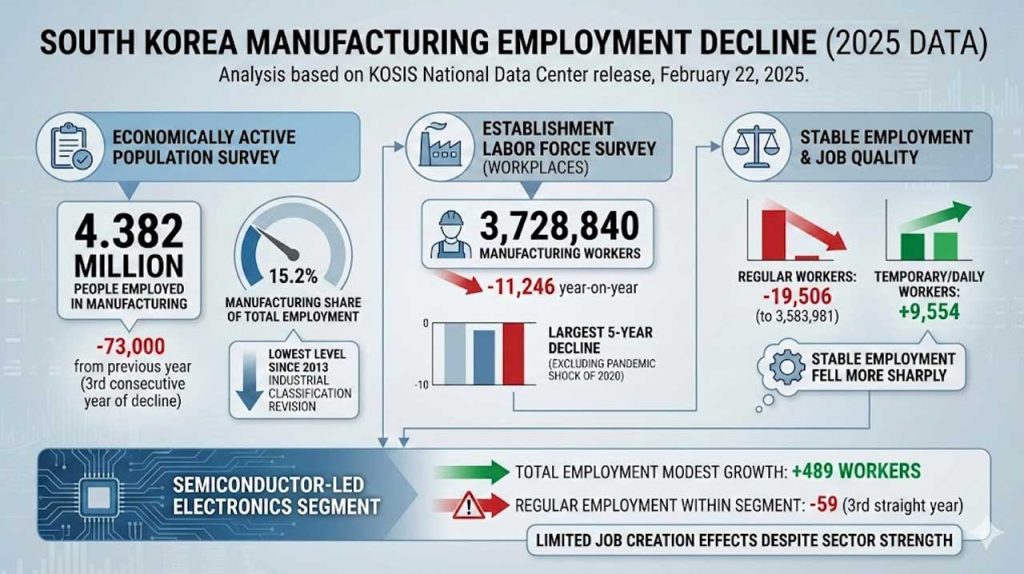
The Economically Active Population Survey shows 4.382 million people employed in manufacturing, down 73,000 from the previous year. This marks a third consecutive year of decline.

Manufacturing’s share of total employment fell to 15.2 percent, the lowest level since the 2013 industrial classification revision.

The Establishment Labor Force Survey, which tracks employment at workplaces, recorded 3,728,840 manufacturing workers, down 11,246 year-on-year. Excluding the pandemic shock in 2020, this was the largest five-year decline.

Stable employment fell more sharply. The number of regular workers in manufacturing dropped by 19,506 to 3,583,981. At the same time, temporary and daily workers increased by 9,554.

The semiconductor-led electronics segment returned to modest growth in total employment, adding 489 workers. However, regular employment within that segment declined by 59 for a third straight year, indicating limited job creation effects despite sector strength.
Wage Gaps Between Large and Small Firms Continue to Widen

The data also highlights a widening compensation divide.

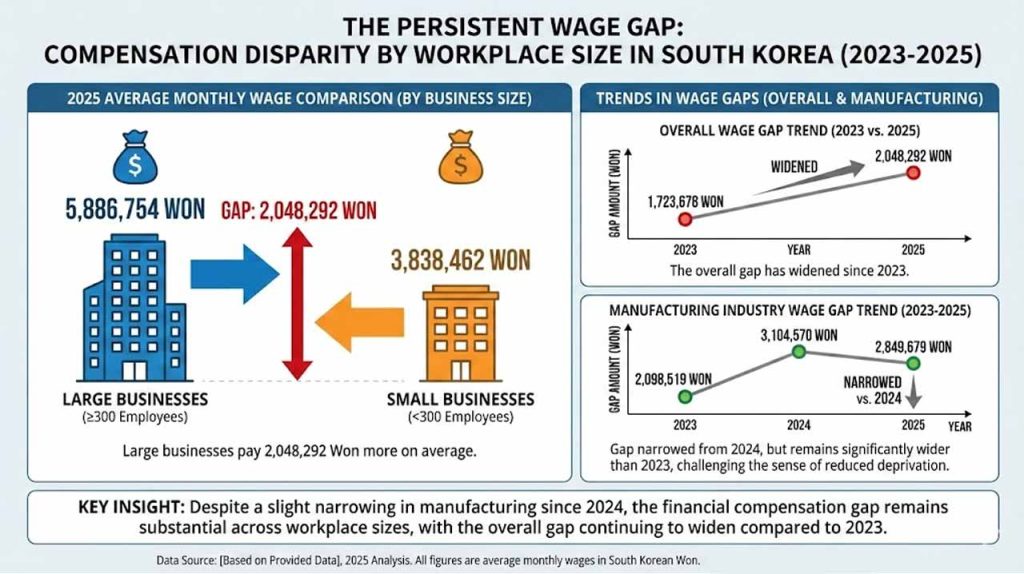
Regular workers at establishments with 300 or more employees earned an average monthly wage of KRW 5,886,754. Workers at establishments with fewer than 300 employees earned KRW 3,838,462.

The gap exceeded 2 million won in 2025, widening from 2023 levels.

In manufacturing specifically, the wage gap narrowed slightly from the previous year but remained significantly wider than in 2023. The broader divergence between large and small firms remains intact.

This wage concentration has structural implications for SMEs, which make up the overwhelming majority of Korean enterprises and include most startups.
Youth Exit Manufacturing as Workforce Ages

Youth employment in manufacturing saw the sharpest contraction among age groups.

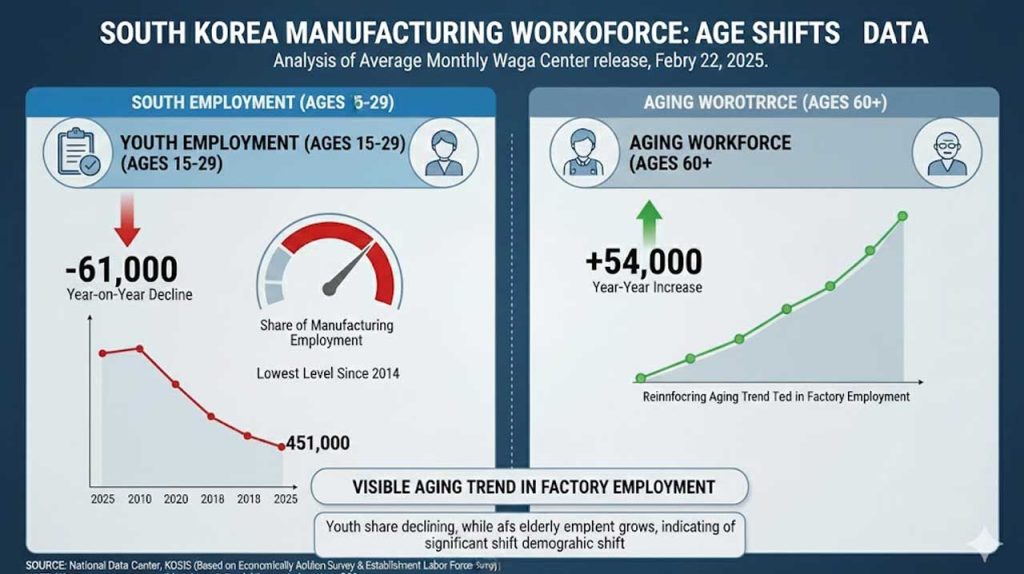
The number of manufacturing workers aged 15 to 29 fell by 61,000 year-on-year to 451,000. The youth share of manufacturing employment declined to 10.3 percent, its lowest level since 2014.

By contrast, workers aged 60 and above increased by 54,000, reinforcing a visible aging trend in factory employment.
These figures do not confirm a single cause. However, officials cited structural hiring shifts, tariff uncertainty affecting exports, and evolving labor demand patterns as contributing factors.

Automobile exports to the United States declined 13.2 percent last year amid tariff policy effects, while total exports to the US fell 3.8 percent to USD 122.9 billion. Employment is widely understood as a lagging indicator, and manufacturing hiring appears to reflect those external pressures.

What This Means for Korea Startups and SME Hiring Challenges in 2026

For the Korea startup ecosystem, the issue is not that manufacturing is collapsing. It is that the structure of employment within is shifting.

Stable roles are contracting. Temporary roles are expanding. Wage premiums remain concentrated in large firms.

Startups and SMEs compete in the lower tier of that wage structure. As the gap between large and small companies widens, the cost of attracting experienced engineers and technical operators increases.

The aging of factory employment also raises knowledge transfer risks. Industrial deep-tech startups, robotics firms, and smart manufacturing solution providers depend on a technically skilled workforce. If entry-level absorption narrows and senior workers dominate, onboarding dynamics may become more complex.

The semiconductor boom employment impact in Korea illustrates the nuance. Revenue and export performance can rise without broad-based hiring expansion. For founders, this reinforces a shift toward capital efficiency and automation-first scaling.

Construction contraction adds another layer. With construction employment down 5.6 percent year-on-year, industrial demand conditions remain uneven. Startups serving construction technology or industrial supply chains must navigate a softer demand environment.

For global founders entering Korea, this creates a dual reality. The country remains technologically advanced and export-oriented. Yet the labor market shows increasing segmentation between large conglomerates and SME-based employers.

Structural Pressure, Not Sudden Collapse

The data does not prove a startup downturn. It does not confirm AI as the primary driver of employment shifts. And it does not measure venture funding flows directly.

Yet, it does show a labor market that is concentrating stability and wage power in larger firms, while manufacturing’s share of total employment continues to decline.

If this trend persists, Korea’s startups and SMEs may face tighter hiring competition and higher hiring costs. Policymakers focusing on training and AI literacy will still need to address wage competitiveness and SME productivity.

For investors and founders, labor structure now becomes a strategic input. Team composition, retention planning, and compensation modeling require more discipline.

A startup economy grows on talent mobility as much as capital flow. When stable industrial roles shrink and wage divergence widens, ecosystem resilience depends on how quickly SMEs and startups can adapt.

Key Takeaway on Korea’s Manufacturing Employment Impact on Startups in 2026

  • Korea manufacturing employment declined for a third consecutive year in 2025.
  • Manufacturing’s share of total employment fell to 15.2 percent, the lowest since 2013.
  • Regular factory jobs decreased by 19,506 while temporary roles increased.
  • The wage gap between large firms and SMEs exceeded KRW 2 million per month.
  • Youth manufacturing employment dropped by 61,000, while workers aged 60+ increased.
  • Tariff-driven export declines and structural hiring shifts coincide with employment changes.
  • For startups, rising wage concentration and shifting labor composition increase hiring complexity and cost discipline pressures in 2026.

🤝 Looking to connect with verified Korean companies building globally?
Explore curated company profiles and request direct introductions through beSUCCESS Connect.


– Stay Ahead in Korea’s Startup Scene –
Get real-time insights, funding updates, and policy shifts shaping Korea’s innovation ecosystem.
➡️ Follow KoreaTechDesk on LinkedIn, X (Twitter), Threads, Bluesky, Telegram, Facebook, and WhatsApp Channel.

Tags: Employmentemployment crisisHiring in Koreahiring shift to experienced workersKorea employment data analysisKorea employment trendsKorea labor market trends 2026Korea manufacturing jobs 2026Korea startup ecosystem competitivenessKorea startup hiring costsKorea wage gap large vs small firmsKorea youth employmentKorean Startupslabor marketlabor shortageregular vs non regular employment Korea startupssemiconductor employment KoreaSME hiring challenges KoreaSMEs and StartupsSMEs and Startups EmploymentSMEs and Startups Hiring TrendsSMEs and Startups TrendsSouth Korea manufacturing employmentstartup hiring trendsunemploymentUS tariffs impact on Korean jobsyouth employment Korea manufacturingYouth laboryouth unemployment rate Korea
Previous Post

Korea Moves to Shield 6,000 Exporters After U.S. Supreme Court Tariff Ruling

Next Post

MRO and AI Safety: What the Netform R&D Pre-IPO Push Reveals About Korea’s Industrial Tech Shift

Next Post

MRO and AI Safety: What the Netform R&D Pre-IPO Push Reveals About Korea’s Industrial Tech Shift

MOST READ ARTICLE OF THE WEEK

1.
As Lunar New Year Cash Flows In, Korea’s Newly Institutionalized STO Market Faces Its First Real Retail Test
17 Feb 2026
2.
How Korea’s Post-Coupang Regulatory Shift is Quietly Redrawing the Startup Playbook
18 Feb 2026
3.
Medical AI Revenue Surge Brings Korea Its First Profitable Listed Player
18 Feb 2026
4.
Three Months into the Coupang Probe, Korea Confronts the Limits of Cross-Border Enforcement
19 Feb 2026
5.
Korea’s Startup Risk Has Changed: Profitability and IPO Credibility Now Decide the Price
19 Feb 2026
Register for Event

[the_ad id=”18508″]

List Article

1.
6 Reasons Why Seoul Is Poised to Become a Top 5 Global Economic Hub by 2030
20 Aug 2024
2.
Top Co-working Spaces for Startups & Companies to Explore in South Korea
3 Apr 2024
3.
Top Accelerators in South Korea Shaping Startup Success
29 Nov 2023
4.
Top Korean Venture Capital Firms Backing Startup Success
26 Oct 2023
5.
Top Apps for Seamless Korean to English Translation
14 Aug 2023

Similar Articles

Trends

Women’s Share in Korea’s Startup Workforce Has Doubled in a Decade: What Changed Inside the Ecosystem?

More
Trends

Korea’s Startup Risk Has Changed: Profitability and IPO Credibility Now Decide the Price

More
Trends

Korea’s Youth Employment Slide Deepens, Raising Questions for an AI-Led Startup Economy

More

Topics

Menu
  • AI & Big Data
  • AR & VR
  • Blockchain
  • Clean Technology
  • Content & Games
  • Cybersecurity
  • Enterprise & SaaS
  • FinTech
  • Gadgets & Electronics
  • Health & Bio
  • IoT

Program

Menu
  • Asan Voyager
  • CAPA Global Program
  • SGSC Global Bootcamp
  • LAUNCHPAD
  • COMEUP STARS 120
  • K-Startup Grand Challenge
  • TIPS X beSUCCESS Global Project
  • SFL Global Program
  • KTO Global Showcase
  • Yonsei Univ Global Class
  • KOSME Global Program

About

Menu
  • About Us
  • all articles
  • Terms of Use
  • Privacy
  • Cookie-policy
  • twitter

Subscribe and be informed first hand about actual Korean startup news.

All the day’s headlines and highlights, direct to you every morning.

Contact us : [email protected]

Topics

Menu
  • AI & Big Data
  • AR & VR
  • Blockchain
  • Clean Technology
  • Content & Games
  • Cybersecurity
  • Enterprise & SaaS
  • FinTech
  • Gadgets & Electronics
  • Health & Bio
  • IoT

Program

Menu
  • Asan Voyager
  • CAPA Global Program
  • SGSC Global Bootcamp
  • LAUNCHPAD
  • COMEUP STARS 120
  • K-Startup Grand Challenge
  • TIPS X beSUCCESS Global Project
  • SFL Global Program
  • KTO Global Showcase
  • Yonsei Univ Global Class
  • KOSME Global Program

About

Menu
  • About Us
  • all articles
  • Terms of Use
  • Privacy
  • Cookie-policy
  • twitter

Subscribe and be informed first hand about actual Korean startup news.

All the day’s headlines and highlights, direct to you every morning.

© 2023 Koreantech News & Media Korea Zrt. All rights reserved.

Our Spring Sale Has Started

You can see how this popup was set up in our step-by-step guide: https://wppopupmaker.com/guides/auto-opening-announcement-popups/

Our Spring Sale Has Started

You can see how this popup was set up in our step-by-step guide: https://wppopupmaker.com/guides/auto-opening-announcement-popups/

We hope you enjoy our content, May you please give us Feedback regarding our website!

Single Post Feedback

dgdfgfdgdf

What you think about Koreatechdesk, Share your idea with us!

feedback popup

Invitation submission has been closed

Insert/edit link

Enter the destination URL

Or link to existing content

    No search term specified. Showing recent items. Search or use up and down arrow keys to select an item.