Korea is taking a major step to fix one of the country’s biggest startup bottlenecks: talent. The Ministry of SMEs and Startups (MSS) and the Ministry of Employment and Labor (MOEL) have signed a landmark agreement to align AI-based training with real labor market demand, aiming to ease workforce shortages in small businesses and startups while creating sustainable career paths for young professionals.
Korea’s Ministries Join Forces to Address Workforce Gaps
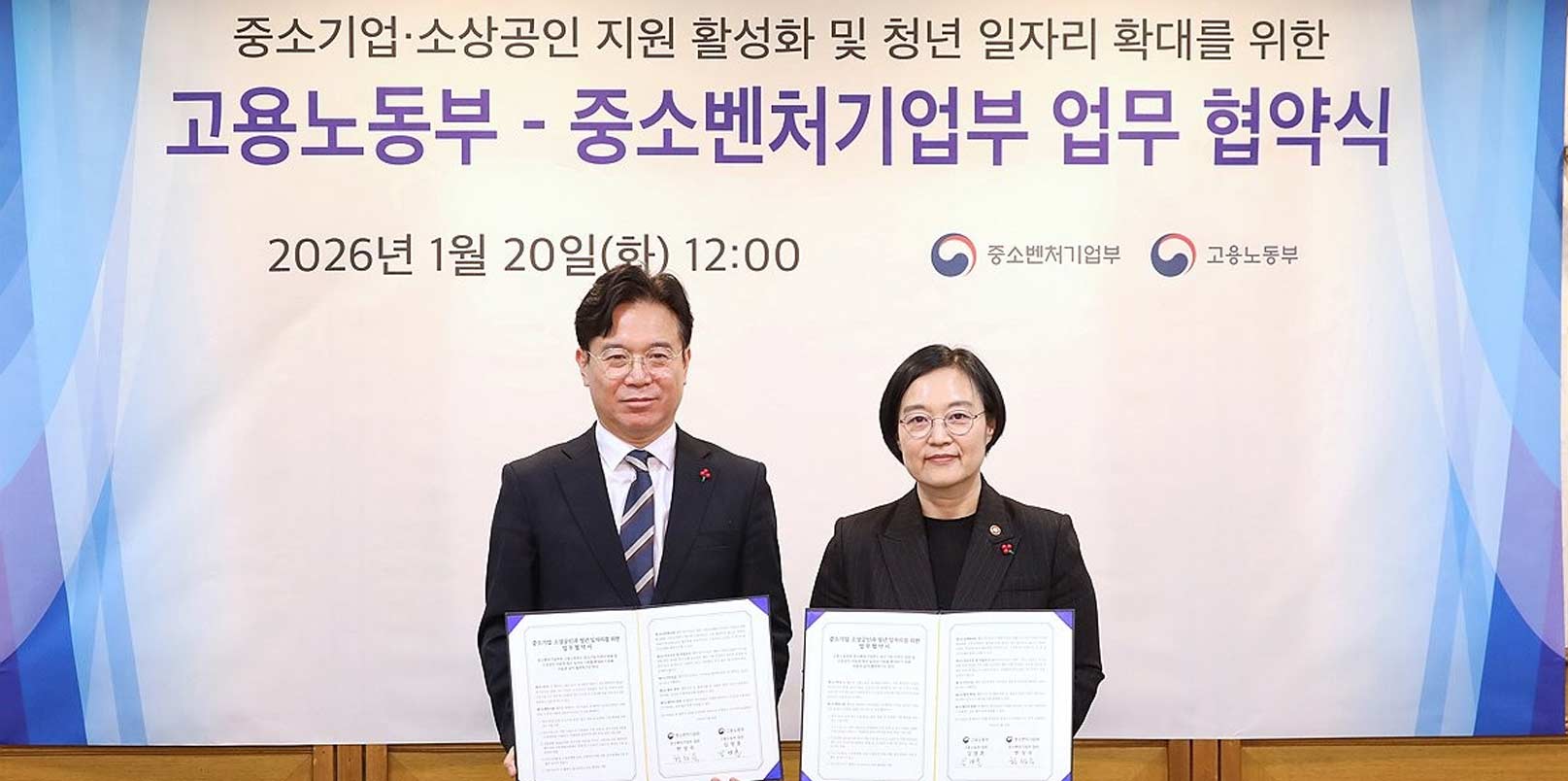
On January 20, the Ministry of SMEs and Startups and the Ministry of Employment and Labor signed an official Memorandum of Understanding (MOU) at the Government Complex in Seoul.
The agreement establishes a joint policy coordination framework designed to connect SME labor needs, AI-based skills training, and youth employment support.
Under this cooperation, the ministries will hold quarterly minister-level meetings to monitor progress and jointly refine national strategies. Their shared goal is to expand youth employment opportunities, resolve SME and startup labor shortages, and improve overall working conditions.
The policy emphasizes four pillars:
- Bridging job mismatches between young job seekers and SMEs;
- Developing skilled workers in high-demand sectors such as AI and digital manufacturing;
- Expanding field-based hiring and employment programs;
- Enhancing work environments and building sustainable job structures.
Korea Aligns Labor Policy with AI Workforce Transformation
SMEs and startups account for more than 99% of Korean enterprises and employ nearly nine out of ten workers nationwide. However, workforce shortages, especially in technical and digital roles, remain one of the most cited barriers to growth.
The new MOU links existing programs such as the SME AI Transformation (AX) initiative and the AI Vocational Training Project. The two ministries aim to ensure that participants in national AI and digital-skills programs can transition directly into SME and startup positions.
The ministries also plan to strengthen the Hope Return Package (which supports small business owners’ re-entry into employment) and the National Employment Support Program, integrating both to create a smoother safety net for founders and displaced workers.
Government Leaders Outline Vision for Youth Employment and Smart Industry Talent
Minister Han Seong-sook of SMEs and Startups said the initiative represents “a national task that transcends ministerial boundaries,” adding that “youth employment and SME labor challenges require joint, field-driven solutions.”
Minister Kim Young-hoon of Employment and Labor echoed that sentiment:
“This MOU is the beginning of tangible change connecting young talent to SMEs and startups. We aim to create a virtuous cycle that gives youth opportunity and SMEs the talent they need.”
MSS official Kwon Soon-jae, Director of Regional Enterprise Policy, noted that both ministers “share a strong interest in smart factory and AI transformation,” confirming plans to expand AI literacy training for SME employees nationwide.
“Both ministers share an interest in smart factories. We plan to strengthen the connection between existing projects and jointly pursue AI literacy training for SME employees.”
How the MOU Impacts Startups, Investors, and Korea’s Venture Ecosystem
Although the agreement primarily targets SMEs, startups fall directly under the same policy umbrella. Early-stage tech companies, often classified as SMEs, stand to benefit from:
- Access to AI-trained talent aligned with real-world startup needs.
- Reduced recruitment costs, as national programs begin supplying more digitally skilled job seekers.
- Improved labor market stability, which reduces turnover risk and strengthens startup sustainability.
This cooperation also signals policy alignment between labor and innovation ministries, a rarity in Korea’s traditionally siloed bureaucracy. For venture capital and ecosystem stakeholders, it indicates the government’s recognition that human capital is now as critical as funding in scaling national innovation capacity.
Moreover, linking workforce policy to AI and deep-tech capability development directly complements Korea’s broader sovereign AI and digital transformation agenda, where AI literacy, retraining, and smart manufacturing are all essential pillars.
Toward a Smarter Startup Economy: Building a Sustainable Talent Pipeline
For the Korean startup scene, the agreement represents a shift from reactive hiring support to proactive talent pipeline design. It connects training, employment, and entrepreneurship support into one continuum.
By structurally aligning the AI training ecosystem with SME labor needs, the policy may help reduce the talent gap that has slowed commercialization for deep-tech and software ventures. Over time, the ministries’ quarterly governance structure could evolve into a national employment innovation model—one that balances rapid technological adoption with inclusive workforce growth.
As Minister Han Seong-sook stated,
“This is the starting point for policies that entrepreneurs, employees, and youth can truly feel in the field.”
For founders and investors, it signals a maturing policy environment—where innovation policy and labor policy finally converge to strengthen Korea’s next-generation startup engine.
– Stay Ahead in Korea’s Startup Scene –
Get real-time insights, funding updates, and policy shifts shaping Korea’s innovation ecosystem.
➡️ Follow KoreaTechDesk on LinkedIn, X (Twitter), Threads, Bluesky, Telegram, Facebook, and WhatsApp Channel.
🤝 Looking to connect with verified Korean companies building globally?
Explore curated company profiles and request direct introductions through beSUCCESS Connect.