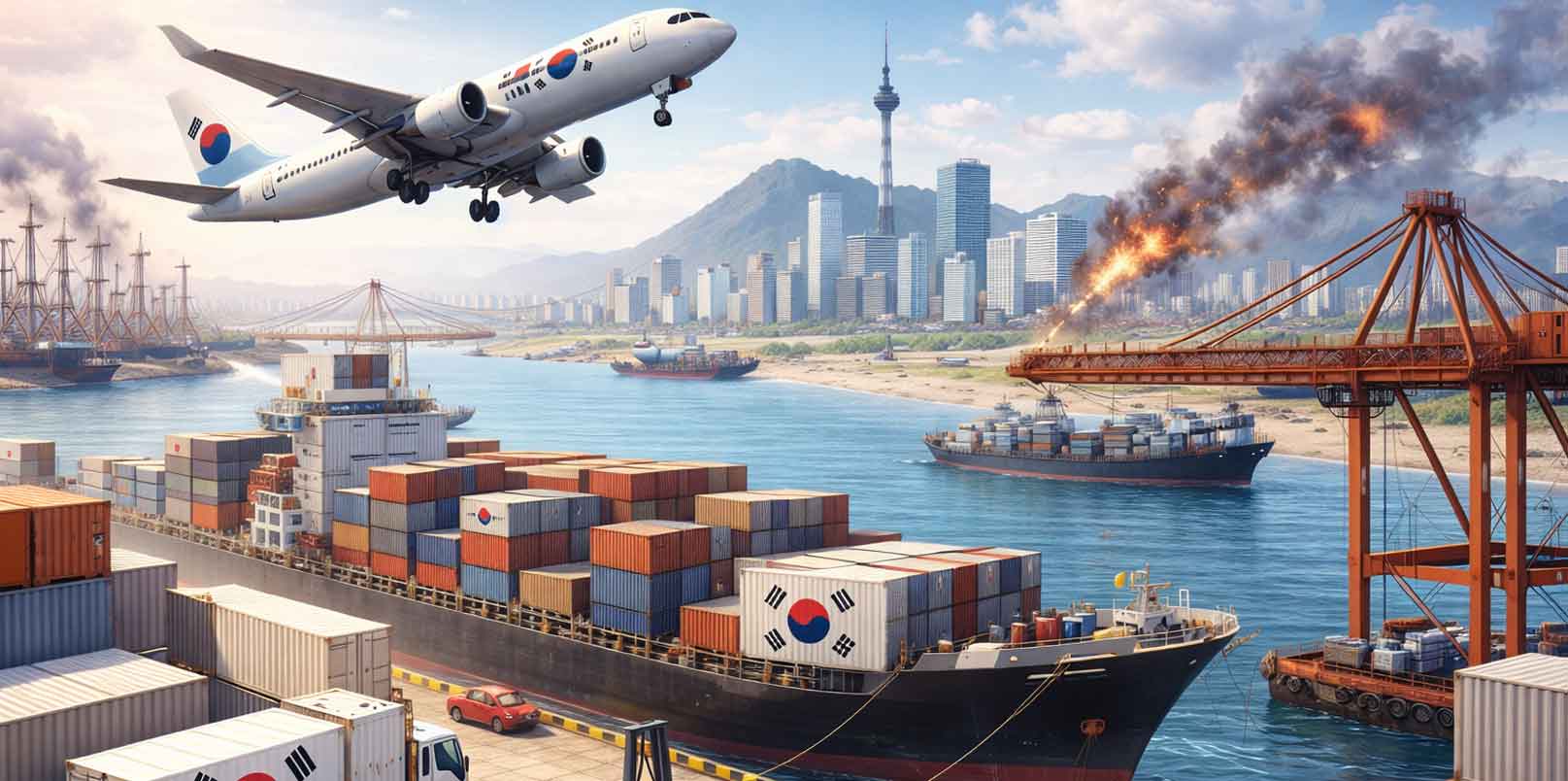
A startup export strategy can look global on paper and still fail at the point of movement. Korea’s latest Middle East response makes that gap visible. The government is no longer treating this disruption as a temporary shipping headache. It is now testing how fast public support can move when cross-border startup execution begins to stall under geopolitical pressure.
Korea’s Emergency Logistics Vouchers: Fast-Track Export Support for Middle East-Affected SMEs
On March 6, 2026, South Korea’s Ministry of SMEs and Startups (MSS) announced a new Emergency Logistics Voucher program for SMEs exporting to the Middle East, while also expanding existing logistics and financing support as regional disruption deepens.
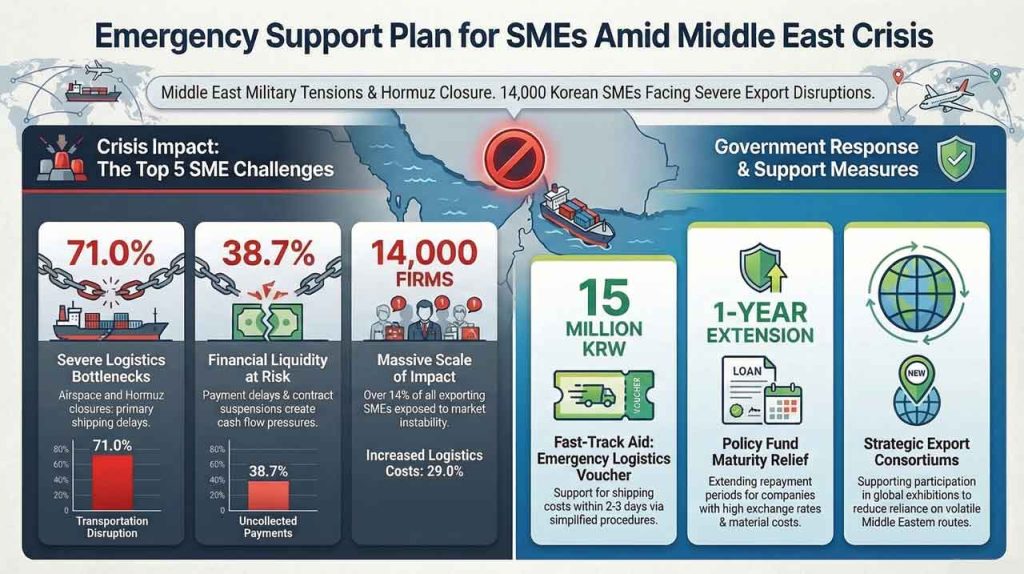
According to the ministry, 80 companies had submitted reports related to damage, difficulties, or concerns as of March 5, with 64 cases identified. The most frequently reported issues were:
- transportation disruption at 71.0% or 22 cases,
- unpaid receivables at 38.7% or 12 cases,
- increased logistics costs at 29.0% or 9 cases,
- business travel disruption at 16.1% or 5 cases, and
- contract holds at 12.9% or 4 cases.
The ministry said the reported difficulties were linked to risks including possible airspace disruption, possible closure of the Strait of Hormuz, cancellations of visits to Korea by Middle Eastern buyers, and rising export cargo insurance costs.
According to Minister Han Seong-sook,
“Military tensions in the Middle East continue and the situation remains uncertain. There are concerns about both direct and indirect damage to Korean companies, including SMEs exporting to the Middle East.
If logistics problems persist for a prolonged period, they could lead to liquidity crises for exporting companies.”
Hence, the policy response now has several layers. For companies already covered by Korea’s export voucher scheme, the ceiling for international shipping support is being raised from KRW 30 million to KRW 60 million. For firms outside that program, the ministry plans to create a separate emergency logistics voucher track focused on the Middle East. Officials also said they are reviewing a fast-track process that could determine eligibility within two to three days once export performance and logistics contracts are confirmed.
In parallel, the ministry is reviewing a special maturity extension for policy fund loans for companies with high exposure to imported raw materials. The measure would extend the grace period on principal repayment by up to one year. It is also preparing strategic export consortium support to help affected firms explore alternative markets through export consultations and exhibitions if the disruption lasts longer.
Minister Han Seong-sook reassured,
“We will closely monitor in real time the damage and operational difficulties faced by SMEs related to the Middle East situation and provide prompt, tailored support measures that reflect the voices of companies in the field.
We will also quickly prepare and implement both the ‘Emergency Logistics Voucher’ and the ‘Special Maturity Extension of Policy Funds’ for companies experiencing management difficulties due to the strong exchange rate.”
Why Korea’s Middle East Export Response Now Matters for Startups and Scaleups
The new MSS response matters because the policy signal has now shifted. Korea is no longer responding only to trade disruption in the abstract. It is responding to the possibility that export friction can quickly become an execution problem for smaller companies that do not have the balance sheet, route flexibility, or overseas staffing depth of large conglomerates.
That is especially important for Korea’s startup and scaleup ecosystem. Over the past two years, the Middle East has become more than a symbolic expansion market. It has been treated as a live commercial destination for Korean companies pursuing hardware deployment, industrial technology pilots, mobility projects, beauty exports, and B2B market entry.
Previously, KoreaTechDesk showed how flight suspensions, shipping instability, and field deployment constraints were beginning to interfere with real startup operations. This new announcement adds another layer. The state is now trying to accelerate the speed of export support itself.
That changes the story.
The issue is no longer only how much exposure Korea has in the region. It is also whether Korea’s support machinery can move at something closer to startup speed when external shocks hit. That question matters beyond the Middle East. It goes to the credibility of Korea’s broader global expansion model for smaller companies.
Minister Han framed the concern in those terms when she said prolonged instability could create direct and indirect damage not only for companies exporting to the Middle East, but for Korean firms more broadly.
Oh Ki-woong, Standing Vice Chairman of the Korea Federation of SMEs (KBIZ), stated:
“If exports to the Middle East are interrupted, there is concern that corporate cash flow and business conditions could deteriorate.”
The Real Friction Is That Faster Vouchers Still Cannot Reopen Broken Trade Routes
The policy move is meaningful, but it does not remove the core operational constraint.
A fast decision on support is useful when the problem is cost absorption. It is less powerful when the problem is physical interruption. If routes are delayed, air access becomes unstable, buyers fall silent, or equipment cannot move on schedule, cash support can soften the hit but cannot restore execution conditions on its own.
That is the tension beneath the announcement.
Korea is trying to solve a high-speed external shock with a faster domestic support mechanism. That is rational. But it is also limited. A voucher can help pay for more expensive logistics. It cannot guarantee that goods will move when routes are constrained. A maturity extension can ease repayment pressure. It cannot prevent a delayed pilot, a stalled launch, or a broken delivery timeline from weakening a startup’s market position.
There is another friction point here. The government’s current figures show that confirmed cases are still at an early stage. Some coverage noted that large-scale contract termination or full non-payment has not yet widely materialized. That means the state is acting before maximum damage is fully visible. From a policy standpoint, that is a strength. From a business standpoint, it also means the hardest outcomes may still sit ahead if disruption continues.
The blind spot is not policy intent. It is the structure of exposure. Smaller exporters often get hurt not only by headline disruptions, but by timing mismatches: invoices that arrive late, inventory that stalls, meetings that do not happen, and counterparties that stop responding just long enough to damage momentum.
What Korea’s Emergency Logistics Support Can Help With, and Where the Limits Remain
The new package can help in several practical ways.
First, it may reduce the lag between shock and support. That matters for smaller exporters that do not have much room to absorb sudden freight spikes or rebooking costs.
Second, the two-track structure is important. Expanding support only for companies already inside the export voucher system would have left many affected firms exposed. Creating a separate emergency track suggests the ministry understands that crisis support cannot depend entirely on preexisting program boundaries.
Third, the combination of logistics support, maturity extension review, and alternative market exploration shows a broader policy instinct. The government is not treating the issue only as a freight invoice problem. It is beginning to see it as a chain of pressure that can touch shipping, cash flow, sourcing, and market strategy at the same time.
Still, the limits are clear.
The support is designed to ease friction, not eliminate it. Companies with simple shipment profiles may benefit quickly. Firms whose expansion depends on synchronized movement of people, products, installation, testing, or buyer engagement will remain more exposed. Deep-tech startups, industrial solution providers, and companies entering the region through pilots or local partnership models may still find that policy support cannot fully compensate for operational delay.
The same applies to alternative market support. Helping companies join exhibitions or export consultations can open a path to diversification. It does not replace a market that was already in motion. For startups, a delayed market is not always a neutral event. Timing can affect fundraising narratives, commercial proof points, and partner confidence.
What Global Founders, Investors, and Cross-Border Partners Should Watch in Korea
And so, global founders should read this episode as a reminder that export policy capacity is becoming part of startup competitiveness. Encouraging companies to expand overseas is only one piece of the equation. The harder test appears when geopolitical friction interrupts that expansion and companies suddenly depend on how quickly the state can respond.
Furthermore, international investors may see a useful signal in Korea’s response. Authorities are moving early, gathering damage reports quickly, and designing targeted support around logistics and financing pressure. That reflects institutional seriousness. On the other hand, it also highlights a limitation: government intervention can cushion shocks, but it cannot remove the structural fragility that still exists in many cross-border startup strategies.
Meanwhile, overseas partners working with Korean SMEs and emerging tech firms may need to adjust expectations in the near term. Companies are likely to continue pursuing partnerships and market entry, yet timelines around deployment, staffing, delivery, and pilot execution may become less predictable if transport disruption deepens.
As for global policymakers, this situation offers a broader lesson. Startup internationalization is often framed around innovation capacity, market access, or investment support. The current disruption shows that logistics resilience and the speed of policy response deserve equal attention when governments encourage startups to operate across borders.
Korea’s Global Startup Push Is Now Being Measured by Response Speed, Not Just Ambition
Korea has spent the last few years telling startups to think globally. The Middle East disruption is now testing a harder question: when global expansion hits a real-world bottleneck, can the state respond in a way that matches the urgency of startup risk?
That is why this announcement matters.
The emergency voucher itself is not the whole story. The deeper story is that Korea is being pushed to prove that export support can act less like a bureaucratic program and more like crisis infrastructure.
If it succeeds, that strengthens the country’s credibility as a serious platform for outward-looking startups. If it moves too slowly, the cost will not show up only in shipping bills. It will show up in lost momentum, weaker trust, and a more cautious view of Korea’s global execution model.
Key Takeaway on Korea’s Middle East Emergency Logistics Voucher Support
- South Korea’s Ministry of SMEs and Startups on March 6 introduced a new Emergency Logistics Voucher program for SMEs affected by the Middle East crisis.
- As of March 5, the ministry had identified 64 cases of damage, difficulty, or concern among 80 reporting companies.
- The most common reported issue was transportation disruption at 71.0%, followed by unpaid receivables at 38.7% and higher logistics costs at 29.0%.
- Korea is also raising the logistics support ceiling under its existing export voucher program from KRW 30 million to KRW 60 million.
- Officials said emergency support for eligible companies may be processed through a fast-track review within two to three days once basic documents are verified.
- The ministry is reviewing a special maturity extension for policy loans, including up to a one-year extension of principal grace periods for companies with high exposure to imported raw materials.
- The policy is important because it shows Korea testing how quickly public export support can move when startup and SME supply chains face geopolitical disruption.
- The main structural limit remains unchanged: faster support can ease cost pressure, but it cannot on its own restore broken logistics routes, delayed operations, or lost execution time for exporters.
– Stay Ahead in Korea’s Startup Scene –
Get real-time insights, funding updates, and policy shifts shaping Korea’s innovation ecosystem.
➡️ Follow KoreaTechDesk on LinkedIn, X (Twitter), Threads, Bluesky, Telegram, Facebook, and WhatsApp Channel.
🤝 Looking to connect with verified Korean companies building globally?
Explore curated company profiles and request direct introductions through beSUCCESS Connect.