
South Korea’s open innovation model is becoming increasingly structured. In Seoul, a new platform is bringing major corporations and startups into the same room to reveal concrete collaboration plans. The upcoming Seoul Open Innovation Partners Day will allow global observers to see how Korean conglomerates are sourcing external technology and where startup partnership opportunities may emerge inside one of Asia’s most concentrated enterprise markets.
Seoul Opens 2026 Corporate–Startup Collaboration Series with New Event
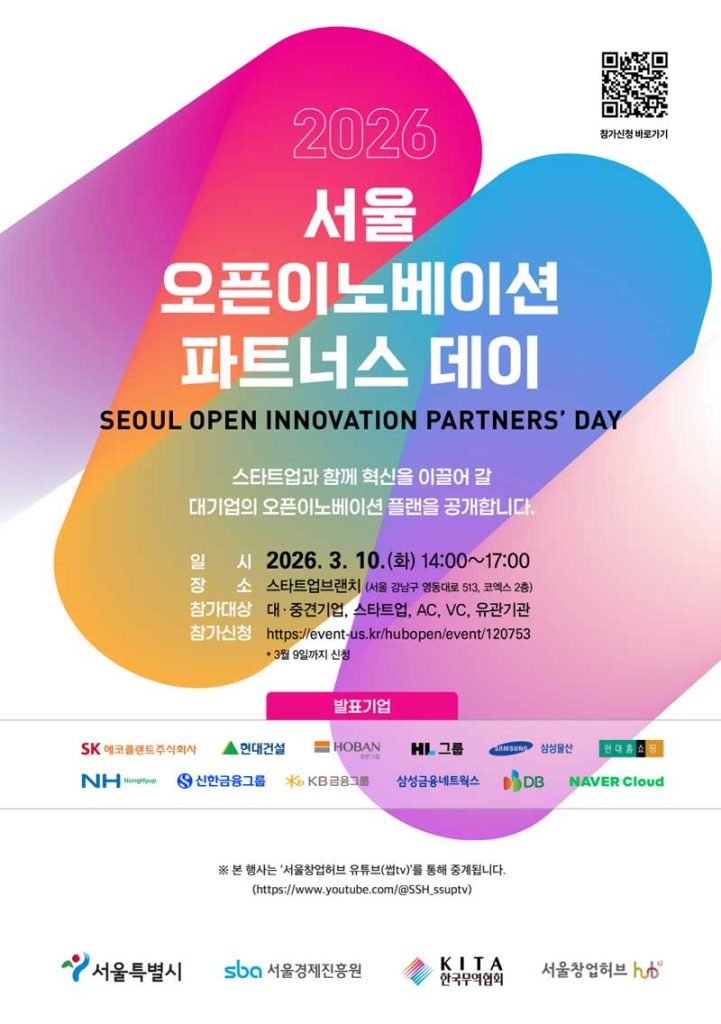
Seoul is expanding its role as a connector between startups and major corporations. On March 10, the Seoul Metropolitan Government and the Seoul Business Agency (SBA) will host “Seoul Open Innovation Partners Day” at Startup Branch inside the COEX complex in Seoul.
The event will gather 12 large corporations that plan to reveal their startup collaboration strategies and investment priorities for 2026. Organizers say the initiative is designed to give startups early visibility into corporate partnership opportunities while helping companies identify technologies that support new business development.
The program also marks the opening session of the Seoul Open Innovation Day series, which is scheduled to take place five to six times throughout the year.
Corporations Outline Startup Collaboration and Investment Plans
Participating companies include major Korean industrial and financial groups:
- SK ecoplant
- Hyundai Engineering & Construction
- Hoban Group
- HL Group
- Samsung C&T
- Hyundai Home Shopping
- NH NongHyup
- Shinhan Financial Group
- KB Financial Group
- Samsung Financial Networks
- DB Group
- NAVER Cloud
According to organizers, the number of participating companies increased from 10 corporations last year to 12 this year, reflecting growing corporate interest in structured startup collaboration programs.
The event will introduce open innovation initiatives across several sectors including artificial intelligence, mobility, construction, and retail. Networking sessions will also connect corporations with startups, accelerators, and venture capital firms.
Organizers plan to present the corporate recruitment focus areas, technical cooperation opportunities, and investment approaches that companies intend to pursue with startups during 2026.
Seoul Startup Hub Expands Its Role in Corporate Innovation Programs
The initiative builds on the Seoul Startup Hub Open Innovation program, which the city and SBA have operated since 2020.
Through the program, public institutions act as intermediaries that connect startups with corporate partners. The new Partners Day format was introduced in 2025 to expand the initiative into a dedicated platform where corporations can present collaboration roadmaps and directly engage with startups.
Officials say this structure helps startups gain earlier insight into corporate demand for emerging technologies and potential proof-of-concept projects.
Open innovation programs are increasingly used in Korea to lower the barriers surrounding proof-of-concept validation and investment fundraising, two steps that many early-stage startups must complete before commercializing new technologies.
Stakeholders Highlight the Role of Open Innovation
Kim Jong-woo, Head of the Startup Division at SBA, emphasized the strategic importance of open innovation programs for Seoul’s startup ecosystem, saying:
“Open innovation is an essential strategy for advancing Seoul’s startup ecosystem. Seoul Startup Hub will expand its role at the center of innovation.”
He added that the agency plans to encourage greater participation from large and mid-sized corporations so that more startups can gain practical opportunities for collaboration and investment.
This starting event of the series will run for approximately three hours starting at 2 PM on March 10 and will be held both offline and online. Viewers who cannot attend in person can watch the session live through the Seoul Startup Hub YouTube channel.
What the Event Signals for Korea’s Startup Ecosystem
The event reflects a broader trend within Korea’s innovation landscape. Corporations are increasingly searching for external technologies that can support new business lines while startups seek corporate infrastructure and early market access.
Corporate participation from sectors such as finance, construction, mobility, and cloud computing suggests that open innovation programs are expanding beyond technology companies into traditional industries.
For startups, these programs often serve as the entry point to corporate procurement systems. Many partnerships begin with proof-of-concept projects, which allow corporations to test emerging technologies before pursuing deeper collaboration or investment.
This approach has become common in Korea as corporations attempt to shorten development cycles and access technologies developed by startups.
The Seoul initiative also illustrates how local governments are attempting to act as neutral intermediaries that coordinate these partnerships. Programs run through public platforms such as Seoul Startup Hub help reduce the friction startups often face when approaching large conglomerates independently.
Why Global Founders and Investors Are Watching Korea’s Corporate Innovation Programs
South Korea hosts one of Asia’s most concentrated corporate ecosystems, with major conglomerates operating across sectors ranging from construction and manufacturing to finance and digital platforms.
For startups seeking enterprise customers, this structure creates a dense market for potential technology partners. Events like Seoul Open Innovation Partners Day provide a centralized forum where corporate technology demand becomes visible to startups and investors.
The participation of companies such as NAVER Cloud and major financial groups including Shinhan Financial Group and KB Financial Group also indicates that collaboration opportunities span digital infrastructure, fintech services, and enterprise platforms.
For international founders evaluating market entry into Korea, such programs may offer structured pathways to corporate pilots and partnership discussions that would otherwise require extensive local networks.
Seoul Expands the Platform Connecting Corporations and Startups
Seoul’s decision to organize multiple open innovation sessions throughout the year suggests a sustained effort to institutionalize corporate–startup collaboration.
As the Seoul Open Innovation Day series continues through 2026, the program will likely become a recurring venue where corporations publicly outline technology priorities and startups present solutions.
For the Korean ecosystem, the significance lies in coordination. When corporate demand, startup supply, and public intermediaries operate through structured platforms, collaboration opportunities become easier to identify.
That structure may help more startups move beyond early experimentation and toward real commercial partnerships inside Korea’s industrial network.
Key Takeaways on Seoul Open Innovation Partners Day 2026
- Seoul and the Seoul Business Agency will host Seoul Open Innovation Partners Day on March 10 at COEX Startup Branch.
- The event launches the 2026 Seoul Open Innovation Day series, which will take place five to six times during the year.
- 12 corporations, including SK ecoplant, Samsung C&T, and NAVER Cloud, will present startup collaboration and investment plans.
- The event will introduce open innovation programs across sectors such as AI, mobility, construction, and retail.
- Organizers aim to provide startups with direct access to corporate partnership opportunities and proof-of-concept collaborations.
- The initiative expands Seoul’s role as an intermediary connecting startups with major corporate partners inside Korea’s innovation ecosystem.
– Stay Ahead in Korea’s Startup Scene –
Get real-time insights, funding updates, and policy shifts shaping Korea’s innovation ecosystem.
➡️ Follow KoreaTechDesk on LinkedIn, X (Twitter), Threads, Bluesky, Telegram, Facebook, and WhatsApp Channel.
🤝 Looking to connect with verified Korean companies building globally?
Explore curated company profiles and request direct introductions through beSUCCESS Connect.