South Korea’s decision to anchor its first-ever offshore global fund-of-funds in Singapore marks the end of an era where “globalization” was merely a localized policy buzzword. By moving capital management physically outside its borders, Seoul is finally admitting that the domestic venture ecosystem cannot scale to the top three global AI powerhouse level through internal incentives alone. This isn’t just a bilateral handshake; it is a structural hedge against the gravity of a shrinking domestic market, repositioning Korea’s “AI Action Plan” within the liquidity and neutrality of a global financial hub.
Establishing the Korea-Singapore AI Alliance and the $300M Global Fund
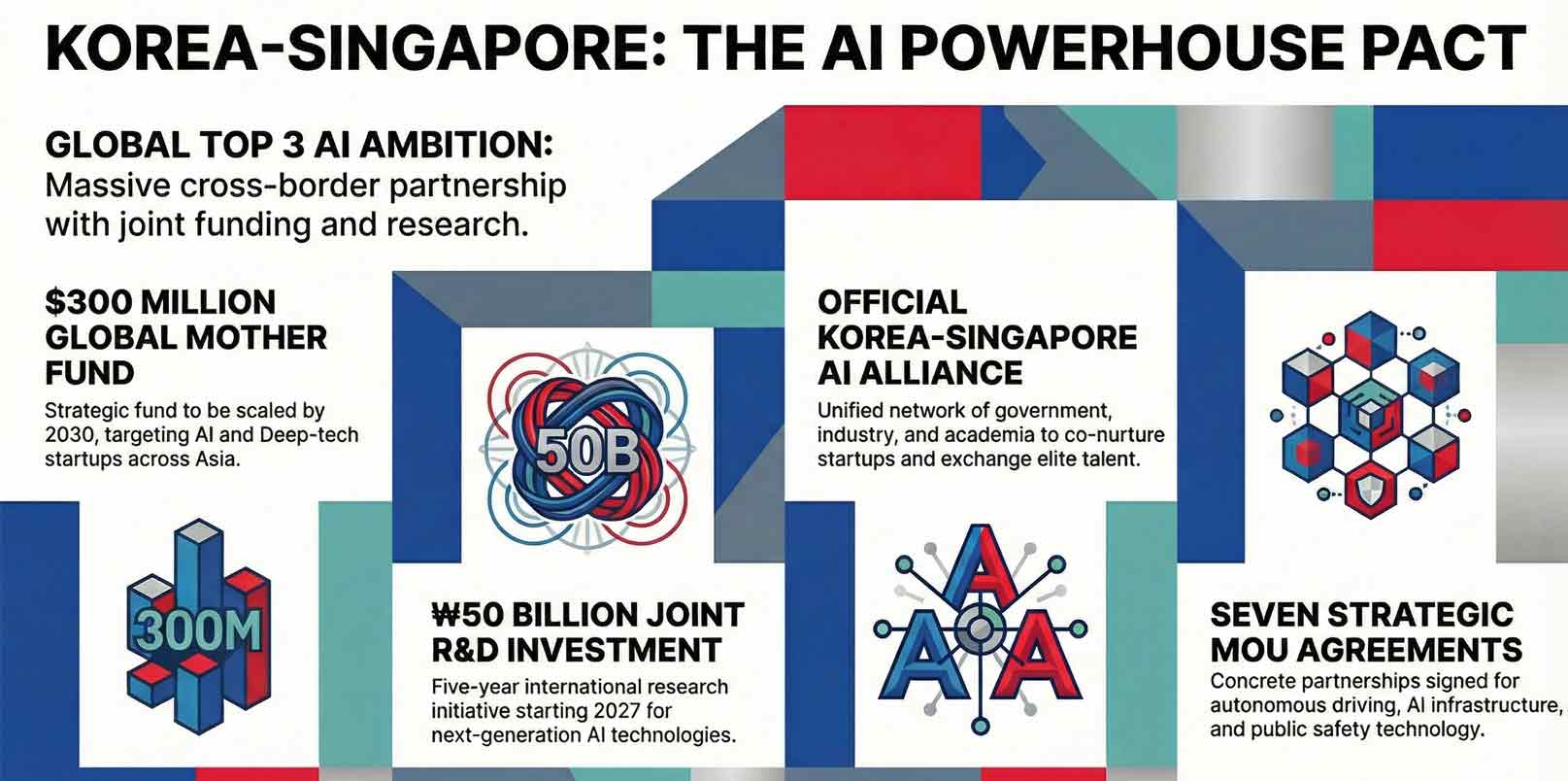
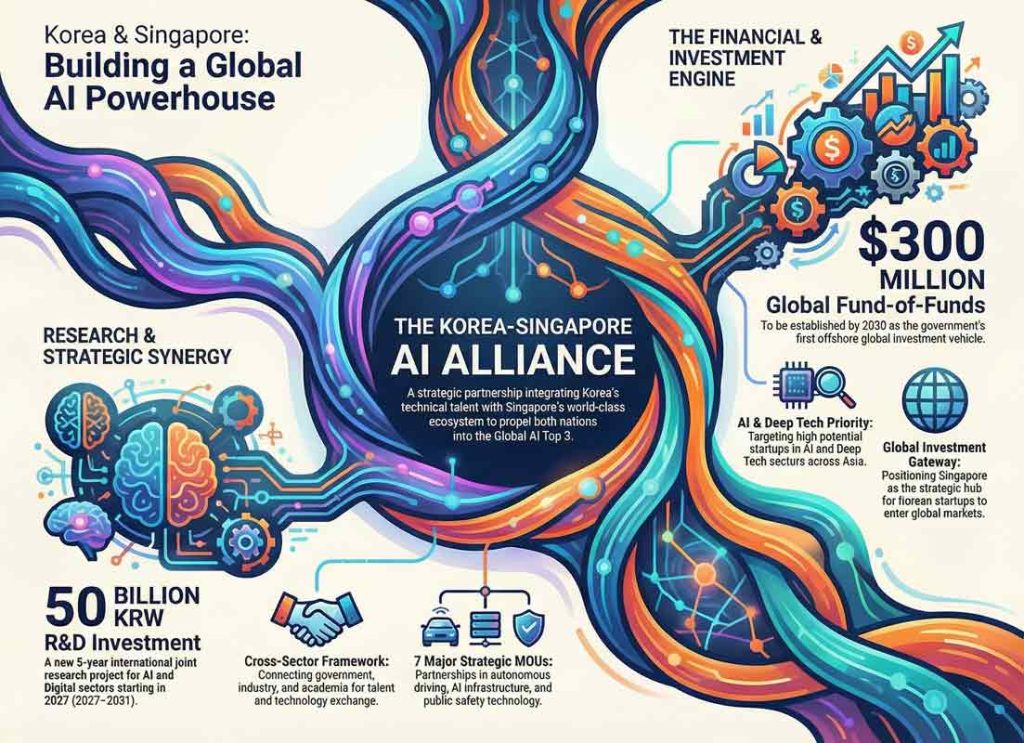
During the Korea-Singapore AI Connect Summit held on March 2, 2026, the Ministry of SMEs and Startups (MSS) and the Ministry of Science and ICT (MSIT) formalized a massive cross-border investment and research framework.
The centerpiece is the creation of a government-backed offshore global fund-of-funds, set to launch in Singapore in the second half of 2026. This fund is projected to scale to USD 300 million (approximately KRW 437.6 billion) by 2030, specifically targeting startups in the AI and deep tech sectors.
Simultaneously, the MSIT announced a 50 billion KRW (USD 34M) international joint research project spanning the next five years. This initiative connects Korea’s Institute for Information & Communications Technology Planning & Evaluation (IITP) with AI Singapore (AISG).
The summit concluded with seven pivotal Memorandums of Understanding (MOUs), including deep-tier research collaborations between the KAIST Graduate School of AI and the National University of Singapore (NUS) School of Computing, as well as autonomous driving partnerships involving Korea’s Autonomous A2Z and Singapore’s NCS and SMRT.
A Strategic Shift from Exporting Products to Exporting Capital
For years, the Korean government’s approach to global expansion focused on pushing Korean founders “out” into foreign markets. But this new Singapore-based fund-of-funds flips the script entirely.
By establishing a venture capital platform in a global financial hub, the government is building a permanent infrastructure to attract international LPs and VCs into the Korean orbit.
Minister of SMEs and Startups Han Seong-sook noted,
“Singapore is a global financial hub and a vital gateway for our ventures and startups to expand globally.”
This move acknowledges that for Korean AI startups to survive, they need more than just Korean capital; they need to be embedded in the same ecosystem where global investors evaluate deal flow.
Hence, this fund isn’t just a pool of money but a signal to the global market that Korean deep tech is now ready to be priced by international standards, not just protected by domestic subsidies.
The Friction: Institutional Design vs. Execution Reality
While the policy ambition is clear, the tension lies in the execution of “offshore” management.
Historically, Korean government funds (Fund of Funds or locally known as Mother Fund) are governed by strict auditing requirements and conservative risk profiles that often clash with the fast-moving, high-risk nature of Singapore’s venture scene. There is an inherent friction between the Korean government’s need for “visible returns for the taxpayer” and the reality of deep tech investing, which often requires long horizons and high failure rates.
Furthermore, the “AI Alliance” faces a structural gap in talent mobility. Memorandums of Understanding between institutions look excellent on paper. The actual movement of high-level researchers is often hindered by differing intellectual property regulations and the sheer cost of living in Singapore.
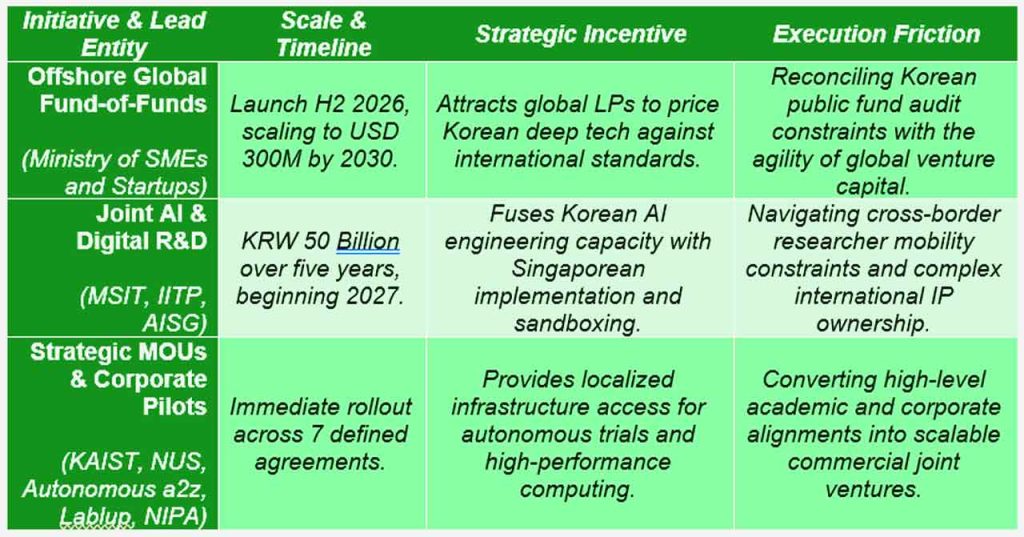
To bridge the gap between ambition and execution, founders and investors must navigate the specific mechanisms driving this initiative. The table below breaks down the capital structures, timelines, and systemic friction points.
The Korea-Singapore AI Framework: Capital & Systemic Mechanisms
What This Enables — and the Limits of Capital
This framework provides Korean AI startups with something they have lacked for a decade: a localized “Home Court” in Southeast Asia.
Founders can now leverage Singaporean infrastructure for autonomous driving trials (via the SMRT/NCS partnerships) and high-performance computing (via the Lablup/PTCsys agreements) without starting from zero. It lowers the barrier to entry for the “Deep Tech” cohort that cannot scale through software-as-a-service (SaaS) alone.
However, a $300 million fund-of-funds is relatively modest when compared to the capital requirements of generative AI and sovereign AI infrastructure. While it is a significant step for Korea, it does not solve the underlying problem of “Founder Readiness.”
Many Korean startups still struggle with the cultural and linguistic pivot required to lead global teams. Capital can buy office space in Singapore, but it cannot buy the global-first mindset necessary to compete with Silicon Valley or local Singaporean unicorns.
Strategic Implications for Global Investors and Partners
For international investors, this move provides a derisked entry point into the Korean deep tech scene. The offshore fund acts as a validator, curating “investment-ready” Korean startups that have already passed the rigorous screening of the MSS. It effectively bridges the information gap that has historically kept global VCs away from Seoul’s high-potential but insular venture market.
Global partners should view this as an invitation to engage with Korean IP in a more flexible environment. By utilizing Singapore as a “neutral sandbox,” Korean firms are signaling a willingness to adapt to international IP standards and corporate governance. This makes them significantly more attractive for M&A and cross-border joint ventures than they were when tethered solely to the Gwanghwamun policy circle.
Actionable Engagement: Capitalizing on the Corridor
Meanwhile, founders and stakeholders must look beyond the announcements and position themselves strategically within this new financial corridor.
- Who Benefits: Deep tech, autonomous driving, and AI infrastructure startups seeking Series A and beyond, particularly those requiring Southeast Asian market entry or high-performance computing (HPC) testbeds.
- How to Engage: Startups should align their product roadmaps with the specific verticals outlined in the seven MOUs, such as public safety AI (NIPA and HTX) or autonomous transit (Autonomous A2Z and SMRT). Proactively seeking co-research opportunities through the IITP will serve as a strong signal for the upcoming MSS fund deployment.
- What Actions to Take: Shift the fundraising narrative. Rather than pitching exclusively to domestic venture capitalists in Seoul, founders must prepare data rooms built for Singaporean LPs. This requires strict compliance with global corporate governance and international intellectual property standards.
Beyond the Summit: A Test of Sovereign AI Ambition
The success of the Korea-Singapore AI Alliance will not be measured by the number of MOUs signed, but by whether a Korean AI startup can successfully list or achieve a major exit via Singapore’s financial markets.
If the offshore fund-of-funds remains a “Korean-only” club operating in a foreign city, it will fail. To truly move the needle, it must evolve into a truly pan-Asian vehicle that fuses Korean technical engineering with Singapore’s unmatched ability to scale and govern global capital.
Key Takeaway for the Global AI Ecosystem
- Institutional First: This is South Korea’s first transition from “domestic fund management” to “offshore venture platform” ($ 300M total target).
- Deep Tech Priority: The capital is strictly earmarked for AI, autonomous driving, and HPC infrastructure, moving away from general consumer apps.
- Research Integration: $34M in new funding for Korea-Singapore joint R&D aims to bridge the gap between KAIST’s engineering and Singapore’s AISG implementation.
- Gateway Strategy: Singapore is now officially the “Front Office” for Korean startups aiming for Southeast Asian and global market penetration.
- Investment Hub: The fund-of-funds serves as a platform to connect global LPs with Korean founders in a transparent, neutral jurisdiction.
– Stay Ahead in Korea’s Startup Scene –
Get real-time insights, funding updates, and policy shifts shaping Korea’s innovation ecosystem.
➡️ Follow KoreaTechDesk on LinkedIn, X (Twitter), Threads, Bluesky, Telegram, Facebook, and WhatsApp Channel.
🤝 Looking to connect with verified Korean companies building globally?
Explore curated company profiles and request direct introductions through beSUCCESS Connect.