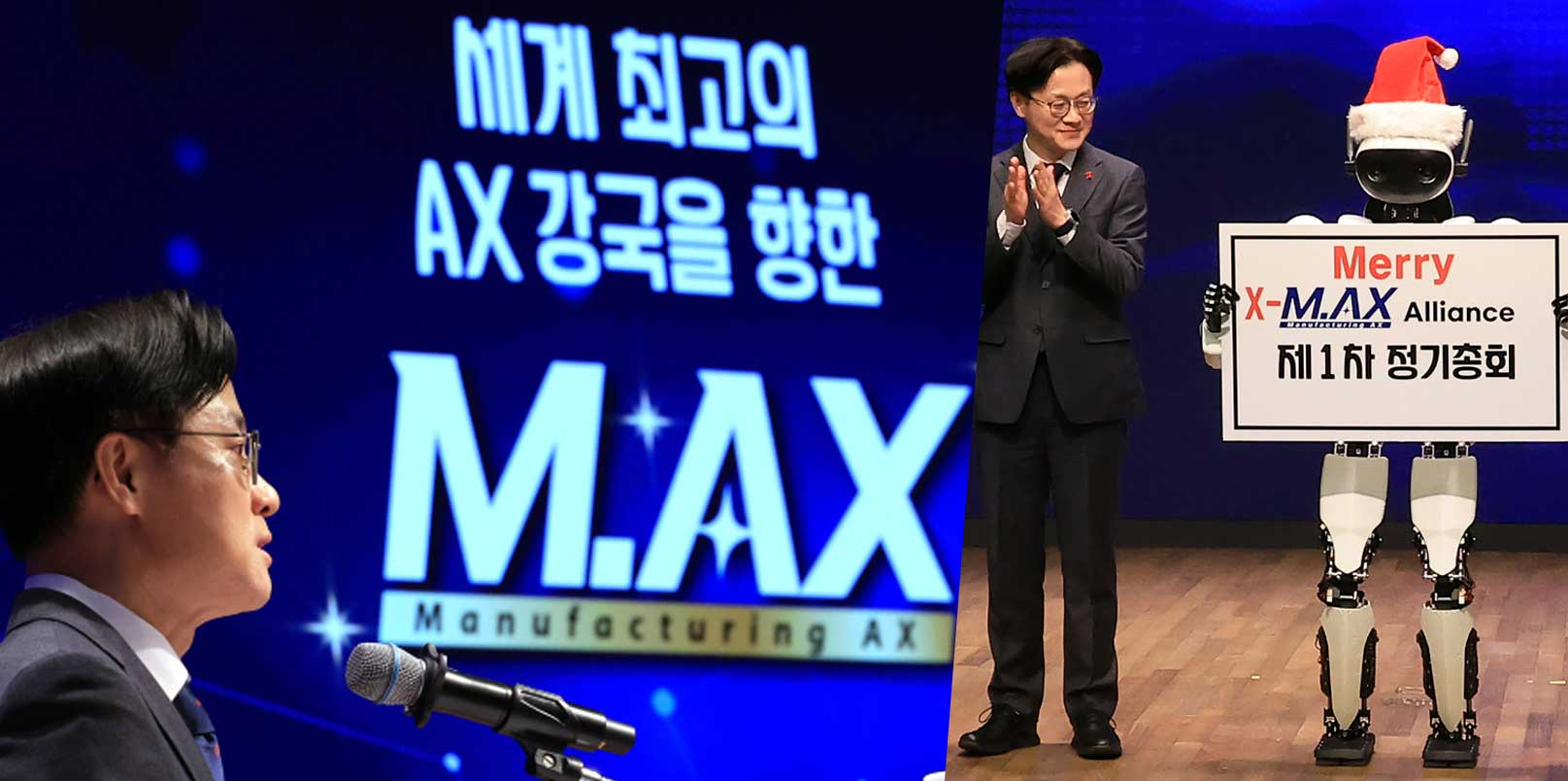
In a world racing to fuse technology and production, South Korea is no longer waiting on global trends. The country is shaping them instead. Through the M.AX Alliance, Seoul is turning industrial AI into a national growth engine, transforming policy into practice and collaboration into capital. For founders and investors watching Korea’s deep-tech rise, this moment marks the blueprint for how manufacturing and innovation can finally move in sync.
MOTIE Launches 700-Billion-Won Drive for AI-Led Manufacturing Transformation
South Korea is launching one of its most ambitious industrial AI policies to date. The Ministry of Trade, Industry and Energy (MOTIE) will invest 700 billion KRW (approx. USD 525 million) in 2026 to accelerate the nation’s Manufacturing AI Transformation (M.AX) program — a coordinated push to bring artificial intelligence into every layer of the country’s manufacturing ecosystem.
The announcement came during the first general assembly of the M.AX Alliance, held on December 24, 2025, at the Korea Chamber of Commerce and Industry in Seoul, with Minister Kim Jeong-kwan presiding.
The alliance, a public–private collaboration launched in September 2025, has already expanded to 1,300 participating organizations including Samsung Electronics, Hyundai Motor, SK Inc., Lotte Hotel, Rainbow Robotics, and Konec, reflecting expansion across major enterprises and emerging tech participants.
Five Strategic Missions: Data, AI Models, Semiconductors, Exports, and Regional Clusters
The 2026 plan focuses on five national priority projects designed to turn AI-driven manufacturing into an economic growth engine:
1. Data Creation, Sharing, and Utilization
MOTIE will allocate over 100 billion KRW by 2030 to build high-quality, industry-grade datasets for AI factories and robotics systems. This data will fuel cross-sector applications that integrate automation and predictive intelligence into real production environments.
2. AI Model Development
Expanding from existing AI Factory, AI Future Mobility, and AI Robotics divisions, MOTIE will support new R&D for autonomous vessels, AI-based consumer appliances, and AI bio-industries. MOTIE plans to invest over 700 billion KRW by 2032 to expand AI model and product development across sectors under M.AX.
3. On-Device AI Semiconductor Development
Backed by a 1-trillion-KRW project exempted from pre-feasibility review, Korea will produce on-device AI chips for vehicles, robots, drones, and home electronics. Prototype release is targeted for 2028, with ten commercial product lines by 2030.
4. AI Factory Export Expansion
The government aims to position Korea as a leading AI factory exporter, developing full-stack manufacturing technologies covering process design, supply-chain management, and logistics optimization. These “dark factories” — fully automated production environments — are expected to showcase Korea’s technological edge globally.
5. Regional AX Clusters
In alignment with the “5 Cores, 3 Specialized Growth Engines” regional strategy, industrial complexes across Korea will be converted into AI-robot-based M.AX clusters, with direct participation from alliance members, universities, and research institutes.
AI in Action: Early Results and Humanoid Deployments
The M.AX Alliance has already recorded over 100 cumulative AI Factory projects, achieving tangible improvements in productivity and efficiency.
- GS Caltex reduced refinery fuel costs by 20% through AI optimization of distillation processes.
- HD Hyundai Mipo shortened welding inspection times by 12.5% using AI robotics.
- TYM, an agricultural machinery company, improved productivity by 11% through AI defect inspection.
Humanoid robots are now being tested in display manufacturing, shipbuilding, logistics, hospitals, and hospitality sectors. Starting with 10 pilot projects in 2025, MOTIE plans to scale to over 100 pilot demonstrations by 2027, using the resulting data to train AI and robotic learning models.
The Urgency Behind Korea’s M.AX
Minister Kim Jeong-kwan emphasized the urgency and collective commitment behind the initiative, stating:
“The M.AX Alliance has quickly become the central axis of Korea’s manufacturing AI transformation. This is a national survival issue — one that no company can tackle alone. Trust and cooperation are the keys to success.”
During the assembly, 50 individuals and companies were recognized for their contributions to the M.AX rollout. Awards included:
- Marine Works, for its autonomous vessel data and remote-control platform;
- HL Klemove, for developing E2E autonomous driving recognition systems;
- Division chairs leading AI Factory, AI Robot, and other subcommittees also received ministerial commendations from MOTIE.
Linking Industrial AI and Startup Innovation
While M.AX primarily targets large-scale manufacturers, its design also inherently benefits startups and venture companies in Korea’s deep-tech ecosystem.
The alliance model is expected to open access to data, pilot projects, and corporate partnerships for emerging AI ventures. Startups specializing in AI software, robotics, sensors, and data platforms can now co-develop solutions with industrial partners, gaining real-world validation and investor visibility.
Moreover, the M.AX budget signals to investors that industrial AI is a government-backed growth priority, encouraging more venture capital to flow into automation, edge computing, and robotics startups. The initiative will thus be able to function as both policy infrastructure and market catalyst, blurring the traditional line between industrial policy and startup innovation.
By integrating universities, SMEs, and public research labs into shared demonstration environments, M.AX also helps close the data gap that has long hindered AI startups. It provides the experimental space and manufacturing data that smaller firms could never access independently.
Korea’s Next-Stage Industrial Policy Blueprint
M.AX represents more than a manufacturing reform — it’s a policy experiment in industrial convergence. By merging AI technology, semiconductor advancement, robotics, and manufacturing policy, Korea is attempting to redefine how a nation scales innovation.
The alliance’s rapid growth — expanded to about 1,300 participants within 100 days after launch — highlights both industrial demand and institutional agility. As implementation accelerates in 2026, the success of M.AX could set a regional precedent for AI-driven industrial strategy, influencing manufacturing policy frameworks across Asia and beyond.
And so this move further shows Korea’s global ambition to transform the AI factory into both an exportable product and a model of ecosystem governance, and demonstrate how coordinated policy and technology alignment can turn national industry into a global innovation engine.
🤝 Looking to connect with verified Korean companies building globally?
Explore curated company profiles and request direct introductions through beSUCCESS Connect.
– Stay Ahead in Korea’s Startup Scene –
Get real-time insights, funding updates, and policy shifts shaping Korea’s innovation ecosystem.
➡️ Follow KoreaTechDesk on LinkedIn, X (Twitter), Threads, Bluesky, Telegram, Facebook, and WhatsApp Channel.