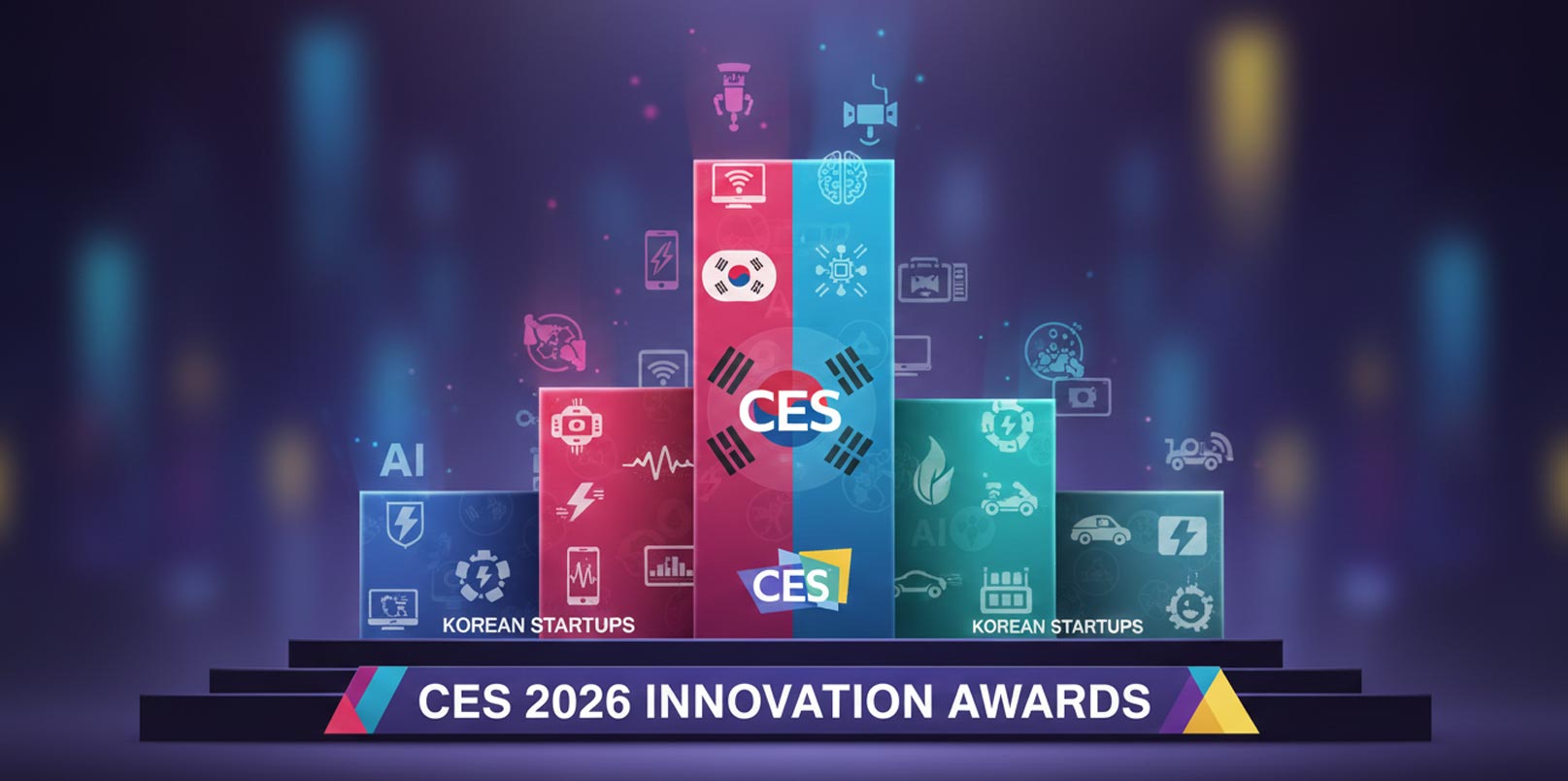
South Korea is entering 2026 with a clear statement of technological intent. At CES 2026 in Las Vegas, Korean startups and manufacturers captured 60% of all Innovation Awards, surpassing last year’s 45%. The achievement marks a critical milestone in the nation’s evolving Physical AI and robotics strategy, reinforcing Korea’s growing influence in the global industrial technology landscape.
Korean Robotics Startups Dominate CES 2026 Innovation Awards
At CES 2026, eight out of fifteen winners in the Robotics category were Korean companies — an unprecedented result that highlights the country’s stronghold in industrial automation and AI-driven robotics.
The featured startups — GOLE Robotics, Navifra, Hurotics, and Humanix — were recognized for addressing long-standing challenges in robot functionality and safety.
- GOLE Robotics won for its AA-2, a last-mile autonomous delivery robot made with flexible materials to reduce collision impact and optimize space efficiency. It integrates obstacle avoidance, complex terrain navigation, and automatic elevator interaction, demonstrating practical advancement rather than concept-level novelty.
- Navifra received the award for its vision-based precision positioning system. Unlike conventional LiDAR or marker-based models, its camera-driven AI enables millimeter-level accuracy while simplifying setup — a step toward scalable, cost-efficient autonomous mobility.
- Hurotics and Humanix showcased rehabilitation and exercise robots powered by Empathy AI, focusing on improving life quality. Hurotics’ wearable gait-assist robot analyzes user movement for rehabilitation, while Humanix’s smart resistance arm calibrates mechanical feedback based on user strength.
These solutions represent a shift away from spectacle toward functional, human-centric robotics — aligning with global trends emphasizing safety, usability, and affordability.
Startups Turning Robotics into Everyday Utility
Korean startups in Eureka Park, CES’s dedicated startup zone, are demonstrating how Physical AI can enhance real-world convenience and sustainability.
- Coffeebara, founded by Konkuk University students, developed a robot that separates, cleans, and recycles disposable coffee cups using edge-based vision AI and robotic gripper systems, addressing an urban waste issue through automation.
- HOP unveiled a compact indoor positioning sensor that enables robots and drones to operate in GPS-denied environments, including underground or industrial sites, while consuming minimal power.
- Cutshion presented software enabling Physical AI integration in collaborative and autonomous robots, while Sequor Robotics, a Seoul National University spin-off, exhibited its vision-AI-based autonomous navigation software.
This group of innovators reflects a defining trend: K-startups are moving beyond robotics hardware to develop the embedded intelligence, edge systems, and environmental sensors that form the foundation of next-generation automation.
National Agencies Back Korea’s Global Expansion at CES 2026
To strengthen global exposure, key public organizations — the Seoul Business Agency (SBA), the Korea Institute of Startup & Entrepreneurship Development (KISED), and KOTRA — jointly established national pavilions.
- The Seoul Pavilion, created through collaboration among 19 institutions including local governments and universities, features 70 booths to showcase promising startups and foster international partnerships.
- KOTRA reported that of the 284 companies recognized in the first round of CES 2026 Innovation Awards, 168 were Korean — a sharp increase from 131 in 2025, confirming Korea’s rising global competitiveness in robotics, mobility, and deep-tech manufacturing.
Physical AI: Korea’s Next Industrial Frontier
The rise of Physical AI — a term emphasized by NVIDIA CEO Jensen Huang during his CES 2025 keynote — has evolved from concept to reality in just one year. It refers to AI systems capable of understanding and interacting with the physical world, and Korea has quickly positioned itself as a frontrunner in applying this intelligence across manufacturing, mobility, and healthcare sectors.
With 1,012 robots per 10,000 workers, Korea already leads globally in robot density. Its advantage lies not only in production capacity but also in ecosystem agility — the ability of startups, universities, and government bodies to collaborate under a shared industrial AI vision.
As global manufacturing economies pivot toward AI-driven production, Korea’s Physical AI progress at CES 2026 underscores a deeper transformation: from digital innovation to tangible intelligence that reshapes how humans and machines coexist in workplaces and cities.
CES Innovation Awards 2026: Investors Confidence in Korea
The nation’s dominance at CES 2026 is more than symbolic recognition. It signals international investor confidence in Korea’s applied AI ecosystem and aligns with Korea’s broader industrial innovation efforts led by the Ministry of Trade, Industry and Energy (MOTIE).
For global founders and venture partners, Korea’s example demonstrates the potential of targeted specialization — prioritizing real-world functionality over speculative R&D. The surge of Physical AI solutions at CES 2026 positions Korean startups among the most active contributors to shaping the next industrial era.
🤝 Looking to connect with verified Korean companies building globally?
Explore curated company profiles and request direct introductions through beSUCCESS Connect.
– Stay Ahead in Korea’s Startup Scene –
Get real-time insights, funding updates, and policy shifts shaping Korea’s innovation ecosystem.
➡️ Follow KoreaTechDesk on LinkedIn, X (Twitter), Threads, Bluesky, Telegram, Facebook, and WhatsApp Channel.