For years, Korea’s startups have arrived at CES 2026 to prove they belong on the global stage. This year, they did more than showcase—they competed, won, and signed real deals. Yet the deeper story is unfolding back home, where exposure must now evolve into execution, and where Korea’s startup policy faces its most practical test: turning recognition into measurable growth.
K-Startup Pavilion at CES 2026 Records ₩2.6 Billion in On-Site Deals
The Ministry of SMEs and Startups (MSS) and the Korea Institute of Startup and Entrepreneurship Development (KISED) reported on January 13 that the K-Startup Integrated Pavilion at CES 2026 concluded with KRW 2.6 billion (~ USD 2 million) in contracts, 35 memorandums of understanding (MOUs), and 1,446 business consultations.
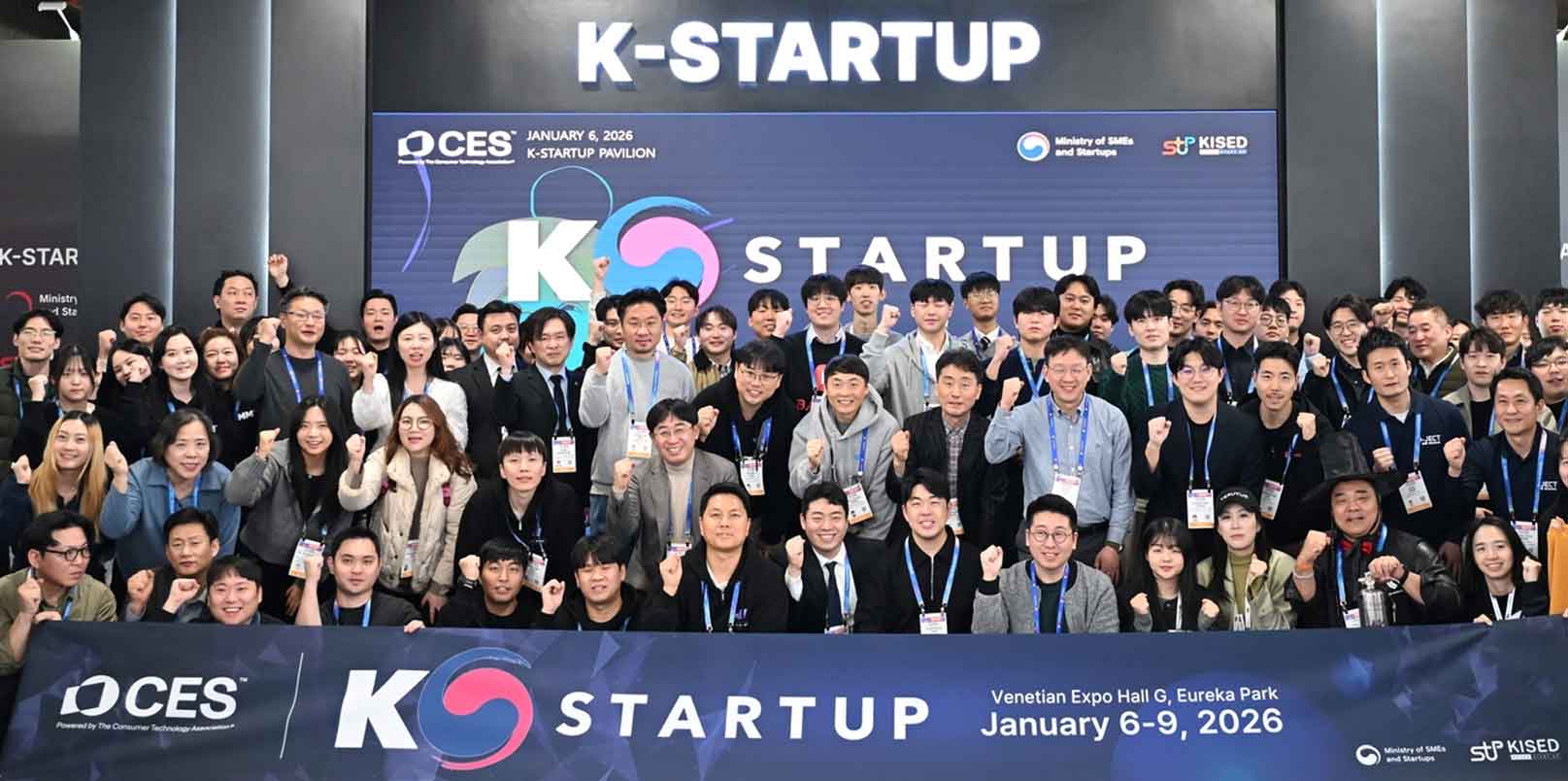
Held in Las Vegas from January 6 to 9, the sixth annual K-Startup Pavilion was organized by KISED in partnership with 19 local governments and public institutions. The delegation featured 81 innovative Korean startups, collectively representing Korea’s broadest participation since the program began in 2021.
Among the exhibitors, 11 companies received CES Innovation Awards, while three—Geeks Loft, CT5, and DeepFusion AI—earned the top honor, the Best of Innovation Award.
The opening ceremony drew key figures including Vice Minister Noh Yong-seok of MSS, KISED President Yoo Jong-pil, Kinsey Fabrizio, President of the Consumer Technology Association (CTA), and Las Vegas Mayor Shelley Berkley.
Mayor Berkley presented KISED with an official commendation recognizing its role in advancing startup collaboration between Korea and the United States—its second U.S. recognition after an award from Nevada’s Deputy Governor in 2025.
K-Startup Pavilion: Korea’s Startup Showcase on the Global Stage
The K-Startup Integrated Pavilion has grown into Korea’s flagship startup exhibition platform within CES, one of the world’s largest technology trade shows. Since its inception, the pavilion has served as a key gateway for early and growth-stage startups seeking to reach global investors, distributors, and partners.
This year’s event featured startups across artificial intelligence, mobility, robotics, energy, and healthcare, reflecting Korea’s diversification beyond traditional ICT. In collaboration with Cheonan Science and Industry Promotion Agency and other regional accelerators, KISED supported the selected firms’ participation with booth operations, translation, and on-site investor networking.
The CES presence also aligns with MSS’s broader 2026 objective of strengthening Korea’s “growth ladder” for SMEs and ventures, connecting early innovation with global market opportunities.
Policy Meets Execution
KISED President Yoo Jong-pil stated:
“We will concentrate our policy resources on close post-event follow-up so that the business agreements and consultations achieved on site can translate into export contracts and tangible sales outcomes.”
He added that 2026 represents a defining year in which AI merges with the physical economy, and that Korean startups demonstrated world-class readiness to compete in this convergence.
The sentiment was echoed by Vice Minister Noh Yong-seok, who emphasized the importance of government institutions providing not only visibility but sustained execution and global linkages for startups beyond exhibition exposure.
Global Recognition, Local Homework
Despite visible success at CES, the real challenge for Korea’s startup ecosystem lies after the event. The contracts and MOUs signed at global expos often require months of negotiation, technical verification, and regulatory adaptation to materialize into revenue.
KISED’s commitment to “localized post-event management” signals awareness of this gap. In previous years, many startups faced difficulties converting international interest into long-term partnerships due to limited overseas support infrastructure and fragmented domestic coordination among government programs.
Experts note that trust and execution consistency—not branding alone—will determine whether Korea’s CES exposure leads to sustainable export pipelines. The post-CES phase now demands what one analyst described as “institutional endurance,” where local agencies ensure startups receive ongoing mentorship, localization support, and capital bridge assistance.
CES 2026 K-Startup Pavilion: From Exhibition to Execution
The K-Startup Pavilion’s growing impact underscores Korea’s shifting position in the global startup map. Once primarily known for hardware excellence, Korea is now being recognized for AI, sensor technology, and deep-tech innovation, especially as startups like Deep Fusion AI and CT5 compete alongside major international players.
At the same time, the pavilion’s structure—integrating local governments, policy agencies, and corporate accelerators—reflects how Korea is regionalizing its startup globalization strategy. By involving 19 local partners, the initiative connects Seoul’s innovation ecosystem with emerging tech clusters in regions such as Cheonan, Daegu, and Daejeon.
This multilayered approach could strengthen regional startup participation in global exhibitions and attract cross-border investment into non-metropolitan innovation hubs, addressing a long-standing imbalance in Korea’s venture geography.
The Test Beyond the Spotlight
CES 2026 reaffirmed Korea’s technological credibility on the global stage. Yet the more critical measure will come in the months ahead: how many of those 1,446 consultations convert into sustained business deals, and how consistently institutions deliver post-exhibition support.
And this is one of the golden opportunities where Korea can finally prove its 2026 commitment that MSS Minister Han Seong-sook had previously declared: the focus on execution and speed.
As Minister Han said,
“The timing of impact is as important as policy content.”
And so, the K-Startup Pavilion continues to demonstrate Korea’s readiness for global innovation leadership. But as the spotlight fades, the country’s startup ecosystem faces a familiar test: transforming international exposure into structured, repeatable growth backed by disciplined execution and institutional trust.
Korea’s innovation may be global, but its real homework remains local.
🤝 Looking to connect with verified Korean companies building globally?
Explore curated company profiles and request direct introductions through beSUCCESS Connect.
– Stay Ahead in Korea’s Startup Scene –
Get real-time insights, funding updates, and policy shifts shaping Korea’s innovation ecosystem.
➡️ Follow KoreaTechDesk on LinkedIn, X (Twitter), Threads, Bluesky, Telegram, Facebook, and WhatsApp Channel.