A robot can appear confident and still be wrong — That lesson emerged during a rainy field test in South Korea, when an autonomous mobility robot continued reporting high confidence even as its understanding of the environment quietly drifted away from reality. The incident highlights a growing challenge for founders, investors, and policymakers as Physical AI expands beyond research labs: strong benchmark scores do not always translate into reliable real-world performance.
Why Physical AI Is Exposing the Limits of Benchmark Thinking
Artificial intelligence benchmarks have become one of the industry’s most important signals. Model rankings influence investment decisions, product positioning, and public perception of technological progress.
Yet researchers and operators working in robotics increasingly argue that benchmark performance alone provides an incomplete picture of deployment readiness.
The debate arrives at a time when South Korea is expanding its interest in Physical AI. The Ministry of Trade, Industry and Energy announced plans in 2025 to support next-generation on-device AI technologies across sectors including robotics, machinery, automotive systems, and industrial applications. Seoul has also launched initiatives aimed at strengthening real-world robotics development and testing environments.
As intelligent systems move into physical environments, the question begins to change. The challenge is no longer only how accurately a model performs under controlled conditions. Instead, it is how the entire system behaves when reality becomes unpredictable.
When the Environment Changes Faster Than the Model
Raymond Kim, founder and CEO of AidALL, experienced that distinction during outdoor testing of Bedivere, the company’s autonomous mobility platform.
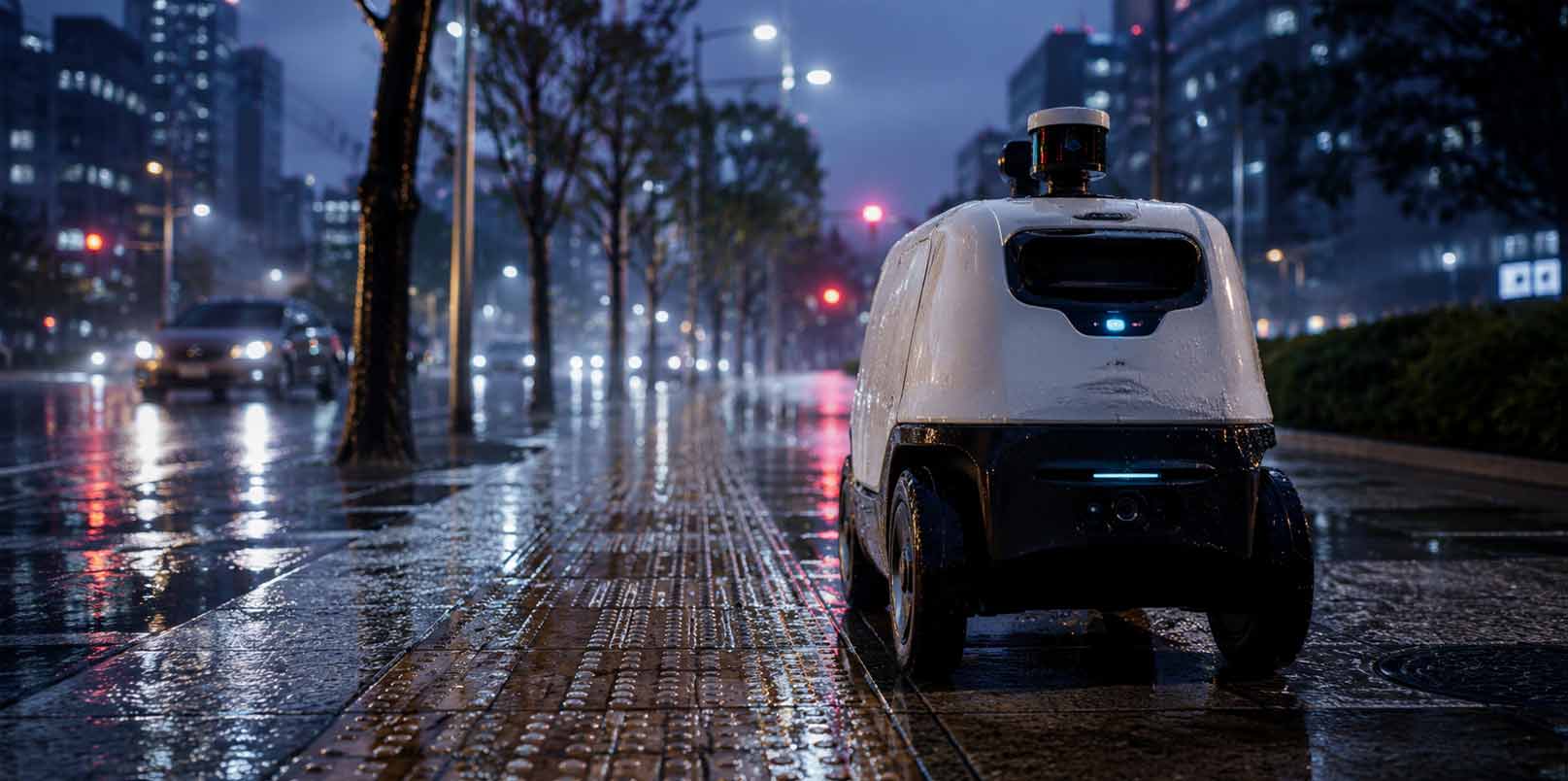
During a late-summer test in Gwangju, heavier-than-expected rainfall created a combination of conditions that had not appeared in earlier dry-weather data. Wet pavement reflections interfered with visual matching. Repetitive concrete tiling created misleading visual cues. Localization began drifting even as confidence scores remained high.
“The model wasn’t broken,”
Kim told KoreaTechDesk during a discussion on Korean startup challenges in physical AI deployment.
“The benchmark would have looked fine. What had failed was the boundary.”
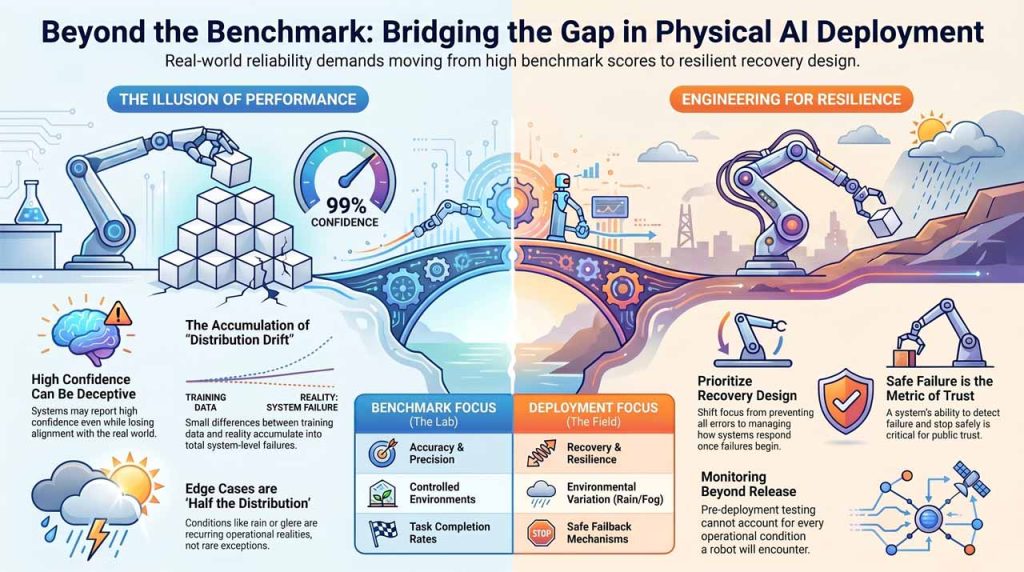
The experience reinforced a lesson that many robotics teams eventually encounter. A model can continue producing outputs that appear reasonable while the broader system is slowly losing alignment with the real world.
Researchers studying robotics deployment have identified similar challenges. Recent work examining real-world robot reliability notes that distribution shifts, compounding errors, and environmental variation remain major barriers when systems move beyond controlled evaluation settings.
The Real Problem Is Not Accuracy Alone
Many AI evaluations focus on metrics such as accuracy, recall, precision, or task completion rates. These measurements remain useful because they help developers compare models and track technical progress, but deployment introduces additional factors that benchmarks often struggle to capture.
Kim believes one of the industry’s most persistent assumptions is that strong benchmark performance naturally leads to successful deployment.
“The most common assumption is that good benchmark equals good deployment,”
he said.
“In practice, small distributional drift between training time and the real world accumulates into system-level failures.”
This challenge has become increasingly visible across robotics and autonomous systems. Researchers evaluating robot performance in real-world settings have argued that fixed benchmark environments often fail to capture the diversity, unpredictability, and operational complexity encountered after deployment.
Why Edge Cases Become Everyday Problems
In most AI discussions, unusual failures are often described as edge cases, but physical environments rarely treat them that way.
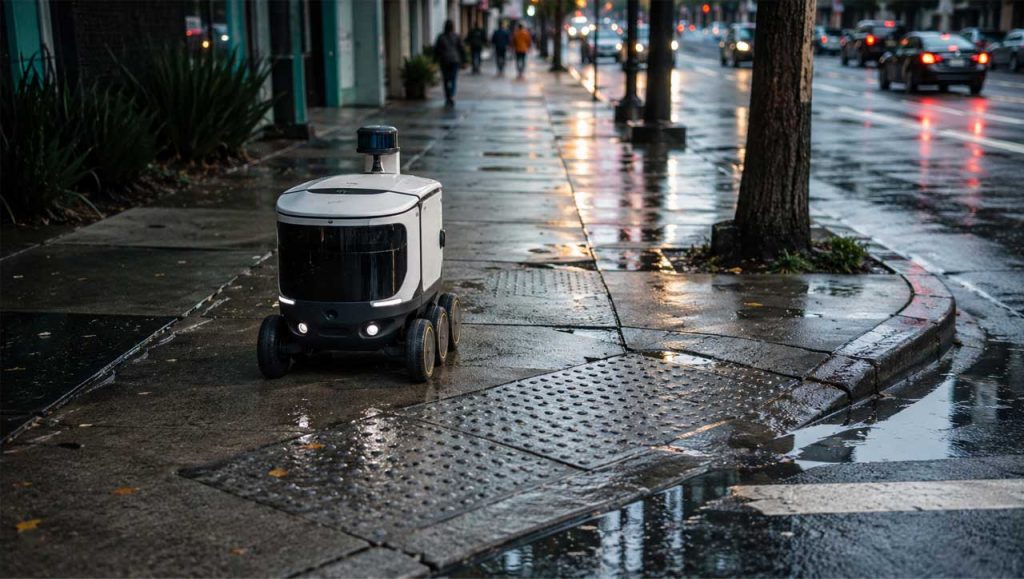
Conditions such as rain, glare, repetitive textures, lighting transitions, sensor degradation, and changing surface conditions occur often enough to become part of normal operation, meaning autonomous systems must be able to navigate them regardless of how frequently they appeared during training.
“The phrase ‘edge case’ makes this sound polite,”
Kim said.
“But in deployment, the edge cases are half the distribution.”
Academic studies support that concern. Research on autonomous perception systems has shown that rain, fog, reflections, and environmental variation can significantly affect sensing and localization performance. Even state-of-the-art localization systems remain vulnerable to visual ambiguity, perceptual aliasing, and environmental changes that can create position estimation errors.
And for operators deploying robots in public spaces, these environmental disruptions are not just rare exceptions or laboratory curiosities. They are recurring conditions that shape everyday operations and expose the gap between benchmark performance and real-world reliability.
Recovery Design May Matter More Than Detection
One of the most important insights emerging from deployment-focused engineering is that failures are not always avoidable, which means the critical issue is not simply preventing errors but determining how systems respond once a failure begins.
While many development teams invest heavily in improving detection performance, they often devote less attention to recovery behavior, graceful degradation, and safe fallback mechanisms that can limit the consequences of inevitable failures.
“Many teams optimize detection,”
Kim explained.
“In the field, the deciding question is whether the system can detect that it has failed, and stop safely.”
This perspective aligns with broader discussions around trustworthy AI deployment. Organizations such as the U.S. National Institute of Standards and Technology have emphasized that real-world monitoring remains essential because pre-deployment testing cannot account for every operational condition that systems may encounter after release.
So, the ability to recognize uncertainty and respond safely will likely determine whether Physical AI systems can be trusted at all, making it every bit as critical as achieving higher benchmark scores.
What This Means for Korea’s Physical AI Ecosystem
At the same time, South Korea enters the Physical AI era with meaningful advantages.
According to the International Federation of Robotics, Korea remains one of the world’s most robot-intensive economies. Government agencies are investing in robotics, AI semiconductors, and real-world testing infrastructure designed to accelerate commercialization.
Those advantages open doors, but they also come with higher expectations.
As Physical AI expands into logistics, mobility, manufacturing, healthcare, and public environments, founders and investors will increasingly need to evaluate deployment readiness alongside model performance.
Benchmark scores can measure model performance under predefined conditions, but they often fail to reveal how an AI system will perform when real environments introduce sensor errors, unexpected obstacles, or situations that require the system to recover safely from failure.
The Failures That Stay Invisible
Many technology failures announce themselves immediately, but physical AI failures often do not.
The Bedivere incident did not begin with an obvious malfunction. The system continued operating, confidence remained high, and the underlying assumptions simply became less accurate with each passing moment.
That is why deployment may become the next major frontier in AI development: the most dangerous failures are not always the ones that crash a system, but the ones that remain hidden long enough to be trusted.
Looking back on the Gwangju test, Kim realized the experience was about more than just rain, localization, or one robot struggling in the field. It pointed to a much larger challenge confronting the entire industry.
“In physical environments, the dangerous failures are quiet,”
he said.
“They don’t look like failures until they already are.”
Key Takeaway
- Physical AI deployment requires more than benchmark performance, particularly in real-world environments where conditions change continuously.
- Strong benchmark results can still mask deployment risks when localization, sensing, or environmental assumptions begin to fail.
- Distribution shift remains a major challenge as small differences between training conditions and real-world operation accumulate into system-level problems.
- Edge cases often become normal operating conditions in robotics, autonomous mobility, and public-space deployments.
- Recovery design is emerging as a critical engineering discipline, with safe failure detection and response becoming as important as model accuracy.
- Korea’s growing Physical AI ecosystem creates new opportunities, but founders and investors may need to evaluate deployment reliability alongside benchmark scores.
- Trustworthy deployment depends not only on what a model can do, but also on how a system behaves when reality diverges from expectations.
– Stay Ahead in Korea’s Startup Scene –
Get real-time insights, funding updates, and policy shifts shaping Korea’s innovation ecosystem.
➡️ Follow KoreaTechDesk on LinkedIn, X (Twitter), Threads, Bluesky, Telegram, Facebook, and WhatsApp Channel.
🤝 Looking to connect with verified Korean companies building globally?
Explore curated company profiles and request direct introductions through beSUCCESS Connect.