

International cooperation often begins with optimism. Government leaders meet, business forums fill conference halls, and organizations exchange agreements that signal future opportunity. But then, many cross-border initiatives quietly fade long before they reach customers, investors, or operating teams. As Korea and Brazil enter a new phase of economic and technology cooperation, a more difficult question is emerging: who is responsible for what happens after the signing ceremony ends?
Korea and Brazil Have Built a Larger Cooperation Framework
Korea and Brazil elevated bilateral relations to a Strategic Partnership during Brazilian President Luiz Inácio Lula da Silva’s state visit to Seoul in February 2026. The two governments adopted a 2026-2029 Action Plan and signed or exchanged ten agreements and memoranda covering areas including trade, industry, innovation, digital economy, health, agriculture, aerospace, and small business cooperation.
The economic relationship already rests on a substantial foundation. According to Brazil’s Ministry of Development, Industry, Trade and Services (MDIC), bilateral trade reached approximately USD 11 billion in 2025. South Korea remains one of Brazil’s most important Asian economic partners, while Brazil serves as South Korea’s largest trading partner in South America.
Business engagement has expanded alongside government cooperation. The Korea-Brazil Business Forum held in Seoul brought together hundreds of government officials and business leaders seeking opportunities in advanced manufacturing, strategic minerals, artificial intelligence, agribusiness, and other emerging sectors.
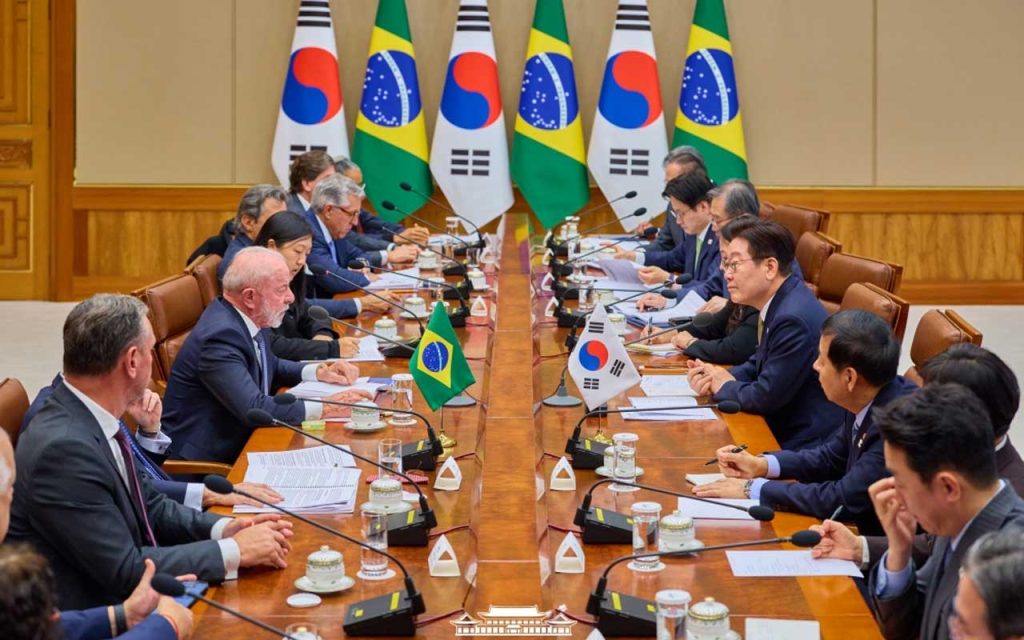
While this developing partnership provides visible momentum, the challenge now lies in turning that momentum into real projects that survive beyond announcements.
Why Agreements Alone Rarely Create Outcomes
Many discussions around international cooperation focus on what gets signed. Far less attention is paid to what happens afterward.
In a previous discussion with KoreaTechDesk examining why foreign technology companies often struggle to execute successfully in Brazil, Mario Laffitte argued that market entry challenges frequently emerge long before commercial scale is reached.
Laffitte brings a rare combination of experience spanning public policy, corporate affairs, industrial strategy, and Korean-Brazilian business relations. He previously served as Vice President for Latin America at Samsung Electronics and currently advises organizations on Brazil market entry while serving as Official Delegate of the Korean Valley Project for São Paulo and the Manaus Free Trade Zone.
As the discussion turned from market entry to bilateral cooperation, Laffitte pointed to a different challenge that often appears after agreements are signed.
“MOU-level agreements frequently fail to become operational because neither side structures accountability from the beginning,”
he told KoreaTechDesk.
The observation is particularly relevant as Korea and Brazil broaden cooperation across multiple industries simultaneously. Large frameworks can create opportunities, but they do not automatically create execution.
And Laffitte argues that many initiatives encounter a familiar pattern.
“Bilateral agreements are announced, photographs are taken, press releases are issued, and both sides return to their respective institutional rhythms without a named person responsible for what happens next.”
Hence, the problem is not a lack of goodwill. It is the absence of operational ownership.

The Gap Between Strategic Intent and Execution
Cross-border cooperation naturally involves complexity. Different regulatory environments, business cultures, procurement systems, and organizational priorities create friction even when both sides share common objectives.
Now, many cooperation frameworks assume institutional alignment is enough to keep projects moving. But according to Laffitte, that assumption often overlooks what happens after the initial agreement.
“The ceremony problem is well-documented. Bilateral agreements are announced, photographs are taken, press releases are issued, and both sides return to their respective institutional rhythms without a named person responsible for what happens next.”
Laffitte argues that momentum is frequently lost not because organizations disagree on objectives, but because no operational structure exists to carry the initiative forward.
As projects move into implementation, technology integration, stakeholder coordination, procurement procedures, regulatory requirements, and budgeting decisions begin to demand sustained attention from both sides.
“Three months later, neither side can identify who is following up or what the next concrete step is.”

What Real Korea-Brazil Cooperation Looks Like
Hence, Laffitte believes successful cooperation follows a more disciplined structure.
The first requirement is identifying named operational counterparts on both sides. These individuals must have enough authority and incentive to move the project forward when challenges emerge.
“Named operational counterparts on both sides. Not institutions, and not senior officials whose primary role is representational, but specific people with decision-making authority and a professional incentive to make the project advance.”
The second requirement is establishing a concrete pilot project.
“A defined pilot or proof-of-concept with a timeline, a budget, and measurable milestones in the first six to twelve months,” he explained.
This approach creates accountability that broad cooperation agreements often lack. When objectives, timelines, and responsibilities are clearly defined, progress becomes measurable rather than aspirational.

The third requirement involves planning for friction rather than assuming it can be avoided.
After all, differences in institutional processes, approval timelines, and operating expectations are inevitable in international partnerships. So, organizations that anticipate those differences will generally adapt faster than those that treat them as unexpected obstacles.
The Undervalued Role of Local Operators
Among all the factors influencing execution, Laffitte believes one remains consistently underestimated.
“A local execution layer,”
he said.
“Someone, or a team, physically present in Brazil, with institutional credibility on the Brazilian side and the confidence of the Korean principal, who owns the day-to-day relationship and can translate between the two institutional logics.”
This role often receives less attention than government announcements, investment commitments, or technology demonstrations. Yet in many cases, it becomes a significant difference between a project that advances and one that remains trapped in discussion.
It is crucial to note that cross-border partnerships rarely fail because both sides lack ambition. They more often struggle because no one is responsible for carrying that ambition through the operational stages that follow.
Therefore, Korean startups, tech companies, accelerators, and innovation agencies can learn something practical from this lesson. Access to cooperation programs, business forums, and official agreements may create opportunities. Converting those opportunities into deployments, customers, partnerships, or investments requires an additional layer of execution discipline.
The Real Test Begins After the Announcement
Finally, the growing cooperation between Korea and Brazil reflects genuine strategic interests on both sides. Governments, businesses, and ecosystem organizations increasingly recognize opportunities in technology, industrial modernization, digital transformation, advanced manufacturing, and innovation.
Yet history suggests that announcements alone rarely determine outcomes.
The more meaningful measure will be how many agreements evolve into pilots, how many pilots become operating projects, and how many operating projects generate lasting economic relationships.
That transition requires a different skill set than diplomacy. It requires ownership, accountability, local execution capacity, and sustained follow-through long after public attention moves elsewhere.

Key Takeaway
- Korea and Brazil expanded cooperation in 2026 through a Strategic Partnership, a 2026-2029 Action Plan, and multiple bilateral agreements.
- Formal agreements do not automatically create operational projects.
- Many cross-border initiatives lose momentum after signing ceremonies because accountability and ownership are not clearly assigned.
- Successful cooperation requires named operational counterparts, not only institutional support.
- Pilot projects with budgets, timelines, and measurable milestones create execution discipline that broad agreements often lack.
- Local execution teams play a critical role in bridging Korean and Brazilian institutional environments.
- The real measure of Korea-Brazil tech cooperation is implementation, not the number of agreements announced.
- For startups, investors, and ecosystem operators, execution capacity remains the most important factor in converting international cooperation into real business outcomes.
– Stay Ahead in Korea’s Startup Scene –
Get real-time insights, funding updates, and policy shifts shaping Korea’s innovation ecosystem.
➡️ Follow KoreaTechDesk on LinkedIn, X (Twitter), Threads, Bluesky, Telegram, Facebook, and WhatsApp Channel.
🤝 Looking to connect with verified Korean companies building globally?
Explore curated company profiles and request direct introductions through beSUCCESS Connect.