
Korean AI industry is racing to build larger models, faster inference systems, and sovereign AI infrastructure. Yet one of the hardest problems emerging inside Korean AI development may not involve raw computing power at all. It involves something much harder to standardize: determining when a sentence sounds socially appropriate inside a real human relationship.
Korea’s AI Ecosystem Is Moving Beyond Simple Language Generation
South Korea has been aggressively expanding its AI ambitions as competition around foundation models intensifies globally.
The Ministry of Science and ICT (MSIT) has been advancing large-scale AI initiatives, including sovereign AI development projects and national AI infrastructure expansion.
The Korean government has also continued supporting domestic AI ecosystem growth through projects involving companies such as Naver, SK Telecom, LG AI Research, and Upstage as Korea attempts to strengthen its own AI competitiveness.
At the same time, Korean AI capabilities themselves have improved rapidly. Naver states that HyperCLOVA X was specifically optimized for Korean-language processing through Korean-focused tokenization and multilingual training structures designed to improve Korean contextual understanding.
Yet as Korean-language AI becomes more fluent, another problem is becoming increasingly visible across startups and conversational AI systems: fluency alone does not necessarily produce socially appropriate communication.
That distinction matters because conversational AI is moving deeper into enterprise communication, multilingual collaboration tools, customer interaction systems, workplace copilots, and AI-powered productivity software.
The challenge is no longer simply generating correct Korean sentences. The challenge is determining whether the sentence actually fits the relationship.
Why Korean Communication Creates a Harder Product Problem
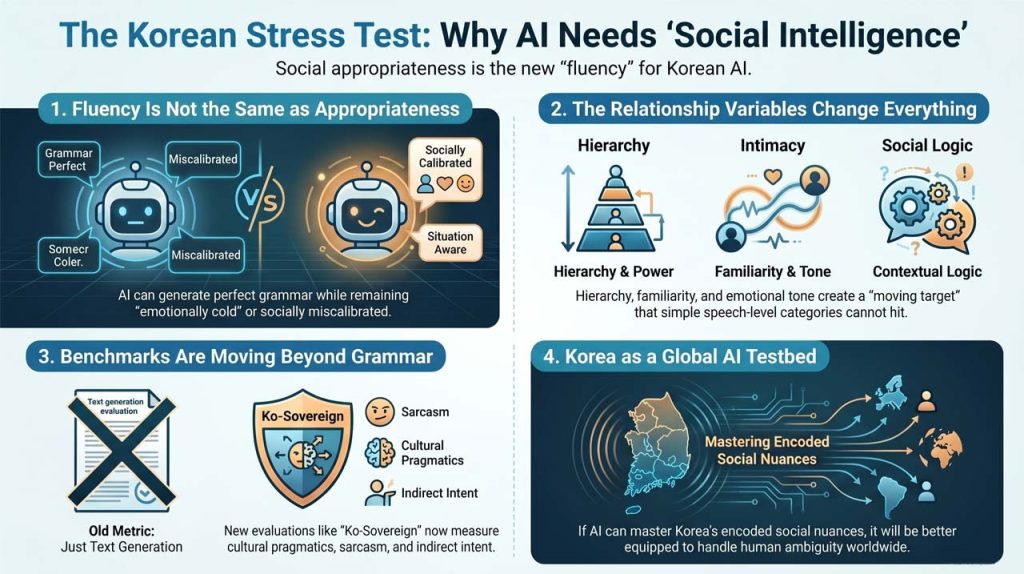
For many AI systems, output quality is measured through accuracy, coherence, or grammatical correctness. But Korean communication complicates those measurements because appropriateness often depends on hierarchy, emotional tone, familiarity, timing, and contextual expectation simultaneously.
Jinseong Kim, founder of AI communication platform Noonchi.ai, believes this is where many current AI systems still struggle.
Kim told KoreaTechDesk while discussing Noonchi.ai’s early product assumptions.
“Turns out real life doesn’t work like that.”
Kim explained that the company originally approached Korean communication through simplified speech-level categories such as formal, semi-formal, and casual. During product testing, however, the team discovered that Korean communication continuously shifts depending on relational context.
“We initially thought we could map Korean communication to a clean set of discrete levels,”
A conversation with a senior colleague known for years may require completely different calibration compared to speaking with someone holding the same hierarchical position for the first time.
“The closeness variable changes everything,”
Kim said.
This creates a product challenge that extends beyond translation itself. AI systems may generate technically correct Korean while still sounding emotionally cold, excessively distant, awkwardly formal, or socially miscalibrated.

Korean AI Evaluation Is Becoming Increasingly Context-Dependent
Researchers are increasingly recognizing this limitation actually.
A 2024 study introducing the Korean-focused “Ko-Sovereign” benchmark argued that evaluating Korean large language models requires more than measuring language fluency alone. The benchmark expanded into Korean-specific domains including law, politics, economics, and cultural context understanding.
Another Seoul National University benchmark, KoBALT-700, similarly introduced Korean linguistic evaluation categories involving pragmatics, semantics, syntax, and contextual interpretation rather than simple sentence generation alone.
These developments reflect a broader realization inside the Korean AI ecosystem: communication quality cannot always be measured through binary right-or-wrong outputs.
The problem becomes even more difficult when human reviewers themselves disagree.
“Being polite but cold. Being casual but deeply respectful. Being formal but warm,”
Kim explained.
“These combinations are what native speakers navigate instinctively.”
In many Korean communication environments, multiple responses may technically appear acceptable while still carrying different emotional implications.
Kim said native Korean reviewers evaluating Noonchi.ai outputs sometimes disagree about whether certain responses sound too formal, too distant, or too familiar within the same scenario.
“That ambiguity is actually the product.”

Korean Communication Is Forcing AI Systems to Handle Human Ambiguity
This ambiguity creates difficult challenges for AI product teams, especially those building systems involving workplace communication, AI assistants, customer interaction, or multilingual collaboration.
A recent Korean-language study examining indirect speech acts found that large language models still struggled significantly more with indirect communication than direct communication. The research evaluated models including GPT-4o, Claude, HyperCLOVA, and Llama variants across contextual Korean dialogue scenarios involving hierarchy, intimacy, and situational relationships.
The findings reinforced a growing concern inside conversational AI development: understanding grammar is not the same as understanding communicative intent.
Another Korean study examining impoliteness perception found that even grammatically correct honorific expressions could still feel socially inappropriate depending on the emotional attitude implied by the conversation itself.
For AI systems, this means relational context cannot be treated as an optional feature layered on top of language generation. It has increasingly become part of the core architecture.
As a result, startups building Korean conversational AI are beginning to move toward relational modeling systems involving contextual memory, relationship-aware prompts, dynamic role calibration, and multi-turn interaction tracking.
Kim believes simplifying Korean communication was ultimately the wrong design direction for Noonchi.ai.
“The goal isn’t removing complexity.
It’s making the complexity navigable.”
Korea May Become a Valuable Testbed for Relationship-Aware AI
Ironically, the same communication complexity that creates product difficulty may also make Korea an unusually valuable environment for developing advanced context-aware AI systems.
Unlike some languages where social nuance remains highly implicit, Korean communication contains structurally encoded hierarchy systems, honorific rules, and relationship-sensitive grammatical adjustments that provide clearer signals for AI modeling.
This combination creates a rare environment where social calibration is difficult enough to expose AI weaknesses while still structured enough to study systematically.
Researchers are already building Korean datasets specifically designed around contextual reasoning, sarcasm detection, indirect communication, and cultural interpretation. Projects such as KoCoSa, CLIcK, and KULTURE Bench reflect growing efforts to evaluate Korean AI systems through contextual understanding rather than language generation alone.
And for startups and investors, this may create an important long-term implication.
If AI systems can successfully handle Korean contextual communication, they may become better equipped to operate across other culturally nuanced communication environments globally.
The broader opportunity may therefore extend beyond Korea itself.

The Next AI Competition May Involve Social Intelligence, Not Just Model Size
Finally, South Korea’s AI ecosystem is entering a phase where scaling model performance alone may no longer guarantee product differentiation.
As conversational AI becomes integrated into real workplace systems and human collaboration environments, companies increasingly need products capable of handling ambiguity, relationship shifts, emotional calibration, and contextual appropriateness.
That challenge may become especially visible in Korea, where communication frequently operates through layered social expectations that resist rigid categorization.
Korea’s communication complexity is therefore creating something larger than a localization challenge. It is becoming a stress test for whether AI systems can move beyond language generation into socially adaptive interaction.
And for context-aware AI startups, that may become one of the most commercially important problems in the next stage of conversational AI development.
Key Takeaway
- South Korea’s AI ecosystem is rapidly expanding, supported by sovereign AI initiatives, Korean foundation models, and national AI infrastructure investment.
- Korean communication creates a difficult AI product problem because appropriateness depends on hierarchy, familiarity, emotional tone, and contextual expectations simultaneously.
- Korean communication cannot be reduced into fixed speech-level categories, since relational context continuously changes conversational calibration.
- Researchers are increasingly building Korean-specific AI benchmarks involving pragmatics, cultural context, indirect communication, and contextual interpretation rather than fluency alone.
- Native Korean reviewers may disagree on what sounds socially appropriate, creating measurement and evaluation challenges for conversational AI systems.
- Startups are increasingly exploring relationship-aware AI architectures, including contextual memory, relational modeling, and dynamic interaction calibration.
- Korea may become an important global testbed for context-aware AI, because its communication systems expose weaknesses in AI social reasoning more clearly than translation benchmarks alone.
– Stay Ahead in Korea’s Startup Scene –
Get real-time insights, funding updates, and policy shifts shaping Korea’s innovation ecosystem.
➡️ Follow KoreaTechDesk on LinkedIn, X (Twitter), Threads, Bluesky, Telegram, Facebook, and WhatsApp Channel.
🤝 Looking to connect with verified Korean companies building globally?
Explore curated company profiles and request direct introductions through beSUCCESS Connect.