
In Korea’s fast-rising AI sector, independence has become both a badge of pride and a battlefield of proof. The controversy surrounding Upstage AI and its foundation model is no longer a question of code, but of credibility—testing how far a nation aiming for sovereign AI can uphold transparency and trust in an era when innovation itself demands verification.
Korean AI Startup Upstage Faces Scrutiny Over Model Originality
A plagiarism controversy surrounding Upstage’s Solar Open 100B model has ignited debate within Korea’s artificial intelligence sector, testing both the nation’s sovereign AI strategy and its broader credibility in global tech. The Seoul-based startup publicly refuted allegations that it had copied China’s Zhipu AI GLM-4.5-Air model, emphasizing that its foundation model was trained from scratch and built on original data.
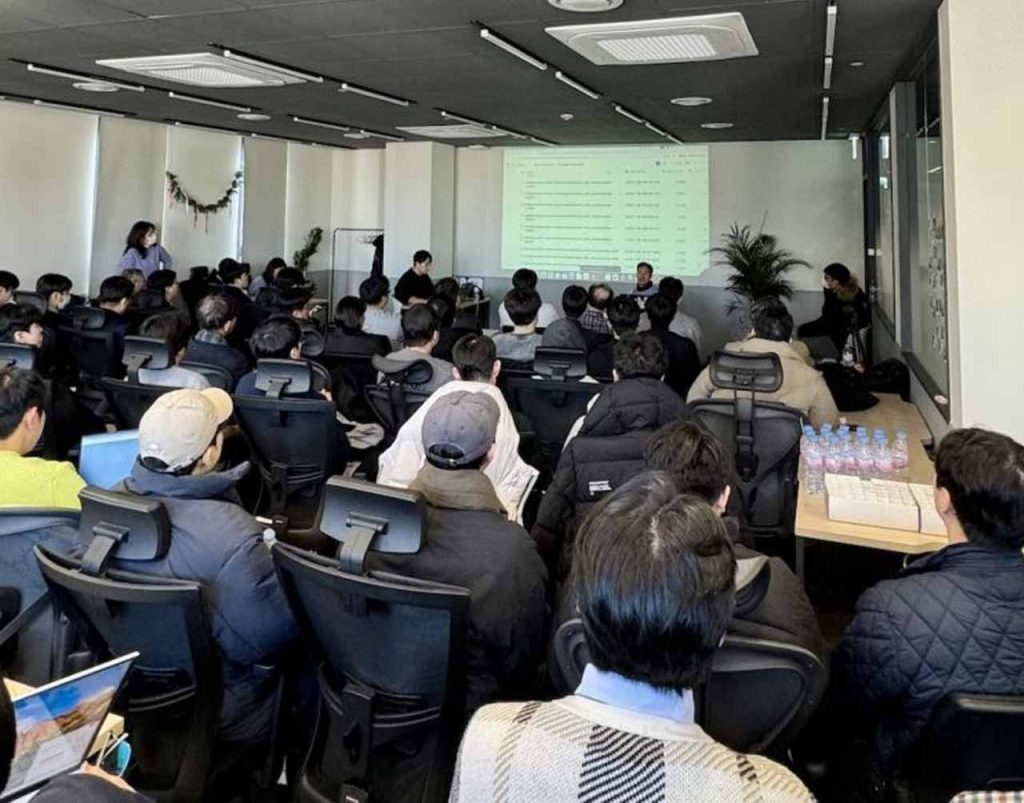
At a public verification session held on January 2 in Gangnam, Seoul, Upstage CEO Kim Sung-hoon revealed internal training logs, checkpoints, and experimental data, asserting that the company’s AI model had been developed independently.
The government-backed Sovereign AI Foundation Model Project, led by the Ministry of Science and ICT (MSIT), has since confirmed that Upstage’s submission will undergo an additional round of verification before final evaluation mid-January.
Allegations and the Growing Pressure for AI Transparency Against Upstage
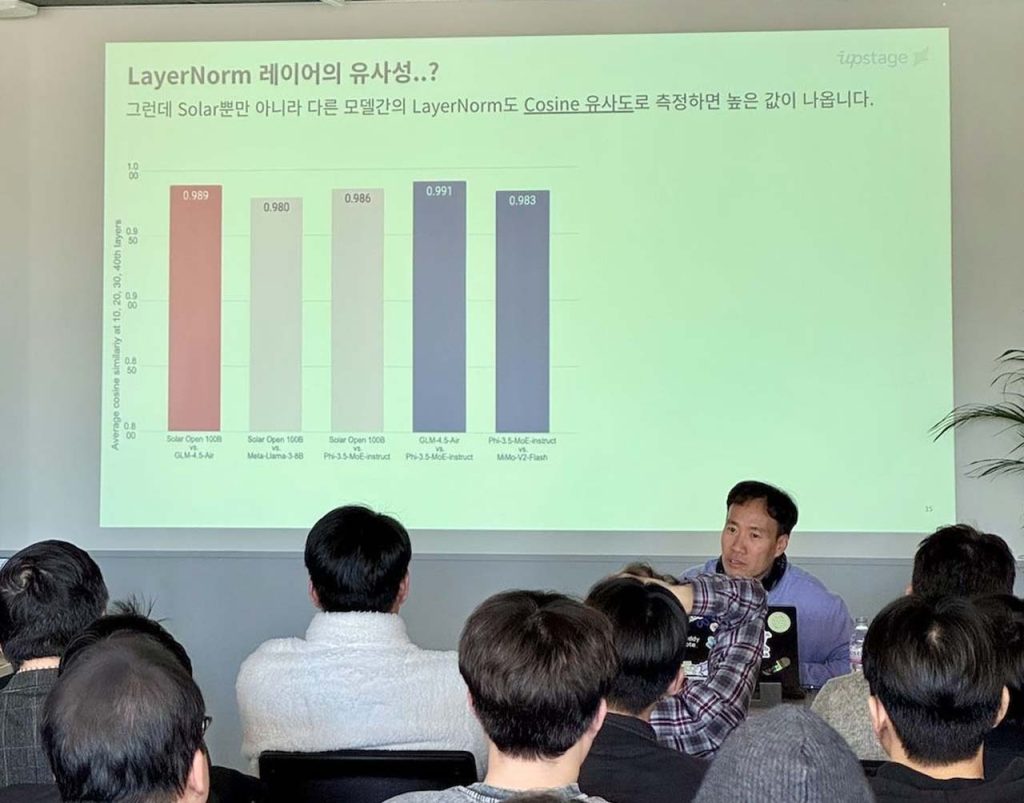
The dispute began when Ko Suk-hyun, CEO of Sionic AI, published an analysis on social media comparing Upstage’s Solar Open 100B with Zhipu AI’s GLM-4.5-Air. He claimed that LayerNorm parameters between the two models showed 96.8% cosine similarity, suggesting that Upstage might have fine-tuned the Chinese model rather than developing its own.
The accusation drew immediate attention because Solar Open 100B is part of Korea’s national “Sovereign AI” initiative, a program launched to build domestic foundation models capable of achieving at least 95% of global performance benchmarks. Five teams—including Upstage, Naver Cloud, SK Telecom, LG AI Research, and NC AI—were shortlisted to represent Korea’s frontier in independent model development.
The MSIT clarified that originality is judged by technical evidence such as random weight initialization and complete training traceability. If any pre-trained weights or distributions are reused, the model no longer qualifies as “from scratch.”
For Korea, the issue goes beyond one company’s reputation as it directly challenges the credibility of the nation’s sovereign AI policy. A policy that positions local companies as global counterparts to OpenAI, Anthropic, and Google DeepMind.
Upstage AI Data, Logs, and the “Parenting Diary” Defense
At the verification session, CEO Kim Sung-hoon stated that Solar Open 100B had been trained entirely through randomized initialization using GPUs allocated under the government program, saying:
“We started with blank parameters and trained the model over three months, recording every stage. This is the equivalent of a parenting diary—it proves we raised our own model.”
He presented training logs, checkpoints, and loss curves demonstrating a typical “from scratch” trajectory: high initial loss values gradually decreasing as performance improved, with MMLU scores rising steadily through training.
Kim rejected claims based on LayerNorm similarity, explaining that such parameters naturally show high correlation across large language models that share Transformer-based architectures. The CEO added,
“Comparing LayerNorm cosine similarity is like opening two English dictionaries and declaring one copied the other because they both contain the same alphabet.”
Upstage also conducted Pearson correlation coefficient analyses, proving no overlapping learning patterns between its model and Zhipu’s. The company further revealed that only 0.0004% of its parameters matched those in the Chinese model, emphasizing that 99.9996% of Solar Open was statistically unique.
What the Dispute Means for Korea’s Sovereign AI Ambition
This case has become a defining test of Korea’s AI governance maturity. The Sovereign AI Foundation Model Project—the government’s flagship effort to secure technological autonomy—relies on startups like Upstage to demonstrate that domestic innovation can rival global platforms without external dependency.
Experts say the outcome of this verification process will influence funding credibility, international collaboration, and public trust in Korea’s AI ecosystem.
The timing of this dispute carries even greater weight for Korea’s AI market. Upstage is currently preparing for what could become Korea’s first generative AI IPO, a milestone that would test investor confidence in homegrown deeptech. The company is also moving toward becoming the nation’s first public-sector generative AI provider, while reportedly exploring a potential acquisition of Daum, once part of Kakao’s core digital assets. These moves make the credibility of its technology not only a matter of ethics or compliance, but of market reputation and valuation. How the controversy unfolds may directly shape both the company’s public image and Korea’s emerging AI capital markets.
Professor Lim Sung-bin of Korea University’s Department of Statistics noted that cosine similarity alone cannot determine plagiarism, emphasizing the need for “variance-based and distribution-level verification.”
Industry reactions were mixed but generally supportive. One startup executive described the controversy as a “stress test for Korea’s AI transparency,” adding that Upstage’s open demonstration “raised the bar for accountability in government-backed R&D.”
The debate also highlights the structural challenge in defining “sovereignty” in AI. Most modern LLMs share Transformer-based architectures and open-source components to maintain interoperability.
As Kim pointed out, global AI systems are already built on standardized frameworks, making architectural resemblance an inevitable outcome of open innovation.
Transparency as Korea’s New Competitive Edge
The Upstage controversy eventually signals a pivotal moment for how Korea defines independence and integrity in AI innovation. The government’s decision on whether Solar Open 100B qualifies as an authentic from-scratch model will set a precedent for all future sovereign AI initiatives.
Regardless of the verdict, the episode underscores one truth: transparency, not isolation, is the new foundation of technological sovereignty. For Korea’s AI ecosystem—now striving to become a global force—the balance between open collaboration and independent capability will determine how credible its innovation truly stands on the world stage.
– Stay Ahead in Korea’s Startup Scene –
Get real-time insights, funding updates, and policy shifts shaping Korea’s innovation ecosystem.
➡️ Follow KoreaTechDesk on LinkedIn, X (Twitter), Threads, Bluesky, Telegram, Facebook, and WhatsApp Channel.
🤝 Looking to connect with verified Korean companies building globally?
Explore curated company profiles and request direct introductions through beSUCCESS Connect.