
Foreign companies entering South Korea often face an early decision that appears straightforward: how to establish a legal presence. Many choose the fastest or simplest option to begin operations quickly. Yet for a growing number of firms, this initial decision becomes a constraint later, shaping what they can do, how they scale, and how much control they retain.
The First Decision Is Not Administrative. It Is Strategic
Market entry into South Korea is often discussed in terms of timing, approvals, and execution. However, before those factors come into play, companies must choose how they will exist legally within the market.
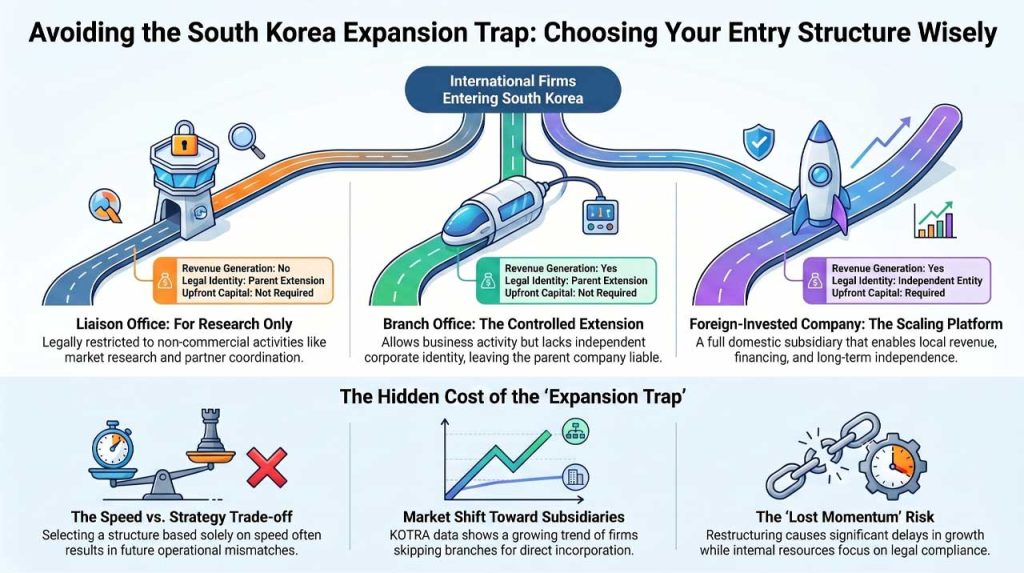
There are three primary forms of entry according to the official frameworks:
- a foreign-invested company established as a local corporation,
- a branch office of a foreign entity, and
- a liaison office.
And these are not interchangeable formats. They operate under different legal regimes and define the scope of business activity, ownership structure, and liability exposure.
According to official guidance from investment authorities, a foreign-invested company is treated as a domestic corporation under Korean law, while both branch offices and liaison offices remain extensions of the foreign parent entity. This distinction determines how companies operate in practice, not just how they register.
Now, for global firms accustomed to standardized expansion models, this structural divergence often goes unnoticed at the early stage.
Why Faster Entry Structures Appear Attractive
Most of the time, companies prioritize speed and flexibility when entering a new market. Branch offices and liaison offices offer an appealing entry point because they do not always require the same level of upfront commitment as a fully incorporated local subsidiary.
External market-entry guides estimate that a liaison office or branch can often be established in a shorter timeframe than a foreign-invested corporation. This may ignite widespread perception for companies, assuming that these structures are more efficient for initial market testing.
Chris Song, Founder and Managing Partner at Hyesung Accounting & Advisory Corporation, observed this pattern in his work with international clients.
“Foreign companies often prefer to enter Korea through branch offices or liaison offices, as these structures do not require an initial capital contribution.”
At this stage, the decision may appear rational. Companies reduce upfront risk, maintain flexibility, and avoid committing to a full local entity before validating the market.
But then the issue emerges later.
When “Lightweight” Structures Restrict Real Business Activity
The limitations of entry structures become visible at the stage when companies begin to operate beyond initial market exploration.
A liaison office, for example, is legally restricted to non-commercial activities. It may conduct market research, coordinate with partners, or support marketing efforts, but it cannot engage in revenue-generating operations. This restriction is clearly defined in official investment guidelines and reinforced in international trade documentation.
Song explained the practical consequence of this limitation:
“Liaison offices are legally restricted from engaging in revenue-generating activities. As soon as commercial operations begin, this structure becomes impractical.”
For companies expecting to transition quickly from research to sales, this creates an immediate structural mismatch.
Branch offices, while able to conduct business activities, present a different challenge. They remain legally tied to the parent company, with no separate corporate identity in Korea. Liability is not ring-fenced locally, and governance decisions often remain centralized at headquarters.
Yes, this structure may function effectively in early operations. However, as transaction volumes increase or local partnerships deepen, the lack of independence could then become a constraint.

The Scaling Problem: Structures That Stop Working
The critical issue is not that these entry structures are flawed. It is that they are often selected without considering how the business will evolve after entry.
Song highlighted this pattern clearly:
“Structures that initially appeared efficient often become less suitable in practice.”
As companies expand their activities in Korea, they start facing requirements that their initial setup was not designed to handle. These may include the need to generate local revenue, secure financing, manage local liabilities, or bring in external investors.
At this stage, the original structure often reaches its limit, and companies are pushed into restructuring. Even when it was not in their original plan.
This transition is not seamless. It involves legal, operational, and strategic adjustments that can disrupt ongoing activities.

Korea Is Already Adjusting to This Pattern
This structural issue is not only observed by advisors. It is reflected in how Korea’s own investment ecosystem is evolving.
KOTRA’s investment promotion materials indicate that, in the past, foreign companies often entered through branch offices before establishing local subsidiaries at a later stage. More recently, it has become common to skip the branch stage and directly establish a local corporation
This change reflects a growing recognition that early-stage flexibility may not translate into long-term efficiency.
External guidance also aligns with this view. Trade and investment advisory from U.S. International Trade Administration suggest that companies expecting to scale operations in Korea may need to consider establishing a local subsidiary earlier, rather than treating it as a later-stage adjustment.
Hence, the entry structure shapes not just the starting point, but also how long the business can operate before changes become necessary.
The Real Risk Is Not Cost. It Is Lost Momentum
Restructuring is often discussed in terms of legal complexity or financial implications. However, the more significant impact is in the operational.
When companies need to revisit their entry structure, they must pause or redirect internal resources. Existing agreements may need to be adjusted. Regulatory approvals may need to be revisited. Internal alignment between headquarters and the local team must be rebuilt.
Song emphasized this broader impact:
“Many initial entry structures are chosen based on speed and convenience. As the business grows, companies often find themselves needing to revisit and restructure their setup.”
This process does not always result in visible failure. Instead, it slows momentum. Growth continues, but at a reduced pace, often without a clear diagnosis of the underlying cause.
Rethinking Market Entry as a Platform Decision
Now, it doesn’t necessarily mean that there’s only one universally correct structure. After all, each model serves a purpose.
That is why the key is in the alignment.
- Liaison Office: observation and relationship-building.
- Branch: early-stage operations under centralized control.
- Foreign-invested company: more independent platform for scaling, governance, and long-term market presence.
The challenge will only arise when the chosen structure does not match the company’s actual trajectory.
South Korea’s market entry framework is not inherently restrictive. It is simply more structured. Each pathway comes with defined capabilities and limitations.
So, understanding these differences early is what separates a smooth expansion from one that requires reconstruction.
Why Entry Structure Now Defines Expansion Outcomes
As Korea continues to attract global companies across technology, manufacturing, and services, the conversation around market entry is shifting.
The question is no longer only how quickly a company can enter the market. It is whether the chosen structure can support what comes next.
For companies that treat entry structure as a strategic decision aligned with their long-term plans, Korea offers a stable and predictable environment for growth.
But for those that treat it as a temporary shortcut, the same structure can become a constraint that must eventually be undone.
Key Takeaway
- Entry structure determines operational capability in Korea, including revenue generation, governance, and liability scope
- Liaison offices cannot conduct commercial activities, making them unsuitable for companies planning near-term operations
- Branch offices allow business activity but remain tied to headquarters, limiting local independence and scalability
- Foreign-invested companies provide a full local platform, but require earlier commitment and planning
- Many companies choose structures based on speed and flexibility, then face restructuring as operations expand
- Korea’s ecosystem is already shifting toward direct subsidiary establishment, reflecting lessons learned from past entry patterns
- The real risk is not setup complexity, but lost momentum when structures no longer fit business needs
– Stay Ahead in Korea’s Startup Scene –
Get real-time insights, funding updates, and policy shifts shaping Korea’s innovation ecosystem.
➡️ Follow KoreaTechDesk on LinkedIn, X (Twitter), Threads, Bluesky, Telegram, Facebook, and WhatsApp Channel.
🤝 Looking to connect with verified Korean companies building globally?
Explore curated company profiles and request direct introductions through beSUCCESS Connect.