
Foreign founders and investors entering South Korea often see steady progress as a sign that decisions are nearing completion. In practice, that assumption can break down. Across industries, a quieter gap persists between visible momentum and actual commitment, shaped by how decisions are structured and approved. Understanding this gap is becoming critical for anyone navigating Korea’s startup and investment landscape.
Business in Korea Starts Strong: the Friction Appears Later
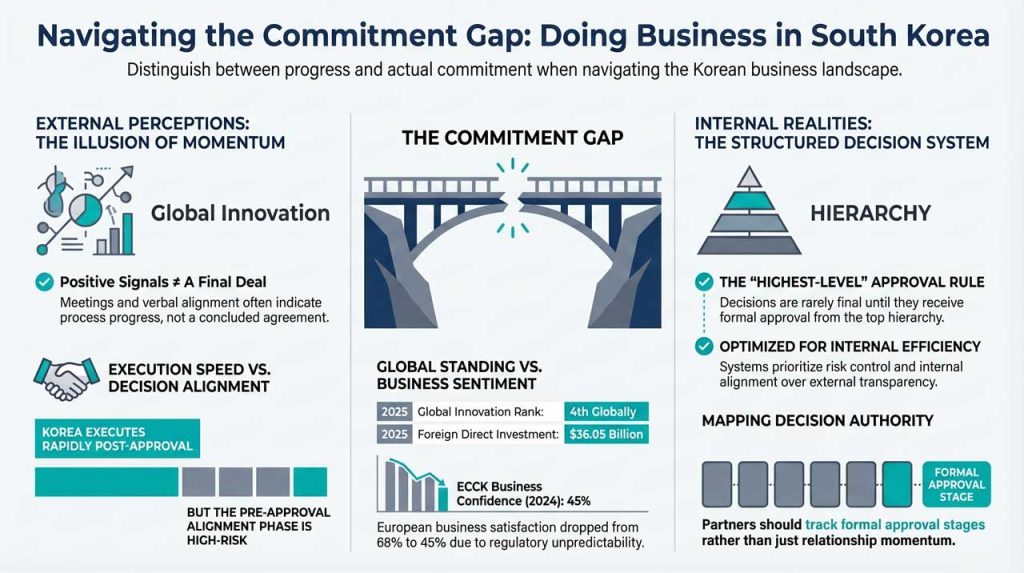
South Korea continues to position itself as one of the world’s most advanced innovation economies. It ranked 4th globally in the 2025 Global Innovation Index, reflecting strong performance in R&D, patents, and industrial capability.
At the same time, the country remains open to global capital. Foreign direct investment reached a record USD 36.05 billion in 2025, according to government data, signaling sustained international interest in entering and expanding within the Korean market.
Digital infrastructure and public systems are also widely recognized as advanced. OECD assessments highlight Korea’s progress in digital government and integrated services.
Yet once global companies move beyond entry and begin operating within the system, a different pattern begins to emerge.
The issue does not lie in access or capability. Instead, it is how decisions are formed, interpreted, and confirmed.
When Progress Is Misread as Commitment
In cross-border business, signals matter. Meetings, follow-ups, and positive feedback are often interpreted as indicators of progress toward a deal.
In Korea, those signals can carry a different meaning.
Valerie Won Lee, an award-winning Global Impact Strategist and former Head of Communications for the UN Global Platform on Big Data, points to a recurring pattern observed in her work.
In an interview with KoreaTechDesk, she stated:
“A series of positive signals, meetings progressing, no objections raised, enthusiasm expressed, are interpreted by the external party as evidence that a decision has effectively been made.
In practice, however, multiple green lights at even senior-management level do not always mean the deal is concluded.”

In many Korean organizations, particularly large corporations and public institutions, decisions are not final until they receive formal approval at the highest level.
And so, it creates a structural gap.
Because when external partners see momentum, internal team may see it simply as process.
Not Miscommunication, Just Different System
This gap is often framed as miscommunication. But in practice, it reflects deeper differences in how decisions are structured.
Won Lee explains that the issue is not a lack of information, but a lack of shared interpretation.
“We don’t lack information, but shared understanding.”
The same set of facts can be read through different priorities. One side may focus on speed and opportunity. The other may prioritize hierarchy, risk control, and alignment before final approval.
And this difference shapes how meetings are understood: who speaks, when input matters, and whether discussion is meant to influence or simply inform a decision can vary significantly.
As a result, two sides can leave the same conversation with different assumptions about what has been decided and what remains open.
Foreign Firms Are Still Navigating the Same Friction
This pattern is not limited to isolated cases. Institutional data suggests that foreign companies continue to face challenges in interpreting how decisions move through the system.
The European Chamber of Commerce in Korea reported in its 2024–2025 Business Confidence Survey that satisfaction among European companies declined from 68% in 2022 to 45% in 2024. Regulatory and legislative issues, including inconsistent enforcement, were identified as the most pressing concerns.
Similarly, the American Chamber of Commerce in Korea’s 2025 Business Environment Insights report highlights ongoing issues around predictability. It notes inconsistencies between written regulations and administrative guidance, as well as practices that are not always fully reflected in formal rules.
These issues do not point to a lack of rules. They point to difficulty in reading how those rules are applied in practice.
Korea’s own policy response reflects this reality. The Foreign Investment Ombudsman system, operated under KOTRA, exists specifically to handle grievances from foreign-invested companies, coordinate with government agencies, and provide translated regulatory guidance.
The presence of this system signals that navigating the decision and regulatory environment remains complex enough that it requires structured support.
Execution Is Fast. Alignment Is the Real Risk
One of Korea’s defining strengths is execution speed once decisions are finalized. Companies and institutions are known for disciplined coordination and rapid implementation after internal alignment is achieved.
The challenge lies in what happens before that point.
Won Lee emphasizes that breakdowns in execution often originate earlier in the process.
“Execution does not usually create the gap. It exposes it.”
Early-stage agreement can appear strong because stakeholders align around vision and opportunity. However, underlying assumptions about ownership, timelines, risk tolerance, and decision authority may remain unaligned.
In cross-border contexts, this gap becomes more pronounced. Each side operates within different institutional norms, which shape expectations of how quickly a decision should move and what signals indicate commitment.
By the time execution diverges, the misalignment is already embedded.
Internal Efficiency Meets External Readability
Korea’s systems are highly optimized for internal efficiency. Decision-making structures are designed to ensure accountability, control risk, and align multiple stakeholders before final approval.
This structure creates both strength once commitment is reached and opacity during earlier stages.
Now for external partners, the challenge is not access to meetings or stakeholders. It is on understanding where authority actually sits and when a process has crossed the threshold into a final decision. All these will be valuable to prevent perception gap.
Because while Korea can appear highly reliable in execution, it is difficult to read in how decisions are formed and signaled.
What Global Founders and Investors Need to Understand
This perception gap further carries direct implications across the startup ecosystem.
Founders entering Korea need to treat early engagement with caution. Positive meetings and continued discussions do not confirm a decision. What matters is understanding how decisions move internally and where final authority sits.
Investors face a similar challenge. Extended timelines often reflect internal approval structures rather than hesitation or deal risk. Late-stage delays can be part of the process, not a signal of breakdown.
For Korean startups expanding globally, the challenge moves in the opposite direction. Because the ability to translate internal decision signals into clear external communication will become a competitive advantage.
The Next Layer of Korea’s Global Positioning
Korea has already established its position in infrastructure, capital, and execution capability. Policy discussions and ongoing regulatory improvements suggest increasing awareness of the need to improve predictability and accessibility for foreign stakeholders.
The next layer of competitiveness may not come from building new systems, but from making existing systems easier to understand from the outside.
This includes clearer signaling of decision stages, more transparent communication of approval processes, and stronger alignment between internal logic and external expectations.
Clarity, Not Capability, Defines the Next Phase
Korea’s systems are not failing. They are functioning as designed. The challenge is that they are designed primarily for internal alignment rather than external readability.
And so, for global partners, success in Korea depends not only on understanding the market, but on learning how to interpret the signals behind its decision-making process.
Progress, in this context, is not a guarantee of commitment. It is part of a system that requires a different way of reading.
Key Takeaway for Global Founders, Investors, and Operators
- Korea ranks among the world’s top innovation economies, with strong execution capability once decisions are finalized
- Foreign firms continue to report challenges around regulatory predictability and interpreting decision processes (ECCK, AMCHAM)
- Positive signals such as meetings and verbal alignment do not necessarily indicate final commitment in Korean organizations
- Decisions often require formal approval at the highest level, even after multiple internal alignments
- Execution gaps typically originate from earlier misalignment in expectations, not from failure at implementation stage
- Korea’s systems are optimized for internal efficiency, but can be difficult for external stakeholders to read
- Global partners should focus on mapping decision authority and approval structures, not just relationship-building or momentum signals
🤝 Looking to connect with verified Korean companies building globally?
Explore curated company profiles and request direct introductions through beSUCCESS Connect.
– Stay Ahead in Korea’s Startup Scene –
Get real-time insights, funding updates, and policy shifts shaping Korea’s innovation ecosystem.
➡️ Follow KoreaTechDesk on LinkedIn, X (Twitter), Threads, Bluesky, Telegram, Facebook, and WhatsApp Channel.