
South Korea has spent years building one of the most advanced digital infrastructures in the world. Payments are widely digitized, public services are online, and mobility systems are tightly integrated. It is undeniable that Korea’s digital strength is real.
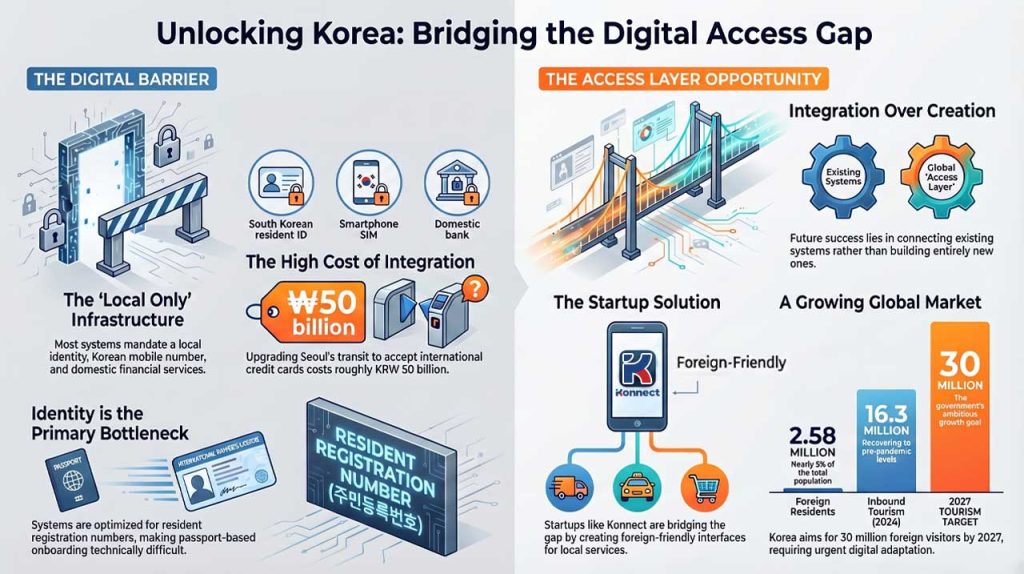
At the same time, the country is actively positioning itself as a global destination. The government is targeting 30 million foreign visitors by 2027, while inbound tourism already reached around 16.3 million in 2024, close to pre-pandemic levels. The foreign resident population has also grown to 2.58 million, nearly 5% of the total population.
Yet a different reality emerges once foreign users try to operate inside these systems: while the infrastructure is there, the access is still extremely limited.
Korea’s Digital Strength Is Real, but Designed for Local Assumptions
Korea’s digital systems are not fragmented in the traditional sense. They are highly functional within their intended design.
But the issue lies in the design assumption itself.
Most of Korea’s systems are built around three core conditions: a local identity, a Korean mobile number, and access to domestic financial services. And these are not optional layers as they are highly embedded into how services are verified, connected, and delivered.
So naturally, it creates a structural gap in the implementation.
Even basic tasks such as opening a bank account or accessing services can become difficult for foreign users due to language barriers and system requirements. Seoul Metropolitan Government has even acknowledged these issues, noting that foreign residents face challenges in areas such as banking, mobile services, and healthcare access.
The result is not a failure of infrastructure. It is a mismatch between system design and user diversity.
Identity Becomes the First Barrier, Not the Last
For startups attempting to build on top of these systems, the friction appears immediately.
Ravi Shankar Pandit, Founder and CEO Konnect and the Grand Prize Winner of 2025 K-Startup Grand Challenge, described this from a real, on-the-ground perspective. His platform is designed to help foreign users access Korean services through an integrated interface.
In an interview with KoreaTechDesk, he described:
“The gap became very clear to me at the earliest stage.
The infrastructure exists, but it is not built with foreign users in mind.”
The most critical bottleneck sits at the identity layer. Pandit explained,
“A clear example is passport-based onboarding. Questions arise immediately. Will this system actually work? How do you verify authenticity? How do you handle fraud risks?”

Beyond what seem to be technical issues, these concerns actually reflect a broader subject of trust and standardization.
While Korean regulations allow multiple forms of identification, including passports and alien registration cards in certain contexts, operational systems remain heavily optimized for domestic identity verification flows. This includes reliance on resident registration numbers, telecom-linked authentication, and local financial data.
Without alignment at this layer, access to downstream services becomes difficult.
Payments and Mobility Show the Same Pattern
The same structural limitation appears in payments and transportation.
Seoul’s own policy response highlights the gap. Despite high digital adoption, foreign users have historically needed to rely on prepaid transit cards, often purchased and reloaded with cash.
To address this, Seoul announced a shift toward open-loop payment systems, allowing international credit cards to be used directly on public transport. However, this transition is not trivial. It requires coordination across multiple stakeholders, including transport operators, financial institutions, and government bodies.
That is why the estimated cost of upgrading existing systems in the Seoul metropolitan area alone is at least KRW 50 billion.
Hence, the signal is now clear that the challenge is beyond just enabling a single payment method. It is aligning multiple systems that were not originally designed to interoperate with global users.
Execution Breaks Inside the System, Not Outside It
Beyond these technical issues, the real gap lies in the operational reality. That is because startups attempting to bridge these systems often rely on partnerships with large corporations or public-sector entities. And the process within this stage is where progress begins to stall.
As Pandit noted,
“Moving from discussion to execution requires internal alignment. Budget approval, risk evaluation, and resource allocation all take time.”
This challenge reflects a broader pattern in Korea’s corporate environment.
Decisions tend to be relationship-driven and risk-conscious. Pilot projects often require dedicated budgets, which are not always pre-allocated. Even when interest exists, execution depends on internal consensus across multiple departments.
While it may seem trivial, it becomes crucial for startups due to the delay between opportunity and deployment.
The infrastructure is ready. But the execution pipeline? It’s not always aligned.
Korea’s Startup Programs Open Doors, But What’s Next?
Meanwhile, programs such as the K-Startup Grand Challenge (KSGC) play a crucial role in bringing global founders into Korea’s ecosystem. Pandit acknowledged this impact as the company won the 2025 KSGC Grand Prize,
“Being part of KSGC and winning it significantly increased our visibility. It opened doors to conversations that would have been difficult to access otherwise.”

Still, the next phase remains less structured. As Pandit described,
“Translating visibility into real business traction requires sustained follow-through. Integration discussions, internal alignment, and long-term trust-building extend well beyond the program duration.”
This reflects a broader ecosystem dynamic.
Korea’s startup programs are effective at attracting and exposing companies. But the real challenge now lies in supporting them through integration, deployment, and long-term scaling within the local system.
A Structural Market Gap
So, why is this challenge growing into a bigger issue? At first glance, the foreign user segment may appear secondary. But in practice, it is becoming increasingly central.
Korea is not only attracting tourists. It is hosting a growing base of international students, workers, and long-term residents. The demand for seamless access across services is expanding accordingly.
Yet many systems still treat foreign users as edge cases.
That is why it creates a persistent gap. Not because the technology is missing, but because coordination, incentives, and system design have not fully adapted to a global user base.
The Real Opportunity: Building the Access Layer
Now this gap is where a new category of startups is emerging.
Rather than building new systems, these companies focus on connecting the existing ones. The goal is to create an access layer that bridges identity, payments, and services for non-local users.
Pandit described this approach clearly.
“We are not trying to create new systems. We want to integrate existing ones and make them accessible.”
And this model actually has broader relevance, not just in South Korea.
Many advanced economies face similar challenges. Systems are optimized for local users, while foreign access remains fragmented. The opportunity lies in making these systems interoperable across borders.
In Korea, this opportunity is particularly visible because the underlying infrastructure is already strong.
What Needs to Change for the Next Phase
The gap Korea is facing is not about missing systems. It is about how those systems adapt to a broader user base.
At the identity level, the challenge is consistency. While multiple forms of identification are legally recognized, real-world implementation still depends heavily on local verification flows. For foreign users, this creates uncertainty at the very first step, which then affects access to payments, mobility, and other services.
Payments reflect a similar transition phase. Seoul’s move toward open-loop transit systems shows that change is already underway, but also highlights how deeply existing infrastructure is tied to domestic standards. Expanding access requires coordination across financial institutions, transport operators, and regulators, not just a technical upgrade.
On the corporate side, execution remains a key constraint. As Pandit noted, even when interest exists, progress depends on internal alignment, budget approval, and risk assessment. Without clear pathways for pilot projects, many initiatives remain at the discussion stage longer than expected.
Startup programs have begun addressing early-stage access and visibility. The next step is continuity. Supporting companies beyond initial introductions, especially through integration and deployment phases, will be critical if Korea aims to convert global interest into long-term participation.
These shifts are already being explored in policy discussions and pilot initiatives. The direction is clear. The remaining challenge is how quickly and consistently these changes can be implemented across the system.
From Infrastructure Strength to Real Global Usability
South Korea has already solved the hard part. Its digital infrastructure works, and it works at scale.
The question now is usability.
As the country pushes toward 30 million foreign visitors and a growing international resident base, the gap between system strength and user access becomes harder to ignore. The issue is no longer confined to convenience. It directly affects how people move, pay, work, and participate in the economy.
For startups, this creates a distinct opportunity. Not in building new platforms, but in making existing ones accessible across identity, payment, and service layers.
It also raises different challenge for corporates and policymakers. Systems that were designed for efficiency within a domestic context now need to operate in a more diverse, global environment. That requires coordination, standardization, and in some cases, a shift in how risk and verification are handled.
The direction Korea takes from here matters beyond its own market.
If access improves, Korea can evolve from a digitally advanced country into a system that global users can navigate seamlessly. If not, the gap between infrastructure and usability will remain, limiting how fully the ecosystem can engage with international users.
Key Takeaway
- South Korea’s digital infrastructure is highly advanced, but largely designed around local identity, telecom, and financial systems
- Foreign users face consistent access barriers across identity verification, payments, and service integration
- Seoul and national policies acknowledge these gaps, particularly in transport payments and multilingual access
- Identity verification remains a key bottleneck due to trust, compliance, and lack of standardized global workflows
- Startup execution is often slowed by internal corporate alignment, budget constraints, and risk management processes
- Programs like K-Startup Grand Challenge provide visibility, but post-program execution support remains limited
- The emerging opportunity lies in building an “access layer” that connects existing systems rather than replacing them
- This model is not unique to Korea and reflects a broader global gap in serving non-local users within advanced digital systems
– Stay Ahead in Korea’s Startup Scene –
Get real-time insights, funding updates, and policy shifts shaping Korea’s innovation ecosystem.
➡️ Follow KoreaTechDesk on LinkedIn, X (Twitter), Threads, Bluesky, Telegram, Facebook, and WhatsApp Channel.
🤝 Looking to connect with verified Korean companies building globally?
Explore curated company profiles and request direct introductions through beSUCCESS Connect.