

Brazil has become increasingly difficult for Korean startups to ignore. The country combines continental-scale market size, growing digital infrastructure demand, expanding GovTech activity, and one of the world’s largest agricultural economies. Yet many foreign companies entering Brazil still discover the same problem after arrival: technical capability alone rarely guarantees operational success.
For Korean startups exploring Latin America, the harder challenge is often not just the technology deployment itself, but learning how to navigate fragmented institutions, regulatory complexity, localization requirements, and relationship-driven market structures that shape business decisions across the region.
Korea-Brazil Cooperation Is Expanding Beyond Large Conglomerates
South Korea and Brazil have recently accelerated bilateral cooperation across technology, industry, and innovation.
During Brazilian President Luiz Inácio Lula da Silva’s state visit to Seoul earlier this year—the first Brazilian presidential state visit to South Korea in 21 years—both governments elevated bilateral ties to a strategic partnership and adopted the Korea-Brazil 2026-2029 action plan

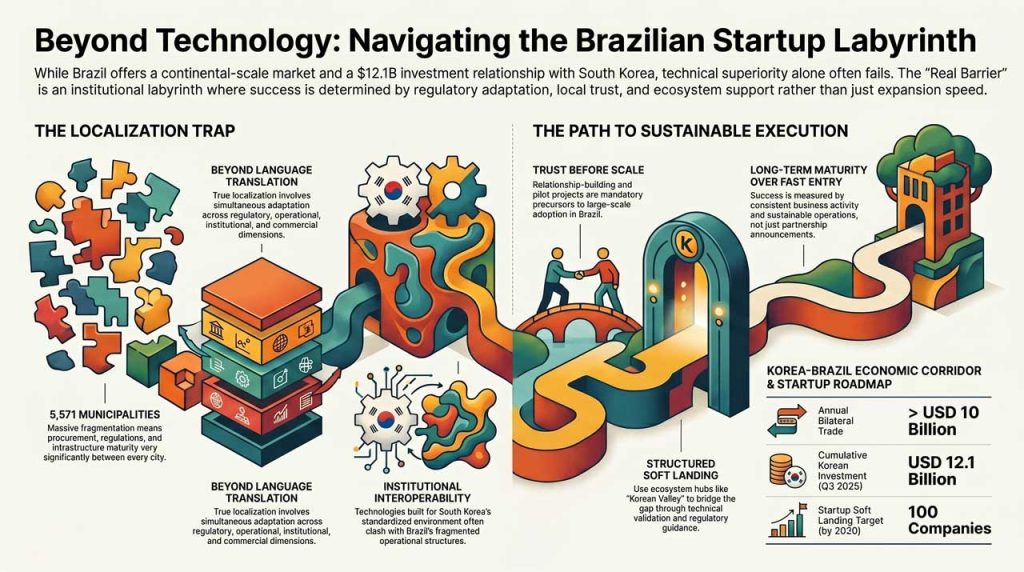
According to the South Korean presidential office, Korea-Brazil bilateral trade has exceeded USD 10 billion annually for the past five years, while cooperation discussions have expanded into artificial intelligence, digital economy, startups, agriculture, bio-pharma, and industrial collaboration.
Korea’s Ministry of Foreign Affairs also reported that cumulative Korean investment in Brazil reached approximately USD 12.1 billion as of the third quarter of 2025.
This broader political momentum is increasingly creating opportunities for Korean startups and emerging technology companies to evaluate Brazil not only as an export destination, but as a long-term operational market connected to the wider Latin American region.
But at the same time, it seems that entering Brazil remains considerably more complicated than many first-time market entrants expect.
The Real Barrier Is Not Language. It Is Institutional Adaptation
Dr. Aleksandro Montanha, GDIN Ambassador in Brazil and project lead for Korean Valley, believes many foreign companies misunderstand the nature of the challenge itself.
“The main challenge is not underestimating the Brazilian market, but rather overestimating the ability to conquer it independently,”
Montanha told KoreaTechDesk in an exclusive interview.
Montanha has spent years working across Brazilian public-sector innovation, smart-city initiatives, international cooperation projects, and AI ecosystems. He currently participates in sustainability and governance initiatives connected to the Commission on Sustainability Data at Kellogg College, University of Oxford, while also helping coordinate Korea-Brazil innovation initiatives through Korean Valley.

According to him, many companies still approach Brazil through fragmented consulting arrangements or short-term market-entry assumptions that fail to reflect how business relationships actually operate across the country.
“One of the most common misconceptions is that localization in Brazil is primarily a language translation process,”
he explained.
“In reality, the adaptation challenge is much deeper and involves regulatory, operational, institutional, cultural, and commercial dimensions simultaneously.”
That operational complexity becomes especially important for startups attempting to scale technologies connected to GovTech, Smart Cities, AI infrastructure, IoT, Agritech, and digital public services.
Brazil’s Scale Creates Opportunity, but Also Fragmentation
In addition to the adaptation challenge, Brazil’s scale itself contributes to the difficulty.
The Brazilian Institute of Geography and Statistics (IBGE) estimates the country’s population at more than 213 million people spread across 5,571 municipalities. Regional infrastructure, procurement systems, regulatory interpretation, and institutional maturity can vary significantly between states and cities.
The World Bank similarly noted that Brazil continues pursuing structural reforms aimed at improving productivity and simplifying the business environment, including tax reform efforts that remain under implementation.
This fragmentation creates additional operational burdens for foreign startups trying to deploy technologies across multiple jurisdictions.
Montanha said Korean companies frequently encounter difficulties involving certification processes, tax adaptation, procurement dynamics, logistics, interoperability requirements, local partnership development, and after-sales operational expectations.
“In sectors such as Smart Cities, AI, IoT, Agritech, and GovTech, another important challenge involves interoperability,”
he explained.
“Many technologies are developed for highly standardized environments in South Korea, while Brazil operates through more fragmented institutional and operational structures.”
That means localization often extends beyond product translation or interface redesign. In many cases, business models themselves require adaptation to Brazilian operational realities.
Why Relationship-Building Still Matters Before Scale in Brazil
One of the strongest themes emerging from Montanha’s observations is the role of institutional trust.
“In Brazil, relationship-building, institutional trust, regulatory validation, and pilot projects frequently play a much more central role before large-scale adoption occurs.”
This becomes particularly relevant in public-sector technology adoption. Brazil’s procurement environment operates across federal, state, and municipal levels, often involving different technical standards, procurement structures, and administrative capacities.
For foreign startups, procurement therefore becomes part of the market strategy itself rather than simply a legal or administrative process handled after product development.
This reality is partly why Korean Valley has positioned itself less as a traditional accelerator and more as a structured ecosystem support environment for Korean companies entering Brazil and potentially broader Latin America.

Korean Valley Is Trying to Build Long-Term Operational Infrastructure
Korean Valley was developed with support connected to the Global Digital Innovation Network (GDIN), a South Korean innovation cooperation organization focused on global digital ecosystem collaboration.
Rather than focusing only on introductions between companies, the project aims to create institutional support structures that help Korean technologies adapt operationally inside Brazil.
According to Montanha, this support may include regulatory guidance, interoperability preparation, technical validation, local partnerships, localization support, and business maturation processes.
“The objective is not merely to facilitate market entry, but to create conditions for sustainable growth and long-term operational success.”
Korean media reports have described Korean Valley as an overseas innovation hub model connected to Paraná state in southern Brazil, with focus sectors including Agritech, GovTech, AI, Industry 4.0, healthcare, biotechnology, smart cities, and sustainable energy.
Montanha also noted that the project is pursuing a long-term goal of supporting the soft landing of 100 South Korean companies in Brazil by 2030.
Yet he also argues that partnership announcements alone should not be treated as success indicators.
“The true measure of success is when companies reach real market maturity, generate consistent business activity, and establish financially sustainable operations in Brazil and Latin America.”
Brazil May Reward Serious Commitment More Than Fast Expansion
For Korean startups, Brazil still represents one of the largest long-term opportunities in Latin America across agriculture, public-sector digitalization, AI infrastructure, sustainability technologies, and industrial modernization.
At the same time, the market continues demanding patience, local coordination, institutional trust, and operational flexibility that many early-stage startups are not naturally structured to handle alone.
And the broader lesson actually extends beyond Brazil itself.
Many Korean startups already know how to build strong technology products. So now, the harder challenge therefore begins after market entry, when companies must adapt to local procurement systems, regulatory procedures, operational expectations, and relationship-driven business environments that often work very differently from South Korea.
Because in markets like Brazil, expansion speed alone rarely guarantees long-term business traction.
The Harder Part Starts After Arrival
Yes, some may describe the complexity of Brazil market as a barrier. But in practice, the same complexity may actually function like an effective filter.
This is why the companies most likely to succeed are not necessarily the ones arriving with the fastest expansion plans or the strongest technical claims. They are often the ones willing to spend time understanding how institutions cooperate, how local trust is built, how regulations evolve, and how operational realities differ between markets.
So for Korean startups looking toward Latin America, the message emerging from Brazil is becoming harder to ignore: global expansion is not won at the moment a company enters a new market. It is decided later, when the company faces regulatory friction, fragmented institutions, procurement realities, operational adaptation, and the slower process of building long-term local trust.
Because in Brazil, technology may open the door, but sustainable execution determines who actually stays inside the market.
Key Takeaway
- Brazil is becoming a strategically important market for Korean startups, especially in AI, Agritech, GovTech, Smart Cities, and digital infrastructure.
- Localization in Brazil involves far more than translation. Regulatory adaptation, procurement systems, interoperability, logistics, institutional trust, and local partnerships all shape operational success.
- According to Dr. Aleksandro Montanha, many foreign companies fail because they overestimate their ability to enter Brazil independently without structured local ecosystem support.
- Brazil’s fragmented municipal and regulatory environment means startups often need different operational approaches across cities and states.
- Relationship-building and pilot validation remain highly important before large-scale adoption, particularly in public-sector and infrastructure-related technologies.
- Korean Valley is attempting to create long-term operational support structures for Korean companies entering Brazil and Latin America through ecosystem coordination, localization support, and institutional collaboration.
- Future Korean startup globalization may increasingly depend on governance adaptation and institutional execution capacity, not only technical capability or speed of expansion.
– Stay Ahead in Korea’s Startup Scene –
Get real-time insights, funding updates, and policy shifts shaping Korea’s innovation ecosystem.
➡️ Follow KoreaTechDesk on LinkedIn, X (Twitter), Threads, Bluesky, Telegram, Facebook, and WhatsApp Channel.
🤝 Looking to connect with verified Korean companies building globally?
Explore curated company profiles and request direct introductions through beSUCCESS Connect.