
A startup founder posts an “entry-level” hiring opening and receives hundreds of applications within days. Many candidates hold degrees, certificates, portfolios, and even digital training credentials. Yet after weeks of interviews, the company still struggles to find the talent it believes can immediately operate inside a fast-moving startup environment.
This contradiction is becoming increasingly common across South Korea’s startup ecosystem. The challenge is no longer simply about producing educated talent. It is about finding people who can turn skills into execution under real business pressure.
Korea’s Startup Ecosystem Is Growing, but Hiring Pressure Is Changing
Korea’s startup ecosystem remains active despite a tougher investment environment.
According to the Ministry of SMEs and Startups (MSS), Korea recorded more than 1.13 million new startups in 2025. Technology-based startups rose 2.9% year-on-year to 221,063, accounting for 19.5% of all new startups, the highest share since related statistics began.
This shift matters because technology startups often operate with smaller teams, shorter execution cycles, and faster product iteration. Hiring decisions therefore carry higher operational risk than in larger corporations.
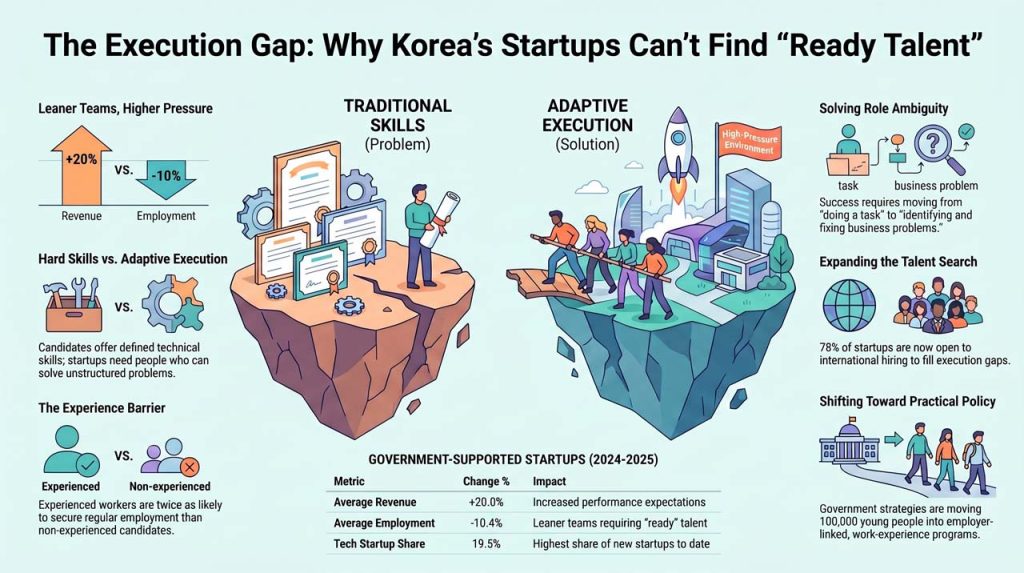
Recent data reflects this pressure. Seoul Economic Daily reported that average employment at government-supported startups fell 10.4% year-on-year to 8.97 employees in 2024, marking the first decline in 12 years. At the same time, average revenue per company increased 20% to KRW 1.775 billion.
The trend suggests that startups are trying to operate more efficiently with leaner teams. In practice, this changes what companies mean when they say they are looking for “ready talent.”

Korean Startups Are Not Just Hiring Skills. They Are Hiring Execution
One of the biggest disconnects in Korea’s hiring market comes from how startups define job readiness compared to how many candidates prepare for employment.
As discussions around Korea’s growing gap between education outcomes and real employment conversion continue, Min Jeong Kim, CEO of Career Road Lab (커리어로드), told KoreaTechDesk that many candidates still prepare around clearly defined technical competencies, while startup environments increasingly require a broader form of execution capability.
“Many candidates are trained to perform a specific skill, while startups need people who can use that skill to define and solve problems that are not yet clearly structured.”
This distinction has become increasingly important in startup hiring.
A candidate may complete a digital marketing course, build a content portfolio, and gain familiarity with advertising tools. However, an early-stage startup may expect that same person to analyze customer behavior, test messaging strategies, improve conversion performance, and collaborate directly with product or operations teams.
The technical skill itself may be real. But the challenge appears when companies expect that skill to be applied in uncertain and rapidly changing business situations.
The Hiring Market Is Quietly Moving Toward “Semi-Experienced” Expectations
This mismatch is becoming more visible as Korea’s labor market increasingly favors practical experience.
A recent Bank of Korea report found that the probability of non-experienced workers obtaining regular employment fell to 1.4% per month, roughly half the 2.7% probability recorded for experienced workers. The report also estimated that about 7 percentage points of the employment-rate gap between workers in their 20s and 30s were linked to the expansion of experienced hiring.
This trend creates a difficult position for both startups and younger candidates.
Startups often describe roles as “entry-level” because they are willing to hire younger workers. In practice, however, many of these positions still require fast adaptation, independent execution, and operational judgment within the first few months.
Min Jeong Kim describes this mismatch as a gap between “Defined Hard Skills” and “Adaptive Execution.”
“The candidate expects to perform the skills they have learned, while the startup expects them to identify unclear problems and develop actionable improvements.”
For startups operating under limited resources, the cost of waiting for a new employee to slowly adapt can be significant. In teams with fewer than 10 employees, one weak hire can directly affect product speed, customer response time, and operational stability.
Korean Startups Are Expanding the Search Beyond Domestic Hiring Channels
Some startups and SMEs have been widening their talent search beyond the domestic labor market.
A recent KOSME survey of 477 SMEs and startups, reported by Korea JoongAng Daily, found that 78.4% were open to hiring foreign employees, while 63.7% said global talent could help address labor shortages. At the same time, 75.9% said they struggled to find information about suitable international candidates.
The data suggests that the issue is no longer simply about the number of available workers. Increasingly, companies are struggling to find people who fit the operational demands of fast-moving startup environments through existing hiring channels.
For startups under hiring pressure, expanding recruitment internationally is becoming less about globalization strategy and more about execution necessity.
Korean Jobseekers Understand the Problem, but Access Remains Uneven
Young jobseekers have been increasingly aware that companies value practical work experience more than certifications alone.
A Korea Enterprises Federation survey of 1,000 unemployed jobseekers aged 20 to 34 found that 74.6% viewed job-related work experience as the most important hiring factor. At the same time, 80.7% identified the lack of work experience and career development opportunities as one of their biggest employment difficulties.
This then creates a structural loop.
Candidates understand that companies want proof of execution. However, many still struggle to access work environments where they can build meaningful operational experience before entering full-time employment.
As a result, portfolios often show completed assignments or training outcomes, while startups are evaluating something more difficult to measure: how a person behaves under ambiguity.
Why Startups and Candidates Often Misread Each Other
Role ambiguity is one of the least discussed drivers of hiring mismatch inside Korea’s startup ecosystem.
Large corporations usually operate with clearer job segmentation and structured onboarding systems. Early-stage startups often function differently. Responsibilities shift quickly, reporting structures are fluid, and execution priorities can change within weeks.
This creates confusion on both sides.
Candidates may believe they are applying for a focused role centered on one skill set. Startups may internally expect cross-functional contribution, rapid experimentation, customer communication, and independent problem-solving.
Kim explains that this gap often becomes visible only after hiring.
“The candidate expects to perform the skills they have learned, while the startup expects them to identify unclear problems and develop actionable improvements.”
The result is not always technical failure. In many cases, it becomes a mismatch in expectations about how work is actually performed inside startup environments.

Korea’s Policy Direction Is Starting to Shift Toward Practical Experience
Government programs are increasingly recognizing this execution gap.
In April 2026, the Korean government announced a revised youth employment strategy supporting around 100,000 young people through expanded work-experience programs, employer-linked education, and practical digital training initiatives. MSS also expanded the AI-focused Eardream School program to 300 trainees across five regions, citing growing startup demand for practical AI talent.
At the international level, the OECD’s 2026 Korea competitiveness report similarly emphasized the need to strengthen employer-linked vocational education and improve skills relevance for SMEs and startups.
The direction of these efforts reflects a broader realization inside Korea’s labor market: training alone is no longer enough. Companies increasingly want evidence that candidates can apply skills under real operational conditions.
What This Means for Founders, Investors, and Global Startup Operators
The hiring problem inside Korean startups is not simply about talent quantity. It is about how effectively talent can operate under startup conditions.
For founders, this changes how hiring should be evaluated. Degrees, certifications, and technical training still matter, but they no longer function as strong standalone signals of startup readiness.
For investors, the issue also affects execution risk. A startup’s ability to recruit adaptable operators increasingly shapes product speed, operational resilience, and scaling capacity.
And for global ecosystem operators looking at Korea, the country’s talent challenge offers a broader lesson. In fast-changing industries, the competitive advantage no longer comes only from producing educated workers. It comes from building systems that convert learning into execution inside real companies.
Korea’s Startup Talent Problem Is Becoming an Execution Problem
Korea’s startup hiring challenge is no longer simply about attracting applicants or expanding education programs. Increasingly, it is about how quickly companies can identify people who can operate under uncertainty, adapt across functions, and contribute inside lean execution environments.
As startups face tighter operational conditions and smaller teams, the definition of “ready talent” is changing faster than many hiring and training systems can respond.
The companies that adapt fastest may not necessarily be the ones with access to the largest talent pools, but the ones that can better recognize, evaluate, and develop execution capability in real working conditions.
Key Takeaway
- Korea’s startup ecosystem continues to grow, especially in technology sectors, but startups are operating with leaner teams and higher execution pressure.
- Startups increasingly prioritize adaptive execution over technical credentials alone, especially in fast-changing operational environments.
- The hiring market is shifting toward practical experience, making it harder for entry-level candidates to compete without evidence of real work capability.
- Role ambiguity inside startups is a major source of mismatch, as candidates and companies often define “job readiness” differently.
- Government and policy institutions are moving toward employer-linked and work-based training models, reflecting growing demand for practical execution skills.
- For founders and investors, the core issue is not talent quantity but execution readiness, particularly the ability to solve unclear problems under resource constraints.
- Korea’s startup hiring challenge is increasingly becoming an execution problem, where the key competitive advantage is not simply access to educated talent, but the ability to identify and develop people who can operate effectively under uncertainty, limited resources, and fast-changing business conditions.
– Stay Ahead in Korea’s Startup Scene –
Get real-time insights, funding updates, and policy shifts shaping Korea’s innovation ecosystem.
➡️ Follow KoreaTechDesk on LinkedIn, X (Twitter), Threads, Bluesky, Telegram, Facebook, and WhatsApp Channel.
🤝 Looking to connect with verified Korean companies building globally?
Explore curated company profiles and request direct introductions through beSUCCESS Connect.