
A university degree, a training certificate, and a portfolio are supposed to open the door to employment. In South Korea, more young people than ever have all these three, yet many still spend close to a year searching for their first job. And even after entering the workforce, early job stability remains fragile.
Now, the problem is no longer in education or access. It is what happens after. Because somewhere between learning and working, the system fails to convert talent preparation into real employment outcomes.
Korea’s Talent Strength Is Real, But So Is the Conversion Gap
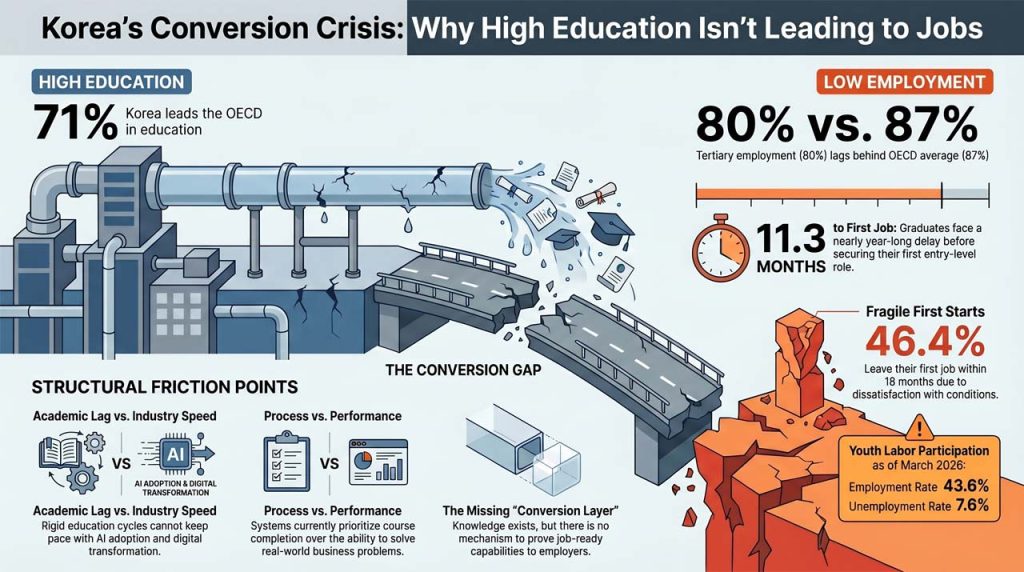
Korea’s position as a high-education economy is well established. According to the OECD’s Education at a Glance 2025, 71% of Koreans aged 25 to 34 have completed tertiary education, the highest among OECD countries.
However, this strength does not translate cleanly into employment outcomes. The employment rate for tertiary-educated young adults in Korea stands at 80%, below the OECD average of 87%. This gap signals a deeper issue: education is not consistently converting into labor-market participation.
Recent labor data reinforces this pattern. In March 2026, Korea’s overall employment rate for those aged 15 to 64 reached 69.7%, while unemployment remained relatively low at 3.0%. Yet youth indicators moved in the opposite direction. The youth employment rate fell to 43.6%, and youth unemployment rose to 7.6%, according to official government data.
These figures suggest that Korea does not face a simple shortage of jobs or talent. The problem emerges more at the transition point where education and training are expected to become real employment outcomes.
The Breakdown Happens After Training Ends
The most critical friction point appears after education and training are completed. Data from Statistics Korea shows that young graduates take an average of 11.3 months to secure their first job.
Even after entering employment, stability remains weak. The average tenure in a first job is about 1 year and 6.4 months, with 46.4% leaving due to dissatisfaction with working conditions such as wages and working hours.
This pattern indicates that entry into employment is not only delayed but also fragile. It raises a deeper question about the effectiveness of the transition from learning to working.
Min Jeong Kim, CEO of Career Road Lab (커리어로드), has worked across labor market research, workforce training programs, career counseling, and public employment support systems in Korea.
Drawing from both field-level counseling experience and institutional workforce research, she frames this issue as a structural conversion problem.
“Korea has a strong education and training infrastructure, but the next challenge is conversion.”

Her perspective draws from experience across labor market research, workforce training, and career counseling. She argues that the gap is not caused by a lack of education itself, but by the system’s limited ability to translate learning into outcomes that companies can recognize and use.
Why Korea’s Talent Education and Industry Move at Different Speeds
One of the key drivers behind this conversion gap is the mismatch in speed between education systems and industry demand.
Education and training programs operate within structured cycles, standardized curricula, and institutional constraints. Industry, on the other hand, is evolving rapidly, especially in areas shaped by digital transformation, AI adoption, and cross-sector convergence.
This creates a critical time lag. Skills taught in training programs may already be outdated or incomplete by the time participants enter the job market.
Min Jeong Kim explains this dynamic clearly:
“The gap between education and employment in Korea is not simply caused by a lack of education or a lack of training programs. Rather, it is a structural conversion problem.”
In practice, companies are not only looking for knowledge or technical ability. They expect problem-solving skills, adaptability, collaboration, and the ability to apply knowledge in uncertain, real-world contexts.
And these capabilities are difficult to standardize and even harder to signal through certificates or course completion.

Process Metrics Do Not Guarantee Employment Outcomes
Korea has built an extensive training and employment support infrastructure. Programs such as K-Digital Training and the National Competency Standards (NCS) system aim to align education with labor-market needs.
The Ministry of Employment and Labor reported that K-Digital Training targeted the development of 180,000 digital professionals between 2021 and 2025. The NCS framework now spans more than 13,000 competency units across multiple industries.
Despite this scale, outcomes remain uneven. One reason lies in how success is measured.
Vocational training systems often rely on process indicators such as completion rates, participation numbers, and short-term employment within six months of finishing a program. These metrics are important for monitoring system activity, but they do not fully capture whether participants can perform effectively in real jobs.
Min Jeong Kim highlights this limitation:
“The outcomes of vocational training programs cannot be judged only by completion rates or certification rates.”
The difference between process and outcome becomes critical at the hiring stage. A completed course or certificate simply signals participation. It does not necessarily signal the ability to solve real business problems, adapt to workplace demands, or contribute to organizational performance.
Korea’s Labor Market Reflects a Structural Mismatch
Institutional research in Korea also supports this view. The Korea Labor Institute notes that youth employment challenges are closely linked to mismatch across industries, occupations, and skill levels rather than a simple lack of jobs.
Similarly, the Korea Institute for Industrial Economics and Trade estimates that mismatch-related employment loss increased significantly over the past decade, reaching 72,000 jobs in 2024.
Not only does this mismatch appear in hiring outcomes, it is also visible in labor-market behavior. A growing number of young people remain economically inactive or classified as “resting,” meaning they are neither working nor actively seeking jobs.
According to recent labor data, Korea recorded 2.64 million “resting” individuals in 2025, including a significant share of people in their 20s. Among young people not participating in the labor market, 34.1% said they could not find the kind of job they wanted, while 9.9% reported that no suitable jobs were available.
These patterns reinforce a deeper structural issue. Korea’s labor market is not failing at the supply stage. It is struggling at the alignment stage, where available talent does not meet real demand under changing industry conditions.
The Missing Layer: Converting Learning into Job Performance
At the center of this issue is the absence of a strong conversion layer.
Education produces knowledge. Training programs build basic skills. Work experience programs introduce real environments. Yet these elements often remain disconnected. They do not consistently translate into clear, credible evidence that a candidate can perform in a specific role.
Min Jeong Kim argues that the issue extends beyond technical preparation alone.
“This gap is not simply a lack of technical skills. It is about how accurately jobseekers understand and respond to workplace expectations and the ambiguity of real job roles. I see this through the lens of Vocational Information Literacy.”
Her framework shifts the discussion beyond education access or certification accumulation. It focuses instead on how individuals interpret labor-market expectations, connect their experiences to actual job roles, and translate learning into workplace performance.
Min Jeong Kim summarizes this shift in focus:
“The purpose of education and training should not be completion, but conversion.”
Conversion, in this context, means transforming learning into something measurable and usable in the labor market. It requires linking education, training, and experience to actual job tasks, performance expectations, and organizational needs.
Without this layer, even a strong education system can produce weak employment outcomes.
What This Means for the Korea Startup Ecosystem
For founders, investors, and ecosystem operators, this issue changes how talent should be evaluated.
Korea’s talent pool is not limited in size or educational quality. The challenge lies in interpreting what that talent can actually do in a real business context.
This has implications beyond hiring. It affects productivity, early-stage execution, and the ability of startups to scale with the right people. It also shapes how global investors assess the readiness of local teams.
Understanding Korea’s talent pipeline, therefore, requires moving beyond surface indicators such as degrees or certifications. The more important question is how effectively the system converts learning into capabilities that companies can trust and deploy.
Key Takeaway on Korea’s Talent Pipeline Challenge
- Korea has one of the highest tertiary education rates globally (71%), yet employment conversion remains weaker than OECD benchmarks.
- Youth employment indicators are declining, with a 43.6% employment rate and 7.6% unemployment rate in March 2026.
- The transition from education to employment is slow and fragile, with an average 11.3 months to first job and short initial job tenure.
- Training systems are extensive but often measured by process metrics, such as completion and certification, rather than real job performance.
- The core issue is not talent supply, but conversion: the ability to translate education and training into credible, job-ready capabilities.
- For startups and investors, the critical question is how effectively talent can be applied in real-world execution, not how much education it has received.
– Stay Ahead in Korea’s Startup Scene –
Get real-time insights, funding updates, and policy shifts shaping Korea’s innovation ecosystem.
➡️ Follow KoreaTechDesk on LinkedIn, X (Twitter), Threads, Bluesky, Telegram, Facebook, and WhatsApp Channel.
🤝 Looking to connect with verified Korean companies building globally?
Explore curated company profiles and request direct introductions through beSUCCESS Connect.