

Many founders look impressive when conditions are favorable. Funding is available, hiring is easier, and growth plans appear achievable. Now, the harder test begins when markets tighten, customers become cautious, and investors demand stronger evidence of execution. Under those conditions, startup success often depends less on vision and more on how founders respond when reality begins pushing back against the plan.
Tighter Funding Cycles Are Changing What Investors Watch
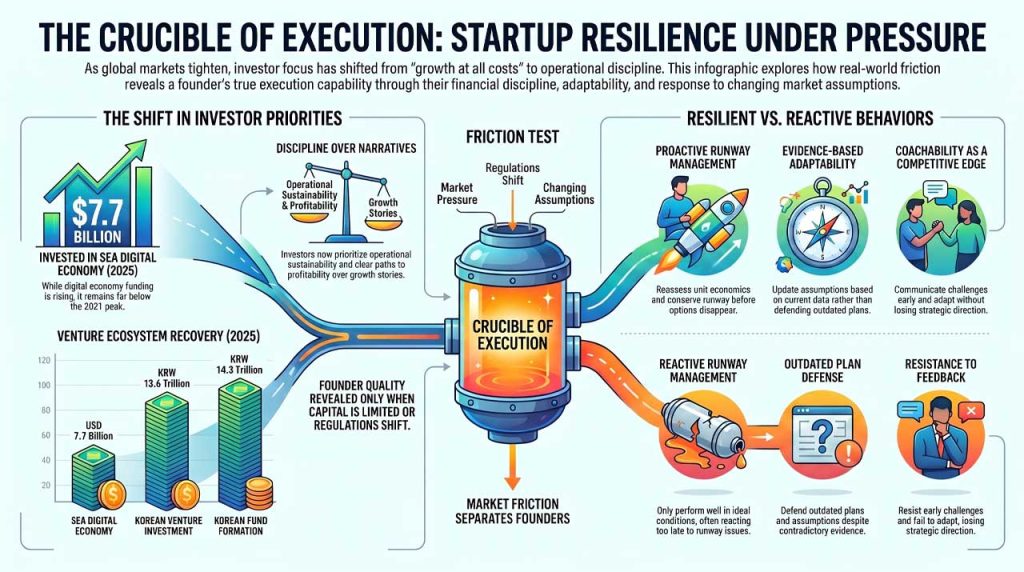
Southeast Asia’s startup ecosystem continues attracting capital, but investor priorities have shifted considerably. According to Reuters, private funding into Southeast Asia’s digital economy reached USD 7.7 billion during the twelve months leading into mid-2025, representing a year-on-year increase but remaining far below the region’s funding peak in 2021.
At the same time, capital has become more concentrated. Investors are increasingly directing funds toward companies that demonstrate stronger operational discipline, clearer paths to sustainability, and more resilient business fundamentals.
And that shift is gradually changing how founders are evaluated.
While growth narratives, market opportunity, and product vision remain important, investors are paying closer attention to how founders behave when businesses encounter friction.

Friction Separates Strong Founders From Strong Presenters
Drawing from years of experience in evaluating founders across venture investment, corporate development, startup operations, and emerging Southeast Asian markets, Henry Maw, Founder and Chairman of X Venture Holdings, believes that founder quality often becomes visible only after ideal conditions disappear.
“The difference is usually revealed when the business encounters friction,”
he told KoreaTechDesk during an exclusive interview on Korean startup expansion to Southeast Asia.
“A founder who is investable in theory often performs well in ideal conditions.”
Pitch decks, ambitious projections, and compelling narratives can create strong first impressions. However, startups rarely operate in predictable environments for long.
“Execution quality becomes visible when capital is limited, regulations shift, infrastructure is imperfect, or customer behavior evolves unexpectedly.”
That distinction is becoming increasingly relevant as startup ecosystems mature, and investors place greater emphasis on operating capability rather than growth stories alone.
Resilient Founders Protect Runway Before Options Disappear
Market pressure often exposes another critical founder behavior: financial discipline.
Recent startup data reflects the consequences of delayed decision-making. Carta reported that startup shutdowns reached record levels during recent funding cycles as companies struggled to adapt to changing capital conditions.
Maw believes resilient founders tend to respond differently when warning signs appear.
“Strong founders tend to reassess unit economics, conserve runway, prioritize core revenue drivers, and adjust execution speed early when market conditions tighten.”
These decisions are often unpopular internally. Hiring plans may slow. Expansion projects may be postponed. Product roadmaps may become narrower.
Yet founders who act early often preserve strategic flexibility while competitors continue operating under assumptions formed during more favorable market conditions.
Reactive Founders Often Scale Based on Yesterday’s Reality
One of the most common startup mistakes involves maintaining growth strategies long after the market environment has changed.
Research from Startup Genome has long identified premature scaling as a recurring contributor to startup failure. Companies frequently expand their teams, increase their spending, or enter new markets before validating that their underlying economics can support that growth.
Maw has observed similar patterns.
“Less resilient teams often continue scaling headcount or expansion plans based on outdated assumptions from stronger funding environments.”
The challenge is rarely ambition itself.
Instead, problems emerge when founders become attached to historical assumptions despite evidence suggesting conditions have changed. Expansion decisions that appeared rational twelve months earlier may become dangerous if customer demand weakens, fundraising slows, or operating costs rise unexpectedly.
Under pressure, strong founders update their assumptions, while reactive founders defend them instead.
Adaptability Is Different From Panic Pivoting
At the same time, adaptability is often celebrated within startup culture, but genuine adaptability is frequently misunderstood.
Research published in Systems and MIS Quarterly suggests successful founders combine flexibility with disciplined decision-making. Adaptation works best when leaders respond to evidence rather than emotion.
And this distinction matters because strong operators do not just pivot constantly. They evaluate signals, reassess priorities, and make deliberate adjustments without abandoning long-term direction.
Maw believes communication behavior often reveals the difference.
“The strongest operators usually communicate challenges early, remain highly coachable, and adapt quickly without losing strategic direction.”
In practice, coachability can become a competitive advantage. Founders who seek feedback, acknowledge weaknesses, and update strategies often navigate uncertainty more effectively than leaders who treat changing circumstances as temporary setbacks.

Why This Matters for Korean Founders Expanding Abroad
The conversation carries particular relevance for Korean startups pursuing international growth.
Korea’s venture ecosystem has shown signs of recovery. According to the Ministry of SMEs and Startups, venture investment reached KRW 13.6 trillion in 2025, while fund formation increased to KRW 14.3 trillion.
However, stronger domestic funding conditions do not eliminate execution risk.
As Korean startups expand into Southeast Asia and other overseas markets, they encounter unfamiliar customers, new regulations, different operating environments, and greater uncertainty. Under those conditions, founder behavior often becomes more important than founder confidence.
Market expansion magnifies weaknesses just as quickly as it amplifies strengths. And founders who remain disciplined under pressure are generally better positioned to navigate that complexity.

The New Founder Signal Investors Cannot Ignore
Over the years, investors have always evaluated products, markets, and business models. But increasingly, they are also evaluating how founders behave when those elements become harder to manage.
A founder’s response to shrinking runway, unexpected setbacks, slower growth, or operational challenges can reveal more about long-term potential than a polished fundraising presentation ever could.
And as startup ecosystems mature, resilience is becoming less about optimism and more about execution.
A Measure of Leadership That Appears Only Under Pressure
Many startup capabilities are easy to demonstrate when resources are abundant. Leadership is different.
Pressure forces founders to make difficult trade-offs, confront uncomfortable realities, and operate with incomplete information. It reveals who can adapt without panic, communicate without defensiveness, and make disciplined decisions before circumstances force them to act.
According to Maw, that ability ultimately shapes long-term outcomes.
“In emerging markets especially, founders rarely operate under perfect conditions, so long-term success often comes down to execution discipline and adaptability under uncertainty rather than optimism alone.”
Key Takeaway
- Founder quality becomes most visible during periods of friction, not during favorable market conditions.
- Investors increasingly evaluate execution behavior, including runway management, prioritization, and decision-making under pressure.
- Founders who are “investable in theory” often differ from founders who can execute through uncertainty.
- Resilient founders conserve runway, reassess assumptions, and protect core revenue drivers early.
- Reactive founders frequently continue scaling based on outdated market assumptions and delayed responses.
- Adaptability is strongest when paired with discipline, coachability, and evidence-based decision-making.
- For Korean startups pursuing international expansion, founders’ behavior under pressure may become one of the most important indicators of long-term success.
– Stay Ahead in Korea’s Startup Scene –
Get real-time insights, funding updates, and policy shifts shaping Korea’s innovation ecosystem.
➡️ Follow KoreaTechDesk on LinkedIn, X (Twitter), Threads, Bluesky, Telegram, Facebook, and WhatsApp Channel.
🤝 Looking to connect with verified Korean companies building globally?
Explore curated company profiles and request direct introductions through beSUCCESS Connect.