

Southeast Asia continues attracting Korean startups searching for new growth markets, digital consumers, and regional expansion opportunities. Yet many founders still approach ASEAN as a single business environment despite major differences in infrastructure, customer behavior, institutional maturity, and operating systems across the region. As Korean government agencies, investors, and startups deepen their ASEAN engagement, a different challenge is emerging beneath the growth narrative: execution literacy.
Korea’s ASEAN Startup Push Is Accelerating Faster Than Many Founders’ Regional Understanding
South Korea’s startup and digital cooperation with ASEAN has expanded significantly over the past few years. In 2024, ASEAN and the Republic of Korea elevated their relationship into a Comprehensive Strategic Partnership, with cooperation areas covering startups, AI, digital economy, MSMEs, smart infrastructure, and innovation ecosystems.
Korea’s Ministry of SMEs and Startups has also continued expanding startup cooperation initiatives with ASEAN economies. Earlier this year, the ministry announced plans to establish a USD 300 million K-VCC global fund-of-funds in Singapore by 2030 while noting that Korea had already operated 19 global funds worth approximately USD 1.8 billion across Singapore and ASEAN markets.
The broader market opportunity is substantial. According to the 2025 e-Conomy SEA report by Google, Temasek, and Bain & Company, Southeast Asia’s digital economy is projected to surpass USD 300 billion in gross merchandise value this year. The region’s digital revenue is expected to reach USD 135 billion, supported by rising internet adoption, digital payments, and online commerce across ASEAN economies.
The scale of that growth has made Southeast Asia one of the most important outbound expansion targets for Korean startups.
However, investors and operators working across frontier ASEAN markets increasingly warn that market-entry assumptions built around a single “regional strategy” often break down quickly on the ground.

Southeast Asia Is Not One Startup Market
Henry Maw, Founder and Chairman of X Venture Holdings, has spent years working across venture investment, healthcare operations, startup development, and corporate advisory environments in Southeast Asia, including frontier markets such as Cambodia and Myanmar.
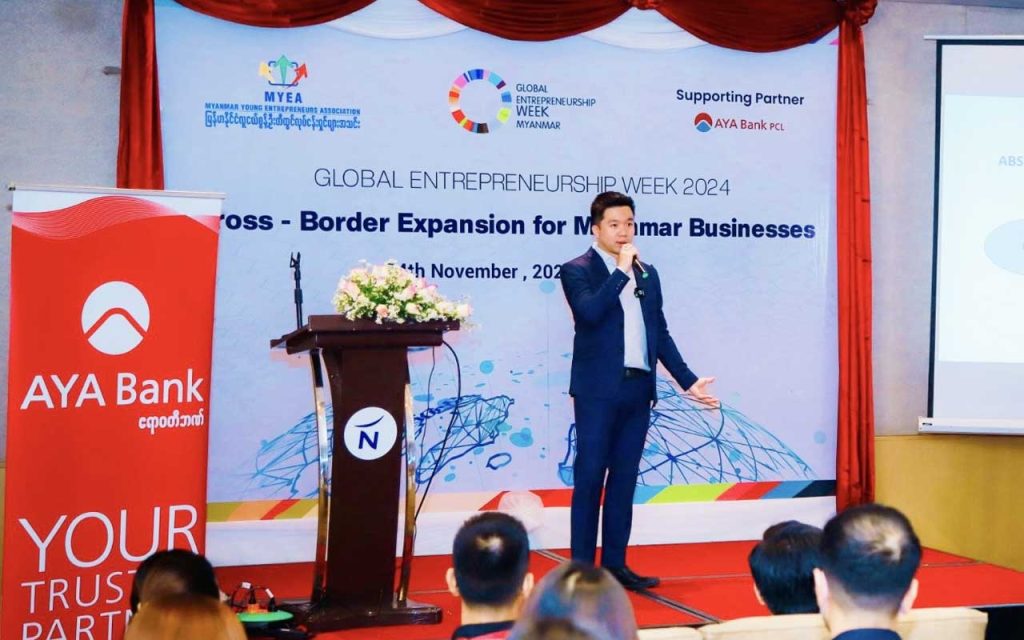
According to Maw, one of the most common mistakes foreign startups make is treating Southeast Asia as a unified operating environment.
“The biggest misconception is treating Southeast Asia as one unified market,”
he told KoreaTechDesk during an exclusive interview.
“In reality, each country operates with very different consumer behaviors, regulatory dynamics, infrastructure maturity, and trust systems.”

That gap becomes increasingly important as Korean startups expand beyond Singapore and begin evaluating emerging ASEAN economies where institutional systems, infrastructure reliability, and distribution networks remain uneven.
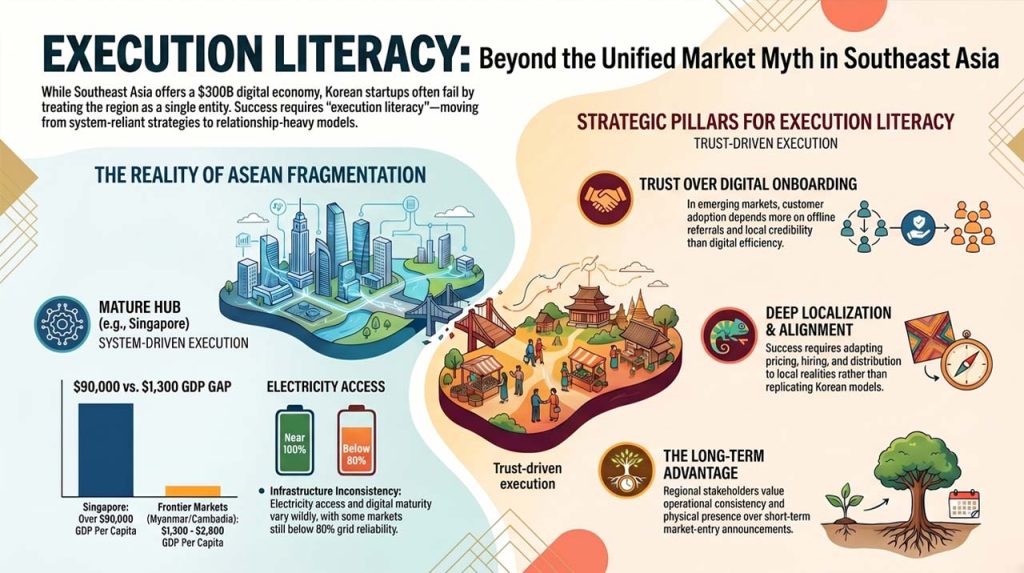
World Bank data illustrates how fragmented the region remains economically. Singapore’s GDP per capita exceeded USD 90,000 in 2024, while Cambodia remained around USD 2,600 and Myanmar around USD 1,300.
Infrastructure differences are also equally visible. World Bank electricity access data showed Myanmar below 80 percent while several mature ASEAN economies remained near universal access.
Those gaps materially affect how startups build logistics, customer support, hiring systems, payment flows, and operational scaling models.
“A strategy that works in Singapore or Bangkok does not automatically translate into Phnom Penh or Yangon,”
Maw said.
“I often tell founders that Southeast Asia rewards adaptability more than perfection.”
Frontier Markets Often Operate Through Trust Before Systems Mature
As Korean startups increasingly enter frontier ASEAN markets, execution challenges often emerge in areas that are difficult to identify through market reports alone.
Maw explained that in many emerging Southeast Asian markets, relationships and trusted local operators still play a major role in commercial execution.
“One practical difference is that in mature hubs, systems tend to support execution.
In frontier markets, execution often depends on relationships compensating for gaps in systems.”

The dynamic therefore changes how startups approach partnerships, hiring, distribution, and long-term expansion planning.
For example, Maw said one of X Venture Holdings’ portfolio companies, Mekongverse, accelerated parts of its Cambodia market-entry process through strong local relationships with marketing agencies that supported enterprise introductions, local manpower recruitment, and distribution access.
“In emerging markets like Cambodia, execution is not only about having the right product or service offering, but also having the right local alignment around the product or service offering,”
he explained.
Those realities are becoming increasingly important as Southeast Asia’s funding environment grows more disciplined.
Reuters reported that private funding into Southeast Asia’s digital economy reached USD 7.7 billion during the 12 months leading into mid-2025, up 15 percent year-on-year but still significantly below the region’s 2021 funding peak. Investors have also become more focused on profitability, governance, and operational sustainability instead of pure growth narratives.
Maw believes the same transition is reshaping founder expectations across ASEAN.
“The ‘growth at all costs’ era has largely ended.
Investors today are far more focused on contribution margins, governance, operational discipline, and realistic expansion sequencing.”
Korean Startups Often Underestimate Localization Beyond Product Quality
Now, Korean startups have already possessed strong advantages in Southeast Asia. Korean brands, entertainment, beauty products, gaming, and digital culture have established broad regional familiarity across ASEAN consumer markets.
However, Maw cautioned that product quality alone rarely guarantees adoption in emerging Southeast Asian environments.
“One common blind spot is assuming that a successful product and efficient operating model can simply be replicated across ASEAN without significant localization.”
In several markets, customer trust still depends heavily on offline relationships, referrals, local community credibility, and human support channels rather than pure digital onboarding efficiency.
Maw added that many startups underestimate how fragmented payment behavior, logistics systems, and distribution networks can remain compared to more mature Asian economies.
“The companies that succeed tend to localize deeply, build trusted local partnerships early, and approach ASEAN market-by-market rather than as a single expansion story.”
That challenge is becoming more relevant as Korean startups move deeper into sectors such as healthcare, logistics, enterprise software, AI infrastructure, and digital services across Southeast Asia.
Long-Term Presence Is Becoming a Competitive Advantage in ASEAN
Beyond localization, investors increasingly view long-term operational commitment as a critical signal in Southeast Asia.
According to Maw, governments, enterprise partners, healthcare institutions, and ecosystem stakeholders across ASEAN often evaluate foreign startups based on consistency and long-term reliability rather than short-term market-entry announcements.
“The companies that ultimately build durable positions in ASEAN are usually the ones that spend meaningful time on the ground, localize deeply, and approach the region with patience rather than short-term expansion expectations.”
In many frontier markets, local credibility compounds slowly through operational consistency, partnerships, and trust-building.
“Trust compounds in Southeast Asia just as much as capital does,”
Maw added.
ASEAN Expansion Is Becoming More Sophisticated and More Demanding
In the end, Southeast Asia remains one of the most important growth corridors for Korean startups, investors, and digital infrastructure companies. Government cooperation frameworks, startup policy dialogues, venture capital flows, and regional digital initiatives continue expanding across ASEAN.
But at the same time, the region’s operating realities are becoming harder to simplify into a single expansion narrative.
So, as Korean startups move deeper into emerging Southeast Asian markets, execution literacy may become as important as product quality, fundraising capability, or technical sophistication.
And the startups that succeed are increasingly the ones capable of understanding how local systems, trust networks, customer behavior, and operational realities differ country by country across ASEAN.
Key Takeaway
- ASEAN markets differ significantly in infrastructure, institutional maturity, customer behavior, and trust systems.
- Korea has expanded startup, digital economy, and venture cooperation initiatives across Southeast Asia, including billion-dollar regional investment programs.
- Successful startups adapt pricing, partnerships, hiring, onboarding, support systems, and distribution models to local market realities.
- In less mature ecosystems, partnerships and local networks frequently compensate for operational and institutional gaps.
- Southeast Asia’s funding environment has become more selective and execution-focused.
- Durable regional expansion increasingly depends on trust-building, local presence, and operational consistency over time.
– Stay Ahead in Korea’s Startup Scene –
Get real-time insights, funding updates, and policy shifts shaping Korea’s innovation ecosystem.
➡️ Follow KoreaTechDesk on LinkedIn, X (Twitter), Threads, Bluesky, Telegram, Facebook, and WhatsApp Channel.
🤝 Looking to connect with verified Korean companies building globally?
Explore curated company profiles and request direct introductions through beSUCCESS Connect.