
South Korea’s export economy depends on deeply interconnected global supply chains. Yet as ESG due diligence requirements tighten across international markets, Korean companies are discovering a difficult reality: the most serious operational risks often emerge in the lower-tier networks that sit beyond formal ESG audit visibility.
That challenge is pushing businesses, regulators, and investors to rethink how supply-chain governance works beyond certifications, questionnaires, and Tier 1 reporting systems.
Korea’s Supply-Chain ESG Pressure Is Becoming a Market-Access Issue
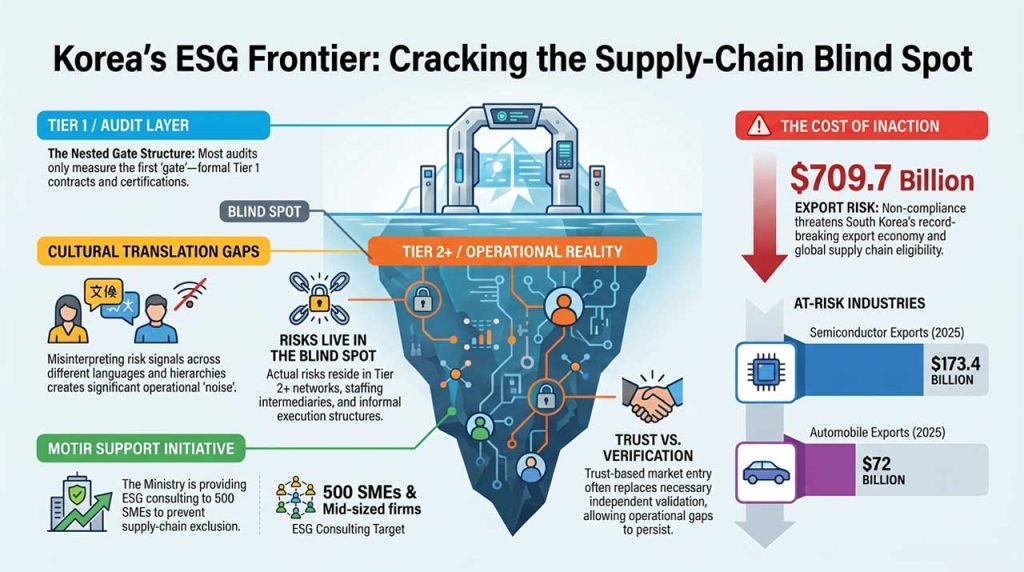
South Korea’s exports reached a record USD 709.7 billion in 2025, according to government-linked trade reporting, with semiconductors reaching USD 173.4 billion and automobile exports totaling USD 72 billion.
This scale matters because Korea’s manufacturing competitiveness depends heavily on overseas suppliers, subcontractors, logistics networks, staffing intermediaries, and regional operating partners spread across multiple jurisdictions.
At the same time, ESG due diligence expectations are expanding quickly across global procurement systems.
In March 2026, South Korea’s Ministry of Trade, Industry and Resources (MOTIR) warned that global prime contractors increasingly require suppliers to submit ESG data and undergo supply-chain due diligence reviews. The ministry also acknowledged that companies unable to respond adequately may face exclusion risks inside global supply chains.
That pressure is now shaping Korean industrial policy itself. MOTIR’s 2026–2030 sustainability support plan includes ESG due-diligence consulting support for 500 SMEs and mid-sized firms this year, alongside a simplified due-diligence platform targeted for rollout by 2028 to reduce repetitive supplier reporting burdens.
The shift reflects a broader reality facing Korean export companies. ESG compliance is no longer limited to public disclosure or investor communication. It is becoming tied directly to supplier eligibility, procurement access, and long-term participation inside global manufacturing ecosystems.
The Biggest Supply-Chain Risks Often Exist Beyond Tier 1
The problem is that many ESG systems still concentrate heavily on the first visible layer of suppliers.
As discussions around ESG execution gaps continue, Wendy (Eunji) Yang, Founder and President of the International ESG & Human Rights Association (IEHRA), believes this creates a structural blind spot inside many global supply chains.
“Companies typically manage ESG compliance at the Tier-1 supplier level. Documents, certifications, and assessment scores concentrate at this layer,”
Yang told KoreaTechDesk.
“But the actual risk lives further down — at Tier-2 and below, or within informal operating networks.”
Yang describes this through what she calls a “Nested Gate Structure.”
The first layer includes formal contracts, certifications, supplier assessments, and documented compliance systems. The deeper layers involve relationship-based networks, subcontracting arrangements, staffing intermediaries, and informal execution structures that often remain outside formal audit visibility.
“Current ESG systems measure only the first gate. The second and third gates remain outside the measurement perimeter.”
This challenge is increasingly recognized globally as well. The OECD has warned that electronics and vehicle manufacturing supply chains often suffer from limited visibility beyond Tier 1 suppliers, particularly in industries involving complex subcontracting and multi-country sourcing structures.
That concern carries particular relevance for South Korea, whose global industrial footprint remains heavily concentrated in semiconductors, batteries, automobiles, electronics, shipbuilding, and advanced manufacturing.
Why Formal Audits Can Miss Operational Reality
Now, the gap does not necessarily mean companies lack ESG systems. In many cases, formal compliance structures already exist.
But then, the harder problem is that operational risk frequently develops through channels that are difficult to document directly.
Yang stated,
“What cannot be measured is treated as if it does not exist. Yet resource diversion takes place precisely there.”
Human Rights Watch has similarly argued that social audits alone are often insufficient to detect labor abuses across global supply chains, especially when audit systems rely heavily on supplier-controlled documentation and site access.
This creates a growing tension for Korean firms expanding internationally. The formal audit layer may appear compliant while operational practices deeper inside subcontracting chains remain difficult to verify consistently.
That issue became visible publicly in the United States after the Department of Labor filed a complaint in 2024 involving Hyundai Motor Manufacturing Alabama, SMART Alabama, and Best Practice Service over alleged illegal child labor inside supplier operations.
Along with the complaint, Reuters had previously reported investigations involving migrant minors working inside Alabama auto-parts suppliers connected to the Hyundai-Kia supply chain.
The case illustrated how labor risks can emerge through staffing intermediaries and lower-tier supplier structures even when formal supplier standards exist at the parent-company level.

Trust-Based Expansion Can Quietly Weaken Verification
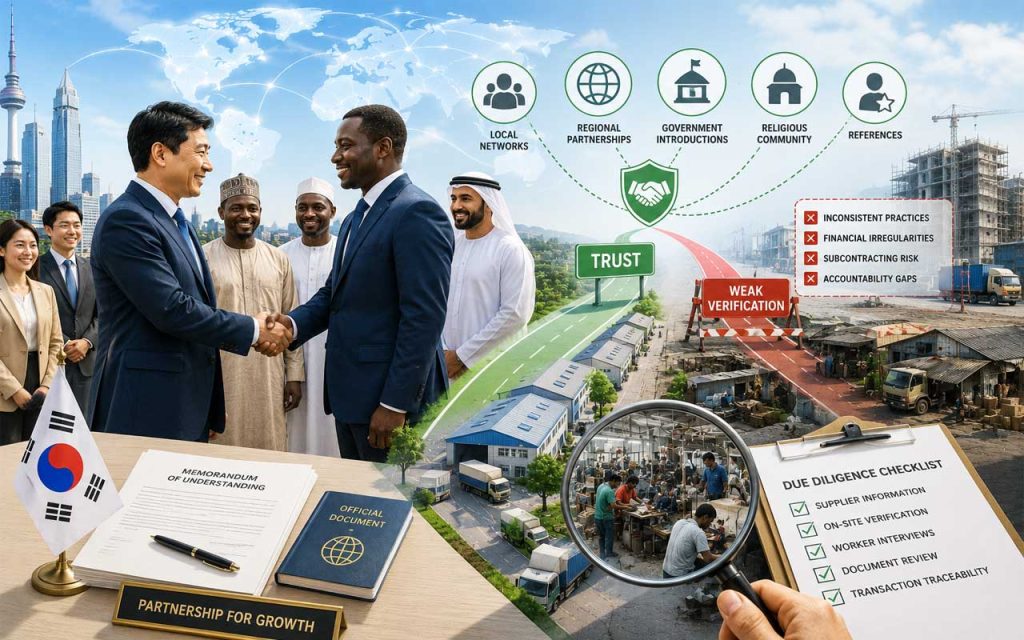
The challenge becomes even more complicated in cross-border expansion environments where business relationships often develop through trust-based entry channels.
“When Korean firms expand into emerging markets, both supply chains and market entry frequently begin through trust-based channels,”
Yang explained.
These channels may include local business networks, regional partnerships, religious communities, government-linked introductions, or references tied to established firms. In practice, such trust signals have indeed been able to accelerate market entry and reduce friction in unfamiliar operating environments.
Now, the problem emerges when trust gradually replaces verification.
Yang noted that authority signals such as official documents, institutional affiliations, or references from established companies can sometimes lower the perceived need for independent validation inside cross-border projects.
This does not automatically indicate misconduct. However, it can create environments where operational inconsistencies, undocumented financial flows, subcontracting irregularities, or accountability gaps remain undetected for extended periods.
Yang said IEHRA has observed similar patterns in “an ongoing East African development case currently under independent third-party verification,” where the analytical focus remains on governance mechanisms rather than the parties involved.
The broader concern extends beyond any individual case. As Korean companies continue expanding across Southeast Asia, the Middle East, Africa, and other emerging markets, supply-chain governance increasingly depends on how companies validate operational reality beyond formal onboarding processes.
Cultural Translation Is Becoming a Supply-Chain Infrastructure Problem
Another operational challenge receiving growing attention involves language and cultural interpretation inside multinational supply chains.
According to OECD guidance on responsible business conduct, companies should remove barriers to stakeholder engagement involving language, culture, hierarchy, and power imbalances. The reason is practical rather than symbolic: risk signals are often communicated differently across regions and labor environments.
Yang believes many ESG systems still underestimate this issue.
“Between the layer where signals form and the layer where decisions are made, there must always be a cultural transformer.”
In practice, workers in Vietnam, Indonesia, Bangladesh, Cambodia, or Central Asia may express pressure, discomfort, coercion, or safety concerns differently than headquarters teams in Seoul interpret them.
After all, the same grievance mechanism may function effectively in one country but then fail completely in another due to hierarchy, indirect communication patterns, or fear of retaliation.
And as supply chains become more internationalized, multilingual grievance systems and culturally adaptive reporting channels are increasingly becoming part of operational risk infrastructure rather than optional ESG programs.
Korean Supply Chains Are Entering a Verification Era
And so, the next phase of ESG governance appears likely to focus less on collecting supplier documents and more on verifying how operational systems actually function beneath the reporting layer.
For Korean companies, this means supply-chain due diligence may increasingly require visibility into subcontracting structures, staffing arrangements, intermediary networks, and local accountability mechanisms that traditional audits often struggle to capture.
The issue is becoming strategically important because global ESG pressure is no longer driven solely by regulators. Investors, multinational customers, and procurement systems are now pushing companies to demonstrate operational credibility deeper inside their supply chains.
And that creates a difficult balancing act. Companies must respond to rising due-diligence expectations without overwhelming suppliers that already operate with limited staffing and compliance resources.
But in the end, the direction is now becoming clearer.
The future of supply-chain ESG governance may depend less on how many supplier questionnaires companies distribute and more on whether they can identify hidden operational risks before those risks escalate into legal, financial, or reputational crises across borders.
Key Takeaways
- South Korea’s export-driven economy is facing growing ESG due-diligence pressure as global customers increasingly require suppliers to provide ESG data and supply-chain verification.
- MOTIR warned in 2026 that suppliers unable to respond to ESG due-diligence demands may face exclusion risks inside global supply chains.
- Many ESG audits still focus heavily on Tier 1 suppliers, while operational risks often emerge through Tier 2 and Tier 3 subcontractors, staffing intermediaries, and informal execution networks.
- Eunji (Wendy) Yang’s “Nested Gate Structure” framework argues that formal audits often measure only the first visible supplier layer, leaving deeper operational risks outside the verification perimeter.
- Trust-based onboarding channels can weaken verification processes during cross-border expansion when institutional credibility replaces independent validation.
- Language and cultural interpretation gaps are becoming operational supply-chain risks, especially across multinational manufacturing and labor environments.
- The next phase of ESG governance will likely focus more on operational verification systems than on document collection alone.
– Stay Ahead in Korea’s Startup Scene –
Get real-time insights, funding updates, and policy shifts shaping Korea’s innovation ecosystem.
➡️ Follow KoreaTechDesk on LinkedIn, X (Twitter), Threads, Bluesky, Telegram, Facebook, and WhatsApp Channel.
🤝 Looking to connect with verified Korean companies building globally?
Explore curated company profiles and request direct introductions through beSUCCESS Connect.