
Japan remains one of the world’s most respected manufacturing hubs. Its reputation for precision and reliability continues to attract global startups and Korean companies seeking high-quality production partners.
Yet behind that reputation lies a less visible reality. Access to manufacturing capacity in Japan is not determined by search, outreach, or initial agreements. It is shaped by trust, relationships, and the networks that connect them.
In Japan’s Manufacturing, Access Is Not the Same as Entry
Many foreign companies assume that entering Japan’s manufacturing market begins with identifying suppliers and initiating discussions. But in practice, this stage rarely determines outcomes.
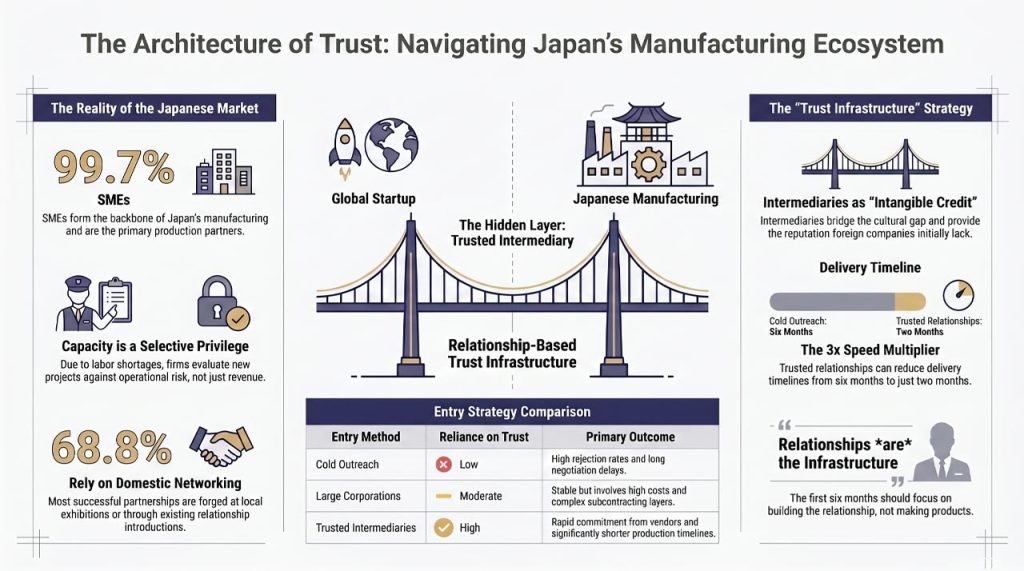
Japan’s supplier ecosystem is highly fragmented and relationship-driven. According to Japan’s Small and Medium Enterprise Agency, small and medium-sized enterprises (SMEs) account for approximately 99.7 percent of all companies in the country. These firms form the backbone of manufacturing activity.
At the same time, structural pressure has intensified. The 2025 SME White Paper also highlights persistent labor shortages and aging ownership, with many firms facing succession challenges. In such an environment, new projects are not automatically treated as opportunities. They are evaluated against existing workloads and operational risk.
As a result, the meaning of access then shifts instead. The question is not whether a company can find a manufacturer. It is whether that manufacturer is willing to commit.
Referrals, Not Outreach, Open the Door
The 2025 Japan External Trade Organization (JETRO) survey of foreign-affiliated companies in Japan shows that 68.8 percent identified domestic exhibitions and events as a key way to find partners, while 49.1 percent relied on introductions through existing relationships.
These numbers point to a pattern. Access is rarely built through cold outreach. It is established through networks that already exist within the ecosystem.
The Organization for Small and Medium Enterprises and Regional Innovation (SMRJ) reinforces this. Its survey shows that 54.9 percent of firms view trustworthy local partners as a decisive factor in overseas expansion. At the same time, 31.9 percent cite the inability to build such relationships as a major barrier.
Korean startups entering Japan often approach the market with strong product capabilities and fast execution models. However, these strengths do not directly translate into access. Without local references or trusted introductions, even technically strong companies face delays in securing meaningful engagement.
The Hidden Layer: Intermediaries as Trust Infrastructure
This is where intermediaries play a critical role.
Yoshiyuki “Zenko” Tamura, Founder and CEO of BITMOVES JAPAN Inc., describes this layer based on direct project experience. As discussion on execution gap in Japan’s manufacturing system continues, he explained,
“The intermediary plays a critical role as intangible credit, something overseas companies typically lack when entering Japan.”
In practice, this means manufacturers are not evaluating only the project itself. They are evaluating who stands behind it.
Not only that but intermediaries also bridge several gaps at once. They translate expectations across business cultures. They coordinate between decision-making layers within Japanese organizations. Most importantly, they signal continuity and reliability to vendors who operate under tight constraints.
This dynamic was also stated in JETRO’s findings. Companies that cited trust-building, mediation by key figures, and networking as success factors also reported stronger business performance outcomes.
Hence, intermediaries play beyond just administrative, into more of structural role, especially when working with Japan’s manufacturers. They enable access to networks that are otherwise closed to unfamiliar participants.

What Happens Without This Layer
On the other hand, when foreign companies attempt to work directly with multiple vendors, the process changes significantly.
Trust must be built from the ground up. Communication requires more time. Vendors remain cautious, especially when existing workloads are already high.
Tamura provides a practical contrast. In one project, an interactive installation that would normally require six months was delivered in two. The difference was not in the technical capability. It was the presence of a trusted intermediary.
“The decisive factor in this success was that the existing intermediary relationship, had regular exchanges with the vendor and had already built a strong relationship.”
This example highlights a key distinction. Reduced timelines are not simply a result of efficiency. They reflect prior trust, which allows vendors to commit resources earlier and with greater confidence.
Why Larger Partners Do Not Always Solve Access
Some foreign companies attempt to bypass these challenges by working with large Japanese corporations. This approach offers certain advantages, including stability and established systems.
However, it introduces a different set of trade-offs. Multi-layer subcontracting structures can increase costs and slow communication. Not only that, but decision-making also often involves multiple layers, which can extend timelines.
Hence, for startups, this means that working with large partners does not eliminate coordination challenges. It just shifts them into a different form.
What This Means for Korean Startups Entering Japan
Korean startups have increasingly explored Japan as a strategic market. Geographic proximity, shared industrial strengths, and growing cross-border collaboration make the opportunity compelling.
Yet the path to execution differs from what many expect.
Market guidance from KOTRA highlights that Japanese buyers place strong emphasis on trust and long-term relationships before committing to initial transactions. Early-stage discussions may progress smoothly, but they do not necessarily translate into execution or commercial commitment.
This reinforces a pattern already observed by operators on the ground. As noted in KoreaTechDesk’s earlier coverage, access to decision-makers and customers in Japan is often mediated through relationships rather than product capability alone.
As a result, expansion strategies require adjustment. Speed and product readiness do not directly translate into access. Relationship-building becomes part of the operational process itself, not a preliminary step before execution.
So for Korean founders, this means allocating time and resources to develop local connections, identify credible intermediaries, and align expectations before production begins. Without this adjustment, strong technical capabilities may not translate into actual delivery.
As Tamura said,
“The first six months are not a period for making products, but a period for building the infrastructure of the relationship.
If you cannot persuade your investors of this, it may be difficult to establish a sustainable market entry strategy.”
A Broader Pattern Across Asia-Pacific
This model is not just isolated in Japan. Across parts of the Asia-Pacific startup ecosystem, access to execution capacity often depends on relationship-based networks rather than open market mechanisms.
In this context, Japan offers a clear case study. Its SME-driven structure and emphasis on trust make these dynamics more visible.
For global participants, the lesson extends beyond a single market. Expansion strategies must account for how access is governed locally, not only how entry is initiated.
Access Defines Execution
Finally, Japan’s manufacturing ecosystem remains highly competitive. Its capabilities continue to attract global demand.
However, access to those capabilities is structured through trust, continuity, and embedded relationships.
For foreign startups, identifying a supplier is only the first step. The decisive factor lies in whether that supplier is willing to commit resources under real constraints.
Because in Japan’s manufacturing system, what gets built is still shaped by who is trusted to deliver it.
Key Takeaway
- Japan’s manufacturing ecosystem is dominated by SMEs, which operate under labor shortages and capacity constraints.
- Partner access is primarily driven by referrals and existing networks.
- Trust-building and local relationships are critical factors in cross-border collaboration.
- Intermediaries function as trust accelerators, helping foreign companies access and coordinate with Japanese vendors
- Without established relationships, projects face longer timelines and higher execution uncertainty
- Working with large corporations can introduce additional layers of coordination and cost rather than simplifying access
- For Korean startups, success in Japan depends on integrating into local trust networks, not only forming initial partnerships
– Stay Ahead in Korea’s Startup Scene –
Get real-time insights, funding updates, and policy shifts shaping Korea’s innovation ecosystem.
➡️ Follow KoreaTechDesk on LinkedIn, X (Twitter), Threads, Bluesky, Telegram, Facebook, and WhatsApp Channel.
🤝 Looking to connect with verified Korean companies building globally?
Explore curated company profiles and request direct introductions through beSUCCESS Connect.