Cross-border expansion into Japan often starts on a positive note. Meetings progress smoothly, partners signal alignment, and projects move forward with confidence.
Yet many global startups encounter a different reality once execution begins. Progress slows, expectations diverge, and what once appeared settled gradually starts to break down.
Indeed, this pattern is not just incidental. Why? Because it actually reflects how Japan’s manufacturing system operates under structural constraints that are often misunderstood by overseas companies.
The Moment Everything Changes: Execution, Not Entry
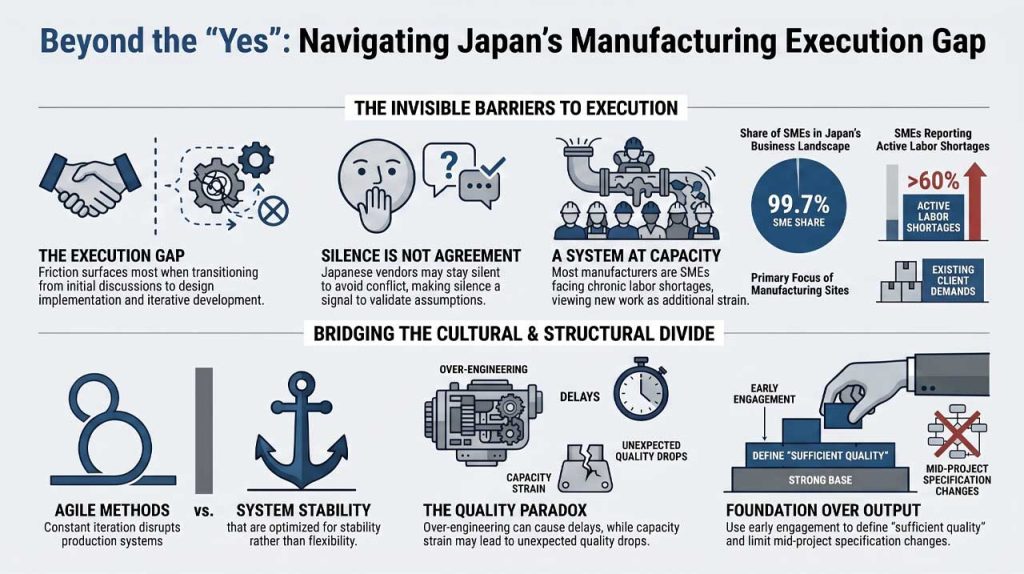
There have always been moments where global partnerships stall midway in Japan. Much of this comes down to how early-stage alignment can be misleading. Agreements appear to be reached, often smoothly. Yet the real test begins when projects move into execution.
Yoshiyuki “Zenko” Tamura, Founder and CEO of BITMOVES JAPAN Inc., describes this shift clearly in correspondence with KoreaTechDesk,
“Friction surfaces most prominently immediately after transitioning from initial discussions to the execution stage, which involves design implementation and iterative development.”

This insight implies that in Japan, gaining access is rarely the main obstacle. The real challenge begins when execution starts.
Many global startups focus heavily on partnerships and early traction. In Japan, however, success is shaped by what happens after those agreements transition into actual production and delivery.
Silence Is Not Agreement: A Misread Signal
Now, during cross-border partnership in Japan, one of the most persistent risks lies in communication. According to Tamura, it was especially crucial how to interpret Japanese silence.
Overseas teams often read silence or agreement as alignment. In practice, this assumption creates downstream problems.
Tamura explains that Japanese vendors may hesitate to express concerns early due to caution and a preference to avoid conflict.
“They fall into a situation where no opinions are given, they are brought up too late, or in the worst case, they remain completely silent.”
KOTRA has noted a similar pattern in its guidance for Korean companies entering Japan. It highlights that Japanese counterparts may respond with phrases such as “I see” or polite acknowledgment, which should not be interpreted as agreement or purchase intent.
This dynamic is not just simply cultural nuance. It becomes an operational risk when decisions move forward without shared understanding.
That is why for global founders working with Japanese manufacturers, silence should be treated as a signal to validate assumptions, not confirm them.
A System Under Pressure: Why Execution Breaks
The execution gap cannot be separated from the structure of Japan’s manufacturing ecosystem.
Small and medium-sized enterprises dominate the system, accounting for around 99.7 percent of all companies in Japan. Many operate under sustained labor shortages and rising operational pressure. Public data indicates that more than 60 percent of SMEs report being affected by labor shortages, while workforce constraints have become a long-term structural issue.
This environment shapes how projects are handled. New work is not always viewed as opportunity. It can be perceived as additional strain on already limited resources.
Tamura reflects this reality directly. Japanese manufacturing sites, he notes, are often “pushed to their limits just responding to the demands of existing clients.”
Execution challenges in Japan are therefore not isolated incidents. They are the result of a system operating close to capacity.
The Quality Paradox: Strength That Creates Friction
Japan’s reputation for high-quality manufacturing remains well established. However, this strength can introduce new risks during execution.
Tamura outlines two recurring patterns.
The first is excessive quality. In an effort to avoid failure or reputational damage, vendors may over-engineer solutions, increasing cost and extending timelines beyond what overseas clients expect.
The second is declining quality under pressure. When capacity is stretched, output may fall below expectations, particularly in projects where trust and alignment are not fully established.
This creates a complete paradox. Quality now becomes both a competitive advantage and a source of friction.
Hence, it is crucial for global startups and partners to specifically define what “sufficient quality” mean in early conversation. Because without that clarity, projects risk drifting in scope, cost, and delivery.
When Agile Meets Constraint
Many global startups rely on iterative development models. In software, this approach often improves speed and adaptability.
Yet in manufacturing, the same approach can create instability.
Tamura highlights that repeated specification changes can disrupt production systems that are already optimized with minimal resources.
“A process change means the collapse of the entire system,”
Tamura notes, particularly in environments where staffing and flexibility are limited.
At its core, this is a structural mismatch. Agile development moves through constant iteration, while Japan’s manufacturing system is designed for stability, where even small changes can disrupt the entire process.
When these two models collide, execution slows and costs rise instead.
Slow Decisions, High Stakes
Another point of tension in cross-border partnership challenge in Japan is the decision-making speed.
Foreign partners often expect rapid responses. In Japan, decisions tend to move more slowly due to internal consensus-building and risk management.
And this goes beyond just organizational habit. It actually reflects Japan’s economic and operational realities as highlighted by Japan’s Ministry of Economy, Trade and Industry (METI). Rising costs and limited margins mean that errors carry significant consequences.
That is why for global startups and partners, understanding this dynamic is critical. What appears to be a delay is often a response to the cost of failure, not a lack of urgency.
After all, as Tamura points out, while consensus-building can take time, it is still closely tied to ensuring execution reliability.
What This Means for Korea’s Startup Ecosystem
Now, Korean startups have increasingly looked to Japan as a strategic market, supported by geographic proximity and complementary industrial strengths. Early-stage engagement often progresses quickly, supported by strong product development and agile execution models.
However, the transition from entry to execution introduces a different set of challenges. And it is particularly complex and cautious when involving manufacturing vendors.
Japan’s manufacturing ecosystem operates under tighter constraints, slower decision cycles, and higher sensitivity to risk. For Korean startups, this requires a shift in execution strategy once projects move beyond initial engagement. Because without these adjustments, projects that move quickly at entry can stall once execution begins.
This dynamic is not limited to Japan. It is increasingly relevant across Asia-Pacific markets where execution systems differ sharply.
Expansion strategies can no longer focus only on market access or partnership formation. They must be tailored around how execution actually works on the ground in each market, particularly in systems where capacity and risk constraints shape decision-making.
Rethinking Strategy: Execution as the Real Entry Barrier
Now, these patterns point to a clear shift in how execution must be approached. Startups entering Japan should treat early-stage collaboration as preparation, not confirmation. Relationship-building, expectation alignment, and system understanding often require sustained effort before production begins.
Tamura emphasizes that the first phase of engagement is not about output. It is about building the foundation for execution.
This includes defining quality expectations, limiting mid-project changes, and recognizing the constraints faced by local partners.
Because execution success in Japan depends less on speed and more on alignment.
The Real Challenge Begins After Agreement
Finally, Japan’s manufacturing ecosystem remains globally competitive, but its operating conditions have evolved. Labor shortages, capacity constraints, and structural pressures are reshaping how projects move from agreement to delivery.
For global startups, this insight offers a clear lesson for partnerships with Japan’s manufacturing: early traction may signal opportunity, but it does not ensure that execution will follow.
Because in Japan, “yes” is only the beginning.
Key Takeaway
- Cross-border manufacturing in Japan often fails at the execution stage, not at market entry
- Silence in Japanese supplier communication can signal unresolved risk, not agreement
- Japan SME manufacturing networks operate under structural constraints, including labor shortages and limited capacity
- Agile development models often conflict with manufacturing systems that prioritize stability
- Quality expectations can create execution risk through over-specification or resource strain
- For Korean and global startups, success in Japan depends on execution alignment, not speed of entry
- Working with Japanese manufacturers requires early definition of scope, quality, and change management limits
– Stay Ahead in Korea’s Startup Scene –
Get real-time insights, funding updates, and policy shifts shaping Korea’s innovation ecosystem.
➡️ Follow KoreaTechDesk on LinkedIn, X (Twitter), Threads, Bluesky, Telegram, Facebook, and WhatsApp Channel.
🤝 Looking to connect with verified Korean companies building globally?
Explore curated company profiles and request direct introductions through beSUCCESS Connect.