
Many governance failures do not begin with a sudden crisis. They begin much earlier, when someone inside an organization quietly senses that something is wrong but chooses not to escalate it. As Korean companies face growing pressure around ESG, workplace safety, and global expansion, a deeper operational question is emerging: what happens when warning signals never reach the people capable of acting on them?
Korea’s Governance Challenge Is Shifting from Detection to Escalation
South Korea has spent the past several years strengthening corporate accountability frameworks across workplace safety, ESG disclosure, and supply-chain governance.
Yet operational failures continue to surface across industries despite the growing volume of reporting systems and compliance procedures.
The Ministry of Employment and Labor (MOEL) disclosed 376 workplaces in January 2026 for confirmed Industrial Safety and Health Act violations involving serious accidents, repeated non-reporting, or concealment of industrial accidents.
Earlier this year, MOEL also reported 403 Industrial Safety and Health Act violations across POSCO E&C headquarters and 55 worksites following inspections tied to repeated fatal accidents.
The issue that has been increasingly drawing attention is not simply whether companies have the reporting systems. The harder question is whether early concerns inside organizations can move through decision-making structures before incidents escalate publicly.
During discussions with KoreaTechDesk about ESG execution gaps inside Korean corporate systems, Wendy (Eunji) Yang, Founder and President of the International ESG & Human Rights Association (IEHRA), further explained that this is where many governance systems begin to fail operationally.
“The most common response in the field is:
‘Human rights, safety, the content is sound, but there is nothing a working-level employee can decide alone,’”
Yang told KoreaTechDesk.
“This is not a complaint. It signals a structural disconnect.”

Korean Workers Often Stay Silent Even When Problems Are Visible
Recent Korean workplace surveys suggest that formal reporting channels alone do not guarantee escalation.
A 2025 Yonhap report citing a Ministry of Employment and Labor workplace harassment survey found that 28.8% of workers had experienced or witnessed workplace harassment during the previous year. Yet around three in ten victims or witnesses reportedly took no action, partly due to concerns about workplace disadvantage or retaliation.
Another 2025 survey conducted by civic labor group Gabjil 119 and Global Research found that 33% of workers experienced workplace harassment during the previous year.
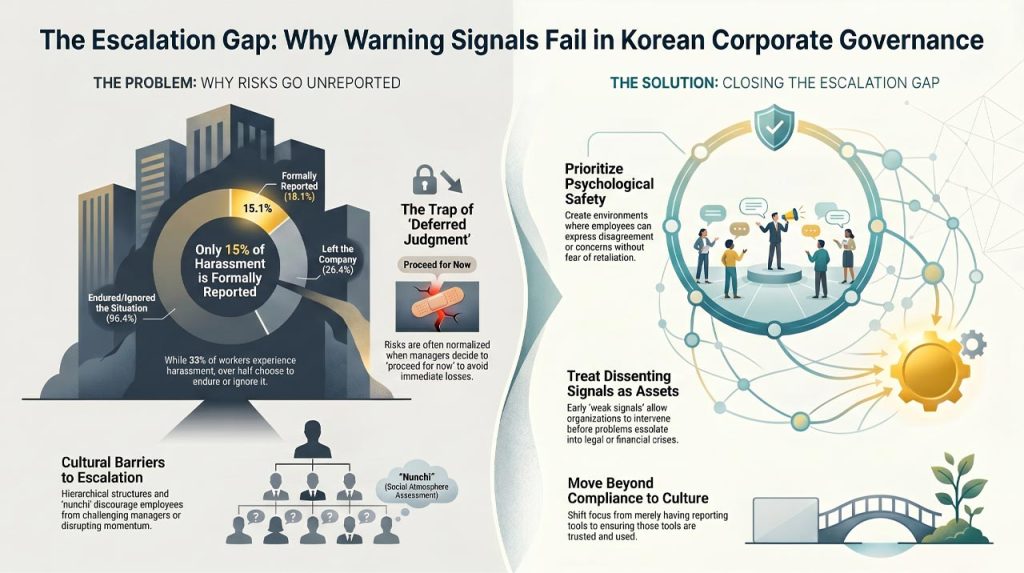
Among those respondents, 56.4% said they endured the situation or pretended not to notice it. Meanwhile, 26.4% left the company entirely, while only 15.1% formally reported the issue to a company, union, labor authority, or government body.
The data reflects a broader governance challenge increasingly discussed across global corporate systems. Employees may recognize risks early, but organizational structures often make escalation socially, professionally, or operationally difficult.
Yang explained that many organizations still struggle to convert internal awareness into actionable decision-making.
“Data exists, but cannot generate behavior.”
That disconnect becomes especially important inside highly hierarchical environments where reporting concerns may carry long-term career implications.
The Most Dangerous Governance Pattern Is Deferred Judgment
Yang believes governance failures frequently emerge through repeated small decisions to delay intervention rather than through a single catastrophic event.
“The judgments most frequently observed in the field are: ‘It’s strange, but let’s proceed for now.’ ‘Stopping now would be a bigger loss.’ ‘We’ll respond when a problem actually arises.’”
According to Yang, these decisions gradually normalize operational risk inside organizations. Over time, unusual situations stop being treated as warning signs and instead become absorbed into standard workflow behavior.
This issue is not unique to South Korea. Reuters reported in 2024 that an EY Global Integrity Report survey involving more than 5,400 respondents across 53 countries and territories found that 54% of people who used whistleblower systems felt pressured not to report concerns.
The findings suggest that many organizations globally still struggle to create escalation systems employees genuinely trust.
Yang argues that the problem often extends beyond formal compliance procedures.
“The state of deferred judgment itself is treated as risk.”
In practice, companies may technically possess grievance systems, ethics hotlines, or reporting procedures. Yet operational failure still develops when employees believe escalation will not change outcomes or may create personal consequences.

Why Hierarchical Workplace Culture Complicates Risk Detection
South Korea’s workplace culture adds another layer of complexity to governance escalation systems.
Korean corporate environments often operate through high-context communication patterns where hierarchy, group cohesion, and indirect signaling strongly influence workplace behavior. In practice, employees may avoid challenging managers directly, raising concerns publicly, or disrupting operational momentum.
Yang pointed to the broader Korean concept of “nunchi,” where individuals constantly assess social atmosphere and interpersonal dynamics before acting.
Under those conditions, weak operational signals may remain trapped inside middle-management layers rather than reaching executive decision-makers.
This challenge has also become increasingly important in global ESG governance discussions. The United Nations Guiding Principles on Business and Human Rights state that grievance mechanisms only function effectively when people trust the process and can safely access it.
The principles emphasize that operational-level grievance systems should be accessible, predictable, transparent, and capable of identifying harms early before they escalate further.
That requirement is becoming strategically important for Korean firms expanding globally, especially across multinational supply chains where language, hierarchy, and cultural interpretation can further complicate escalation.
Governance Systems Are Now Being Judged by How Early They Respond
As ESG governance matures globally, investors and operators are paying closer attention to how organizations handle early-stage operational signals rather than focusing only on post-incident reporting.
McKinsey has described psychological safety as a condition where employees feel safe expressing disagreement, raising concerns, and providing upward feedback without fear of punishment. Research increasingly links these conditions to stronger decision quality, learning capacity, and operational resilience.
For Korean firms, this creates a more practical governance challenge than simply expanding compliance systems. Companies must now determine whether employees can escalate concerns before those concerns become legally reportable incidents.
Yang believes organizations that succeed operationally are often the ones that preserve internal dissent rather than suppress it.
“Dissenting signals are treated as assets.”
She explained that companies capable of identifying weak warning signals early can often intervene before operational problems spread across legal, financial, or reputational layers.
And that distinction is becoming increasingly relevant for Korean startups and scaling firms entering global markets. Because in these companies, governance credibility has been increasingly affecting procurement access, investor confidence, partnerships, and long-term operational trust.
The Next Governance Advantage May Come from Listening Earlier
Finally, South Korea’s governance environment is entering a more operational phase. The challenge is no longer limited to building policies, disclosures, or reporting frameworks. The more difficult task is ensuring that weak signals inside organizations can travel upward before incidents become externally visible.
For founders, investors, and operators, this changes how governance itself is evaluated.
Strong governance increasingly depends on whether organizations can identify hesitation, repeated discomfort, delayed escalation, and suppressed concerns before those patterns evolve into larger operational failures.
As Korean companies continue scaling internationally, the ability to listen earlier may become one of the most important competitive advantages inside modern risk management systems.
Key Takeaways
- Korean firms are increasingly facing governance challenges tied to escalation failure rather than simple lack of reporting systems.
- A 2025 MOEL-linked survey found 28.8% of workers experienced or witnessed workplace harassment, yet many took no action due to fear of disadvantage or retaliation.
- A separate 2025 Gabjil 119 survey showed 56.4% of harassment victims endured the situation or ignored it, while only 15.1% formally reported it.
- Eunji (Wendy) Yang of International ESG & Human Rights Association argues that governance failures often emerge through repeated “deferred judgment” decisions where organizations recognize risks but delay intervention.
- Global whistleblower systems face similar trust problems, with an EY survey showing 54% of whistleblowers felt pressured not to report concerns.
- High-context workplace culture and hierarchical communication structures can prevent operational warning signals from reaching Korean decision-makers early enough.
- The next phase of governance may focus less on formal reporting systems and more on whether organizations can safely convert weak internal signals into actionable decisions before incidents escalate.
– Stay Ahead in Korea’s Startup Scene –
Get real-time insights, funding updates, and policy shifts shaping Korea’s innovation ecosystem.
➡️ Follow KoreaTechDesk on LinkedIn, X (Twitter), Threads, Bluesky, Telegram, Facebook, and WhatsApp Channel.
🤝 Looking to connect with verified Korean companies building globally?
Explore curated company profiles and request direct introductions through beSUCCESS Connect.