

Cities frequently launch smart city initiatives with ambitious goals and strong political support, only to find that many never progress beyond limited trials or demonstrations. Apparently, the challenge is rarely a lack of technology. More often, cities discover that deploying a solution is much easier than integrating it into fragmented institutions, disconnected systems, and long-term public operations.
Smart City Projects Rarely Fail Because of Technology
Cities around the world continue investing in smart city initiatives that promise better mobility, improved public services, stronger sustainability outcomes, and more efficient urban management.
However, international experience suggests that many projects struggle to move beyond the pilot stage. The Organisation for Economic Co-operation and Development (OECD) has repeatedly identified fragmentation, weak coordination, limited institutional capacity, and poor interoperability as common obstacles preventing smart city projects from achieving broader impact.
The problem is becoming increasingly important for Korean GovTech companies, smart city startups, digital infrastructure providers, and public-sector innovation teams seeking opportunities in overseas markets.
Success is no longer determined solely by whether the technology works. Because today, cities must also determine whether that technology can function within existing governance systems.

Why Smart City Pilots Often Stop Before Scale
Dr. Aleksandro Montanha, GDIN Ambassador in Brazil, Korean Valley project lead, and a participant in municipal innovation initiatives across Brazil, believes the underlying problem often begins long before implementation.
“Many cities operate through isolated systems acquired at different times, from different vendors, under different technical standards, and often without long-term interoperability planning,”
Montanha told KoreaTechDesk as discussion on market entry challenges in Brazil continues.
That reality creates a structural challenge for cities attempting to deploy new technologies.
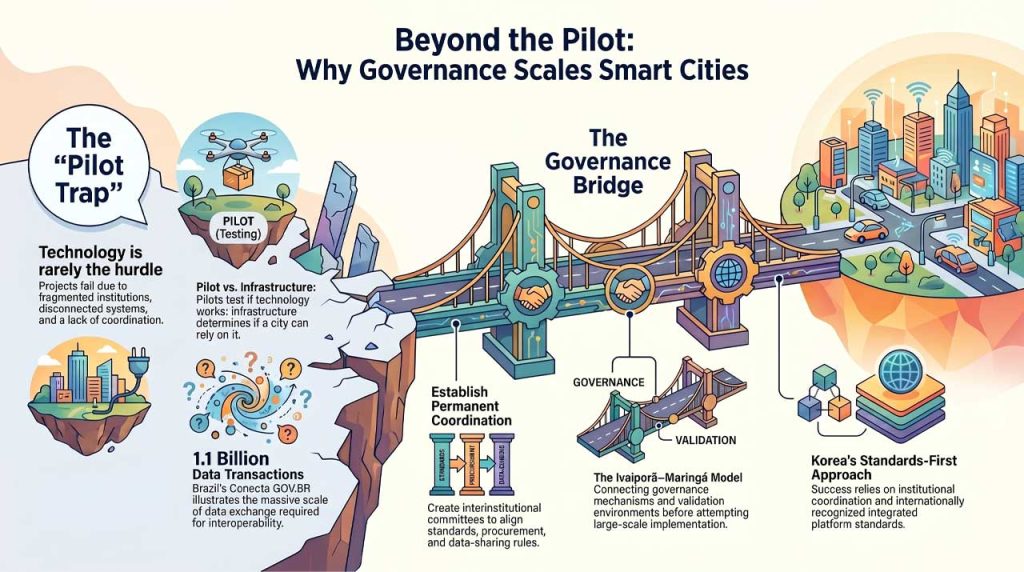
A pilot may perform well within a controlled environment, but large-scale adoption requires integration with existing databases, operational processes, procurement systems, public agencies, and technical teams.
Without that foundation, successful pilots can only become isolated demonstrations rather than operational infrastructure.

The Missing Layer Is Often Governance
Technology vendors frequently focus on platform capabilities, dashboards, sensors, analytics, or artificial intelligence.
Cities face a different problem.
They must coordinate multiple departments, legal frameworks, procurement procedures, technical standards, cybersecurity requirements, and public accountability obligations.
According to Montanha, many municipalities lack permanent coordination mechanisms capable of aligning those interests.
“In many situations, there is no permanent interinstitutional committee structure capable of coordinating decision-making, defining technical standards, or establishing trusted rules for data sharing and operational collaboration,”
he explained.
The OECD has also highlighted similar concerns. Smart city projects often involve multiple stakeholders with different priorities, yet many municipalities still lack governance structures capable of coordinating long-term implementation.
As a result, technology adoption becomes fragmented across departments, creating additional silos instead of reducing them.
Interoperability Determines Whether a City Can Scale Innovation
The discussion around smart cities often focuses on innovation itself.
But in practice, interoperability may be more important.
If transport systems, public safety platforms, environmental monitoring tools, administrative databases, and citizen-service applications cannot communicate effectively, cities struggle to generate meaningful operational improvements.
Brazil’s federal government has spent years expanding digital government interoperability initiatives, including Conecta GOV.BR, which facilitates secure data exchange across public institutions. Government data indicates that more than 1.1 billion data transactions were processed through the platform during 2025 alone.
But this challenge is not unique to Brazil, and the lesson extends well beyond its fragmented digital governance landscape.
Because as governments become increasingly digital, interoperability is gradually becoming a prerequisite for public-sector innovation rather than a secondary technical feature.

Ivaiporã and Maringá Offer a Different Model
One example highlighted by Montanha involves cooperation between the Brazilian cities of Ivaiporã and Maringá.
Earlier this year, the two municipalities established a technical and institutional cooperation framework designed to connect their innovation ecosystems, governance mechanisms, test environments, and technology initiatives.
“The objective is to establish interoperability between data infrastructures, experimental environments, governance mechanisms, and technical committees,”
Montanha said.
The significance of this approach lies in its focus on institutional integration rather than technology deployment alone.
Instead of treating innovation as a series of isolated pilots, the model attempts to connect governance structures, operational processes, and technical validation environments before large-scale implementation occurs.
That approach may attract less attention than launching a new platform or deploying another sensor network, but it addresses the underlying conditions that determine whether innovation can move beyond isolated pilots and become part of everyday city operations.
Korea’s Smart City Experience Highlights the Same Lesson
South Korea’s experience also illustrates why governance and interoperability matter in practice. While the challenges facing Brazilian municipalities differ in many respects, Korea’s smart city development demonstrates how long-term institutional coordination can support the transition from pilot projects to integrated urban systems.
More recently, Korea’s smart city integrated platform standards received international recognition through the International Telecommunication Union (ITU), supporting interoperability and integrated urban management capabilities.
The Korean model demonstrates that successful smart city development depends on institutional coordination as much as technological sophistication.
For Korean companies expanding internationally, this creates an important strategic consideration.
A city’s willingness to test technology does not necessarily indicate readiness for long-term deployment.
Founders and ecosystem operators evaluating overseas opportunities may need to spend as much time understanding governance structures, procurement pathways, technical ownership, and interoperability requirements as they do refining product features.
The Difference Between a Pilot and Infrastructure
A pilot project measures whether a technology can work.
But infrastructure determines whether a city can rely on it every day.
That distinction often separates successful smart city programs from those that remain trapped in demonstration mode.
Montanha believes operational outcomes ultimately matter more than institutional design discussions alone.
“Ultimately, what determines whether a project is effectively adopted is the quality of the results achieved.”
Yet measurable outcomes rarely emerge without governance structures capable of sustaining them.
Cities Do Not Become Smart Through Technology Alone
After years of ambitious pilots and digital experimentation, it’s clear how the smart city sector often celebrates innovation, experimentation, and emerging technologies, and those elements remain essential to urban transformation.
However, as cities adopt more digital systems, the challenge increasingly shifts from deploying new technologies to ensuring coordination, interoperability, operational ownership, and institutional continuity.
Technology may be enough to launch a pilot, but governance is what enables that pilot to evolve into reliable public infrastructure.
Hence, for Korean smart city startups, GovTech companies, and public-sector innovation partners, this may be one of the most important lessons from cities working to turn digital ambition into long-term operational reality.
Key Takeaway
- Smart city pilots frequently fail at the scaling stage because cities struggle with fragmented systems, weak interoperability, and limited institutional coordination.
- Interoperability is becoming a core public-sector requirement, allowing different departments, databases, and digital services to function as part of a unified operational environment.
- Governance gaps and weak coordination mechanisms can be more damaging to smart city projects than the limitations of the technology itself.
- Permanent governance committees and coordination mechanisms help cities align stakeholders, technical standards, procurement processes, and operational objectives.
- The Ivaiporã-Maringá cooperation model highlights an alternative approach, focusing on shared governance structures, data integration, and interoperable innovation environments.
- South Korea’s smart city experience reinforces the importance of standards and institutional coordination, not just advanced technology platforms.
- For Korean GovTech and smart city startups, deployment success increasingly depends on helping cities integrate technology into long-term operations rather than simply delivering successful pilots.
– Stay Ahead in Korea’s Startup Scene –
Get real-time insights, funding updates, and policy shifts shaping Korea’s innovation ecosystem.
➡️ Follow KoreaTechDesk on LinkedIn, X (Twitter), Threads, Bluesky, Telegram, Facebook, and WhatsApp Channel.
🤝 Looking to connect with verified Korean companies building globally?
Explore curated company profiles and request direct introductions through beSUCCESS Connect.