
South Korea’s creative industry is entering a new phase. Production has shifted, but power has not. AI is already changing how films and series are made. But it still has not changed how they reach audiences.
Previous KoreaTechDesk coverage has shown how AI is reshaping financing logic and expanding who can direct. But a third shift is now emerging. Production is opening, but distribution remains controlled.
This gap is becoming one of the most important structural constraints in Korea’s AI filmmaking landscape.
AI Is Expanding Production Capacity Across Korea’s Content Industry
The production side of the Korean content industry has moved quite rapidly.
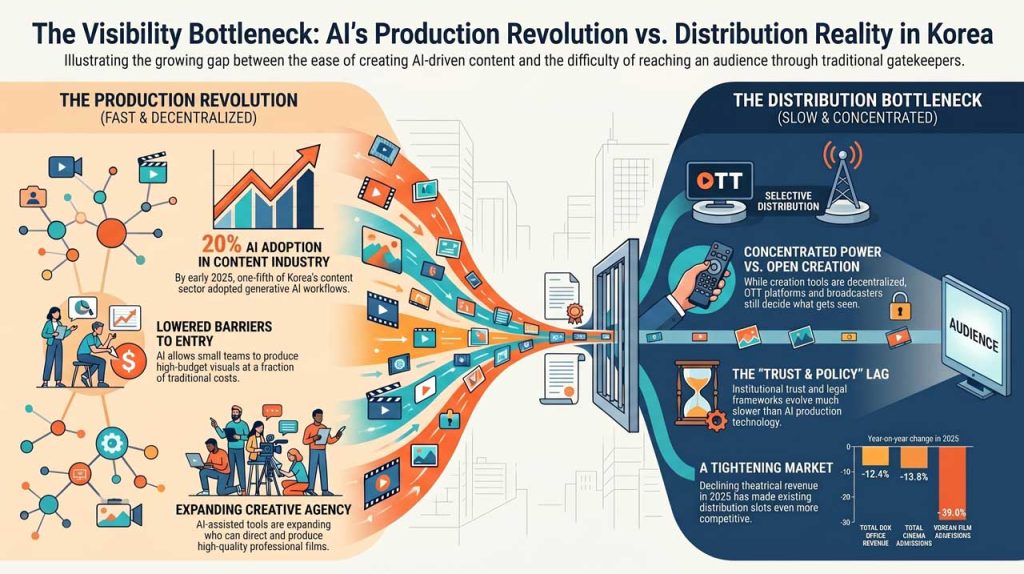
Data from the Korea Creative Content Agency (KOCCA) shows that generative AI adoption in Korea’s content sector reached around 20 percent in early 2025. Broadcasting and video production recorded some of the highest adoption rates, with AI used directly in content creation and production workflows.
This reflects a meaningful shift in capability. Tasks that once required large teams, specialized equipment, and high budgets can now be executed with smaller teams using AI-assisted tools.
In an interview with KoreaTechDesk, Eunkyoung Choi, CEO of Studio Clay and former MBC drama director, described how this change plays out in practice. Her AI short film Dream of Atlantis was produced at a fraction of the cost of traditional methods, with AI enabling visual environments that would previously require significant capital.
This is not simply a matter of efficiency. It has now completely changed who can produce.
Production barriers are lower. Entry points are broader. Creative output is increasing.
Distribution Remains Concentrated Despite Rising Output
On the other hand, access to audiences has not changed at the same pace.
Even as more creators gain the ability to produce, distribution channels remain concentrated in a small number of institutions. OTT platforms, broadcasters, and established theatrical networks still determine which projects reach viewers.
Choi identified this gap directly.
“Production capabilities have become far more democratized. But the channels through which a finished work reaches an audience are still controlled by the same gatekeepers as before.”
This reflects the structure of Korea’s media ecosystem. While production tools are decentralizing, distribution remains organized around platform selection, programming decisions, and established release pathways.
In practical terms, the number of creators is increasing faster than the number of available distribution slots.
A Tighter Market Is Making Distribution More Competitive
This imbalance is reinforced by broader market conditions.
According to the Korean Film Council (KOFIC), South Korea’s theatrical market declined in 2025. Total box office revenue fell by 12.4 percent year-on-year, while admissions dropped by 13.8 percent. Korean films saw a sharper contraction, with revenue down 39.4 percent and admissions down 39.0 percent.
This matters for distribution dynamics.
When fewer films succeed commercially and fewer releases are planned, access to screens and platforms becomes more competitive. Distribution does not expand alongside production capacity. It tightens instead.
At the same time, viewing behavior continues to shift toward OTT platforms. Data from the Korea Information Society Development Institute (KISDI) shows increasing usage of streaming and video services across devices, reinforcing the role of platforms as primary access points to audiences.
Production may be opening. But visibility remains constrained.
Platform Policies Around AI Content Are Still Forming
Another constraint also sits inside the platforms themselves.
There is currently no widely standardized framework for how AI-generated or AI-assisted content is evaluated by OTT services or broadcasters. Industry participants are still determining how to assess quality, authorship, and production integrity in AI-assisted works.
Choi pointed to this uncertainty.
“Many platforms still have no clear official policy on AI-generated content, and the label ‘AI production’ itself can introduce bias in the review process.”
This does not suggest rejection. It indicates ambiguity.
Without clear evaluation criteria, AI-created content enters a system that was designed around traditional production processes. That mismatch can slow acceptance.
Copyright and Rights Frameworks Are Still Evolving
At the same time, legal infrastructure adds another layer of friction.
South Korea’s Ministry of Culture, Sports and Tourism (MCST) has already signaled the need for updated policy frameworks to address AI-driven content production, including copyright and creator protection in the AI era.
The Korea Copyright Commission has issued multiple guidelines between 2025 and early 2026 covering generative AI outputs, copyright registration, and fair use in AI training. These documents reflect an active effort to clarify how AI-generated works are treated under existing law.
However, the system is still developing.
Current interpretations suggest that fully autonomous AI-generated content may not qualify for copyright protection unless human creativity is clearly involved. Questions around authorship, ownership, and licensing remain unresolved in many cases.
For distribution platforms, this creates risk.
If ownership is unclear, downstream monetization, licensing, and international distribution become more complex. As a result, legal uncertainty can slow platform adoption of AI-generated content.
The Core Constraint Is Still Trust
Beyond policy and platforms, a more fundamental constraint remains.
Trust.
Choi described this as the slowest-moving part of the system.
“Technology evolves quickly, but the time it takes for investors, platforms, and audiences to develop the sensibility and criteria needed to evaluate AI-created work is not something that can be compressed.”
Production tools can accelerate output. They cannot accelerate institutional confidence.
Platforms must trust that content meets quality standards. Investors must trust that projects can deliver returns. Audiences must trust that the experience is worth their attention.
These forms of trust take time to build. They are not replaced by technology alone.
What This Signals for Global Startup and Creative Ecosystems
Korea’s situation reflects a broader structural pattern.
AI is lowering the cost of creation across industries. Founders can build products faster. Creators can produce content independently. Prototypes and outputs are easier to generate.
But distribution remains concentrated.
In technology ecosystems, access to users is still shaped by platforms, marketplaces, and networks. In creative industries, access to audiences is still shaped by OTT services, broadcasters, and distributors.
This results in a consistent dynamic.
Creation decentralizes faster than distribution.
Korea offers a clear case study because it combines a globally competitive content industry with rapid AI adoption and a platform-driven distribution environment. That is why the tension between these forces is visible in real time.
Conclusion: Production Is Open, Access Is Not
At the end of the day, while AI has already changed how content is made in South Korea, expanding who can participate and lowered the cost of production, it still has not changed who controls visibility.
Distribution remains concentrated. Legal frameworks are still evolving. Platform policies are not fully defined. And trust is still forming.
The system is now split between fast-moving production and slower-moving infrastructure.
So, what happens next will depend on whether distribution, policy, and institutional trust can adapt to match the pace of production.
And until then, the ability to create will continue to expand, while the ability to be seen remains selective.
Key Takeaways on OTT Platform Gatekeeping in Korea’s AI Filmmaking
- Generative AI adoption in Korea’s content industry reached ~20% in early 2025, with strong uptake in broadcasting and video production (KOCCA).
- AI tools are lowering production barriers, enabling smaller teams and independent creators to produce high-quality visual content.
- Distribution remains concentrated in OTT platforms, broadcasters, and established theatrical networks, limiting access to audiences.
- Korea’s film market contraction in 2025 (KOFIC) has intensified competition for distribution slots.
- OTT usage continues to rise (KISDI), reinforcing platform control over audience access.
- Platform evaluation frameworks for AI-generated content are still evolving, creating uncertainty in acceptance.
- Copyright and authorship rules for AI-generated works remain under development (MCST, Korea Copyright Commission).
- The core constraint is institutional trust, which evolves more slowly than production technology.
- Global implication: AI decentralizes creation, but distribution power remains concentrated across platforms and ecosystems.
– Stay Ahead in Korea’s Startup Scene –
Get real-time insights, funding updates, and policy shifts shaping Korea’s innovation ecosystem.
➡️ Follow KoreaTechDesk on LinkedIn, X (Twitter), Threads, Bluesky, Telegram, Facebook, and WhatsApp Channel.
🤝 Looking to connect with verified Korean companies building globally?
Explore curated company profiles and request direct introductions through beSUCCESS Connect.