
South Korea already operates inside one of the world’s most connected digital consumer environments. Yet as brands continue chasing followers, downloads, and engagement metrics, many still struggle to maintain communities that people genuinely return to over time. The problem is becoming increasingly visible across fandom, commerce, and creator-driven ecosystems, where audience size alone no longer guarantees meaningful participation or long-term retention.
Why Large Digital Audiences Often Fail to Become Real Communities
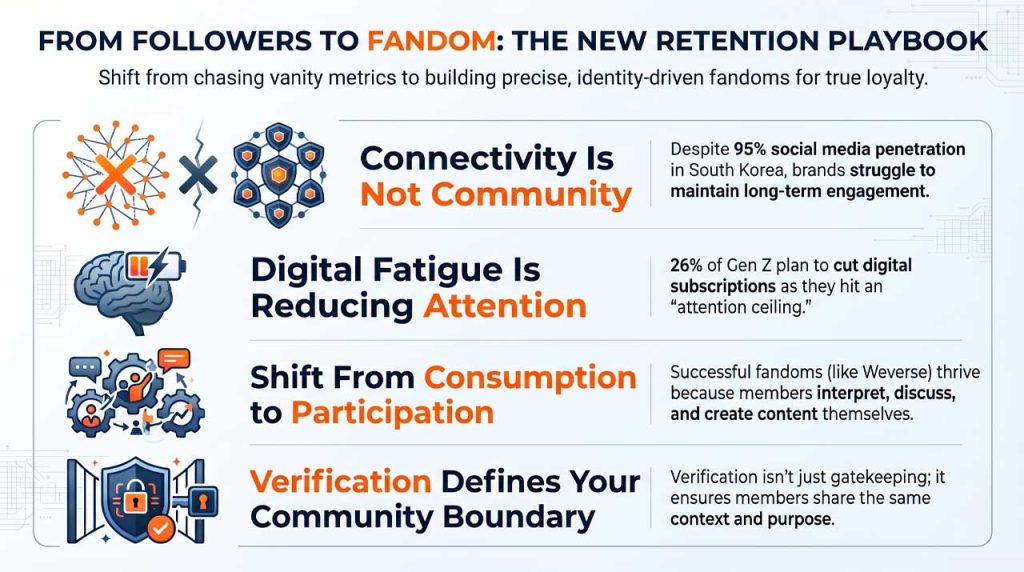
South Korea had 49.3 million active social media user identities in October 2025, according to DataReportal, representing approximately 95.4% of the country’s population. Internet penetration reached nearly 98%, making South Korea one of the world’s most digitally connected societies.
But highly connected audiences do not automatically create strong communities.
Many brands continue building digital spaces that combine casual followers, existing customers, event participants, fans, collectors, and temporary campaign audiences into one broad engagement pool.
While that structure can increase visibility, it also makes long-term interaction increasingly difficult to sustain.
Chaeun Jung, Brand Lead at RIBO’s, explored how brands lose visibility into actual product owners after the sale. He believes the problem often begins with unclear audience boundaries.
“Many brand communities struggle because their boundaries are too broad or unclear,”
Jung told KoreaTechDesk in a written interview.
That lack of clarity creates a deeper engagement problem over time. When communities contain too many different audience types with different motivations, brands often struggle to determine who the space is actually designed for and what value members expect in return.

The Digital Attention Economy Is Becoming Increasingly Exhausted
The pressure becomes more severe as brands compete inside an overcrowded digital entertainment environment.
Deloitte’s 2025 Digital Media Trends report stated that media companies, entertainment platforms, creators, and advertisers are all competing for roughly six hours of daily entertainment and media attention per consumer, a figure the firm noted is no longer significantly expanding.
At the same time, Euromonitor reported growing signs of digital fatigue among younger consumers. Its 2025 Voice of the Consumer: Digital Shopper Survey found that 26% of Gen Z respondents planned to reduce active digital subscriptions in 2025, compared with less than 18% in 2022.
That environment creates a difficult cycle for brand communities.
“The brand has to keep posting, hosting events, and creating reasons for people to come back,”
Jung explained.
The issue is no longer simply attracting audiences. The larger challenge is sustaining meaningful participation after the initial excitement fades.
Many digital communities now operate inside algorithm-driven ecosystems where visibility depends heavily on constant content production. Brands frequently respond by increasing campaigns, rewards, collaborations, livestreams, or limited promotions to maintain momentum.
But repetitive engagement tactics alone often fail to create long-term attachment.
Why Fandom Communities Behave Differently
Korea’s global fandom ecosystem provides a useful contrast because successful fandom communities operate around participation, identity, and shared context rather than passive audience accumulation.
Deloitte’s 2026 Digital Media Trends report found that 46% of fans actively seek fandom-related content from creators and are more likely to engage with content recommended by their communities. The same report noted that fans use an average of six social platforms, compared with four among nonfans.
The distinction matters because fandom behavior is rarely limited to simple consumption.
KOFICE’s 2025 Hallyu analysis described global Hallyu audiences as active participants who interpret, evaluate, discuss, criticize, and reinterpret Korean cultural content inside their own communities. Korea’s fandom economy has also increasingly evolved around participation as part of the experience.
That pattern has already expanded beyond entertainment.
A Korean policy analysis on the “fansumer” economy noted that fandom participation now influences planning, promotion, trend formation, and voluntary marketing activity across industries beyond K-pop.
IBK’s CEO Report similarly argued that business success is increasingly tied not only to audience scale, but also to the existence of active fandom structures.
In other words, stronger communities tend to emerge when members feel they belong inside a shared context, not simply because they clicked a follow button.
Why Verification Changes Community Precision
Jung believes one overlooked problem in modern community strategy is that brands often focus heavily on audience growth while overlooking relationship precision.
“Verification is not just a gatekeeping tool.”
Instead, Jung argues that verification can help brands better define who the community is actually built for and what type of experience members should receive.
“The relationship becomes more precise: who the brand is speaking to, why they are there, and what kind of experience should be offered to them.”
That distinction is becoming more relevant as brands experiment with owner-only access, premium membership systems, collectible ecosystems, limited communities, and fandom-linked experiences.
The broader strategic value is not necessarily exclusivity itself. The larger advantage is contextual relevance.
When participants share clearer reasons for belonging inside a community, brands can create experiences that feel more intentional and less dependent on endless attention generation.
Weverse Shows How Structured Participation Extends Engagement
South Korea’s fandom platforms already demonstrate how repeated participation can become part of a long-term engagement model.
Weverse’s 2024 Fandom Trend Report stated that fans created approximately 370 million posts during the year, while artists posted over 206,000 times. Fans also exchanged more than 96 million messages through direct messaging functions, while Weverse Live generated roughly 426 million cumulative views across nearly 5,800 livestreams.
Reuters previously reported that Weverse averaged more than 10 million monthly active users during the third quarter of 2023, with around 90% of users located outside South Korea.
The platform’s scale reflects more than audience size alone. It demonstrates how recurring participation, interaction rituals, direct communication, and shared identity can extend engagement beyond one-time content consumption.
Not every brand can build a fandom platform at Weverse’s scale. But the broader lesson is increasingly relevant across commerce, creator economies, and consumer communities globally.
Communities tend to remain active when participants feel their involvement carries ongoing meaning.
The Next Retention Challenge Is Becoming More Human Than Technical
The larger problem facing many brands today is not a lack of digital tools.
Companies already possess analytics systems, membership applications, social channels, livestream infrastructure, and customer engagement platforms. Yet many still struggle to create communities that maintain relevance after initial growth slows.
That challenge is becoming especially important as consumers face increasing digital overload and algorithm-driven content saturation.
The strongest communities in the next phase of digital commerce may not necessarily be the largest ones. They may instead be the communities where brands clearly understand who belongs there, why members continue returning, and what type of relationship participants expect to maintain over time.
Key Takeaway
- Large follower counts do not automatically create durable communities when audiences contain users with different motivations and weak shared identity
- South Korea’s highly connected digital market is increasingly exposing the limits of broad audience-driven engagement models
- Digital fatigue and constant competition for attention are making long-term community retention more difficult globally
- Fandom ecosystems succeed because participation carries identity, meaning, rituals, and shared context beyond passive consumption
- Verification can improve community precision by helping brands better define who the community is actually designed for
- Weverse demonstrates how recurring participation and structured interaction can sustain large-scale global fan engagement over time
- The next stage of brand community strategy may depend less on audience growth and more on creating meaningful reasons for members to return repeatedly
– Stay Ahead in Korea’s Startup Scene –
Get real-time insights, funding updates, and policy shifts shaping Korea’s innovation ecosystem.
➡️ Follow KoreaTechDesk on LinkedIn, X (Twitter), Threads, Bluesky, Telegram, Facebook, and WhatsApp Channel.
🤝 Looking to connect with verified Korean companies building globally?
Explore curated company profiles and request direct introductions through beSUCCESS Connect.