
Access to filmmaking in South Korea is no longer defined only by experience or networks. As generative AI moves deeper into production, a new class of creators is emerging with the ability to demonstrate capability early. This shift is exposing a growing gap between what creators can now produce and how the industry evaluates talent, with implications that extend beyond Korea’s media sector.
A New Entry Point Is Opening in Korea’s Film Industry
South Korea’s film and drama industry is beginning to see a shift that goes beyond production tools. It is changing who can participate.
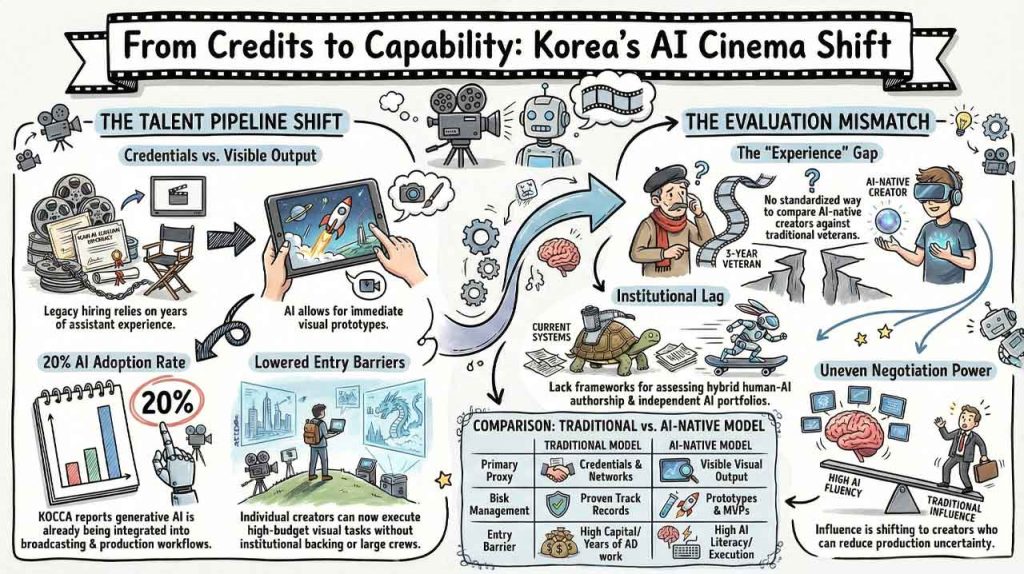
According to the Korea Creative Content Agency (KOCCA), generative AI adoption in the content sector reached around 20 percent in early 2025. Broadcasting and video production are among the most active segments, with AI increasingly used in content creation and production workflows.
This signals more than efficiency gains. It reflects a structural change in access. Tasks that once required large crews, high budgets, and institutional backing can now be executed by smaller teams or even individuals using AI-assisted tools.
In practical terms, the barrier to producing visual output has dropped. Entry into the industry is no longer defined solely by access to capital or networks.
Korea’s Traditional Director Pipeline Was Built on Credentials
Historically, Korea’s film and broadcast system has operated through a structured career path.
Directors typically emerged after years of experience as assistant directors or through established production networks. Hiring decisions relied heavily on track records, prior credits, and relationships within the industry.
This model aligned with how risk was managed. As highlighted in previous KTD coverage on financing, investment decisions in Korea still depend strongly on relationships and proven experience, a pattern also reflected in data from the Korean Film Council.
In this system, capability was inferred. A director’s past work and institutional backing served as proxies for future performance.
AI Is Turning Capability into Something That Can Be Seen Early
And yet today, AI is beginning to disrupt that assumption.
In an interview with KoreaTechDesk, Eunkyoung Choi, CEO of Studio Clay and a former MBC drama director, described how AI changes how creators present themselves.
“In traditional pitching, a director had to persuade through language alone… But the listener could only fill in the gaps with their own imagination.”
But that dynamic is now rapidly shifting.
“It is no longer ‘this is what I intend to make’ — it is ‘this is what I am capable of making.’”
AI enables creators to produce visual prototypes, concept trailers, and mood sequences before securing full production resources. Capability is no longer abstract. It becomes observable.
This mirrors a pattern familiar in startup ecosystems. Early-stage ventures increasingly rely on prototypes or minimum viable products to demonstrate feasibility. In Korea’s creative sector, AI is introducing a similar shift, moving evaluation closer to visible output.
The Industry Now Faces a New Question: How Do You Evaluate AI-Native Talent?
The emergence of AI-assisted creators introduces a problem the industry is not yet equipped to solve.
Choi pointed to a growing gap in evaluation.
“How do you compare an emerging director who has independently made a feature-caliber short film with AI to someone with five years of assistant director experience?”
This is not a theoretical concern. It reflects a mismatch between two systems.
On one side, production capability is expanding rapidly. KOCCA data confirms that AI is being integrated directly into content production processes, reshaping how work is created.
On the other side, hiring and evaluation frameworks remain tied to legacy indicators such as academic background, years of experience, and formal credits.
There is currently no standardized way to assess:
- AI-generated portfolios
- independently produced works outside traditional systems
- hybrid authorship between human creators and AI tools
As a result, the industry risks overlooking new forms of capability simply because they do not fit existing evaluation models.

Negotiation Power Is Shifting—But Not Evenly
The ability to demonstrate capability earlier has implications for creator leverage.
Choi noted that AI can strengthen a creator’s position in discussions with platforms or production partners. When a concept is supported by visual output, it reduces uncertainty and changes how conversations unfold.
However, this shift is uneven.
The advantage depends heavily on the creator’s level of AI fluency and their ability to produce high-quality results. Not all creators benefit equally. Those who can effectively translate ideas into compelling visual outputs gain disproportionate influence.
This creates a new layer of differentiation within the industry.
Access to tools alone does not equal opportunity. Execution capability remains decisive.
Institutional Systems Are Lagging Behind Production Reality
Beyond hiring, broader institutional frameworks are also struggling to keep pace.
Choi highlighted unresolved questions around authorship and credit.
“How much AI usage must be disclosed, and how the concept of co-authorship needs to be redefined are institutional conversations that cannot wait.”
This aligns with ongoing policy developments. South Korea’s broader AI regulatory framework, including the emerging AI Basic Act, reflects a wider effort to define governance and accountability in AI deployment. At the sector level, the Ministry of Culture, Sports and Tourism has identified the need for updated frameworks to address AI-driven content production. Meanwhile, the Korea Copyright Commission has released multiple guidelines covering AI-generated works, registration, and dispute prevention.
These efforts indicate that legal and regulatory systems are still evolving. The framework for defining ownership, contribution, and rights in AI-assisted content remains incomplete.
And so, the gap is not just technical. It is institutional.
Why This Matters Beyond Korea’s Creative Sector
Korea offers a useful case study because it combines a mature content industry with rapid AI adoption.
The shift underway reflects a broader pattern relevant to global startup and creative ecosystems.
Traditional systems rely on proxies such as credentials, experience, and institutional validation. AI introduces the possibility of evaluating capability directly through output.
This creates a tension seen across sectors:
- Established pathways versus new entry points
- Credentials versus demonstrable results
- Institutional validation versus independent creation
In startup ecosystems, similar dynamics have already reshaped how founders are evaluated. Demonstration of product capability often carries more weight than background alone.
Korea’s creative industry is now entering a comparable phase.
A Talent System Under Pressure to Adapt
AI is expanding who can create. That much is clear. Yet what remains unresolved is how industries recognize and validate that capability.
Production tools are evolving quickly. But evaluation systems are not.
This creates a structural tension. New creators can produce work that meets or approaches professional standards. But they still must operate in a system that measures value using older criteria.
For now, this gap limits how far the shift can go.
But over time, it may force deeper changes in how talent is identified, assessed, and trusted.
Key Takeaways on Creative Talent Evaluation in Korea’s AI Filmmaking Industry
- Generative AI adoption in Korea’s content sector reached around 20% in early 2025, with strong uptake in broadcasting and video production (KOCCA).
- AI tools are lowering entry barriers by enabling creators to produce high-quality visual outputs without traditional infrastructure.
- Korea’s film industry still evaluates talent based on credentials, experience, and prior credits, reflecting legacy hiring systems.
- AI enables creators to demonstrate capability earlier, shifting evaluation from abstract potential to observable output.
- There is no standardized framework to assess AI-native creators, creating a growing mismatch between capability and recognition.
- Negotiation power is shifting toward creators who can effectively use AI, but gains are uneven and skill-dependent.
- Legal and institutional frameworks around authorship, credit, and AI-generated content remain under development (MCST, Korea Copyright Commission).
- The broader implication for global ecosystems: industries must adapt evaluation systems as AI changes how capability is demonstrated.
– Stay Ahead in Korea’s Startup Scene –
Get real-time insights, funding updates, and policy shifts shaping Korea’s innovation ecosystem.
➡️ Follow KoreaTechDesk on LinkedIn, X (Twitter), Threads, Bluesky, Telegram, Facebook, and WhatsApp Channel.
🤝 Looking to connect with verified Korean companies building globally?
Explore curated company profiles and request direct introductions through beSUCCESS Connect.