
South Korea has built one of the world’s most dynamic startup ecosystems, producing globally competitive technology companies, deep technical talent, and strong government-backed innovation programs. Yet as more Korean startups attempt overseas expansion, a different challenge is emerging. Building a strong product inside Korea and operating successfully across multiple international markets often require very different organizational capabilities.
Korea’s Startup Ecosystem Is Growing Globally, but Global Scaling Remains Uneven
South Korea’s startup ecosystem has expanded rapidly over the past decade.
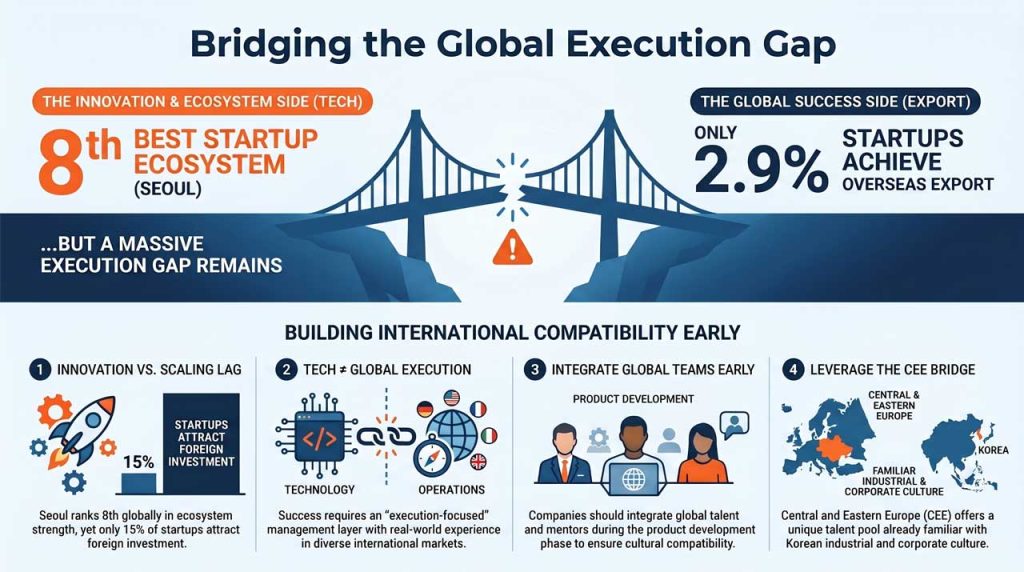
Startup Genome’s 2025 global ecosystem rankings placed Seoul eighth worldwide, while the city ranked first globally in knowledge accumulation and fifth in funding performance. Seoul also achieved “extraordinary” scores across five of six evaluation categories, reflecting the country’s growing position inside the global startup economy.
At the same time, overseas scaling performance remains comparatively limited across much of the broader startup ecosystem.
According to a 2025 report announcement by the Science and Technology Policy Institute (STEPI), only around 15% of Korean startups attracted foreign investment between 2015 and 2024. STEPI also stated that foreign venture capital represented roughly 2% of total domestic startup investment in 2023.
Meanwhile, the institute noted that only 2.9% of general Korean startups recorded overseas export performance as of 2023.
The contrast highlights an increasingly important issue across Korea’s startup ecosystem. Product innovation capability is growing rapidly, but international operating capability remains unevenly distributed.

Strong Technology Alone Does Not Automatically Build Global Operating Capability
Igor Strečko, Founding and Managing Partner at NeoZone Collective, former CEO of Webglobe, Managing Director at Strecko Investment, and a global investor-advisor who led more than 25 strategic acquisitions across multiple markets, believes the challenge is less about technical quality and more about execution readiness during scaling.
“South Korea has an extraordinary concentration of technical talent,”
Strečko told KoreaTechDesk during discussions on the operational challenges startups face after product-market fit.
“What it has less of are people who have actually scaled companies across 50+ markets or led operations in regions like Europe or the US.”
According to Strečko, many Korean startups continue relying heavily on domestic hiring structures even after entering international growth phases.
“Once companies enter the scaling phase, they often continue hiring internally or primarily from the domestic talent pool. That naturally creates limitations.”
His observation aligns with broader founder sentiment inside Korea’s startup ecosystem.
The Startup Trend Report 2025 found that although four out of ten Korean startups were preparing overseas market entry, companies identified difficulties securing local business networks, sales channels, and practical market information needed for expansion.
The issue is becoming increasingly relevant as Korean startups attempt to expand into more fragmented and operationally diverse global markets.
Global Expansion Requires Different Types of Management Experience
Now, the challenge is not simply language or localization. In many cases, startups discover that overseas scaling introduces operational complexity that domestic growth never fully exposed.
“What many expanding companies start missing is an execution-focused management layer with real international operating experience,”
Strečko explained.
He noted that international expansion often demands understanding of different customer expectations, sales cycles, management styles, hiring systems, regulatory environments, and decision-making cultures. And companies must face all these simultaneously.
This creates a different type of organizational requirement compared with building products inside a highly concentrated domestic ecosystem.
The Organization for Economic Co-operation and Development (OECD) similarly noted in a 2024 report examining startup globalization that international expansion increasingly depends on incubation networks, foreign partnerships, overseas placements, mentoring systems, and market-specific operational support.
The OECD also identified Korea’s K-Startup Center program as one of the government initiatives specifically designed to support startup internationalization through localized market assistance, legal support, networking, and operational guidance.
The Korea SMEs and Startups Agency (KOSME), which operates the K-Startup Centers, has stated that startups face fundamentally different overseas expansion challenges compared with traditional exporters, requiring customized support structures rather than standard export assistance alone.
Korea Is Expanding Global Talent Policies, but Integration Remains Difficult
Yes, South Korea has already started strengthening global talent attraction policies as part of its broader startup strategy.
The Ministry of SMEs and Startups (MSS) announced in its 2025 policy roadmap that Korea would revise Startup Korea Special Visa requirements to place greater focus on business outcomes and innovation potential. The ministry also outlined plans for a “K-Startup Silicon Valley Town” designed to function as a public-private global startup and venture hub.
Separately, KOTRA introduced the K-Tech Pass program targeting high-level international professionals hired by Korean high-tech companies, offering support involving visas, settlement, taxation, education, and concierge services.
In February 2025, Korea JoongAng Daily reported that Korea launched a Global Talent Center as part of a broader government plan to attract 1,000 international professionals into high-tech industries by 2030.
Still, attracting international operators and successfully integrating them into Korean organizations remain different challenges.
“Bringing in senior operators from Europe or the US is not always easy either,”
Strečko said.
“Many struggle to integrate into Korean corporate culture and management dynamics.”
Similar operational tensions have already appeared in Korea’s broader global talent hiring environment.
In a previous KoreaTechDesk interview, Monica Jung, founder and CEO of MH CAREER, explained that many Korean companies evaluate international hires not only on technical capability but also on how smoothly they can integrate into existing communication structures, workflows, and team dynamics.
As Korean startups expand overseas, these internal operational dynamics become more consequential. Companies entering foreign markets often need management teams capable of navigating different communication styles, customer expectations, hiring structures, and business cultures simultaneously.
The challenge is not unique to Korea. Many startup ecosystems encounter friction once domestic operating systems begin colliding with international scaling demands.
However, the issue becomes more visible when global expansion accelerates faster than the organization’s ability to adapt internally.
Why Mixed International Teams May Become More Important Earlier
Strečko believes Korean startups may need to approach internationalization much earlier inside the company-building process itself.
“Korean startups should start building international compatibility much earlier, already during the innovation phase, not only once expansion begins.”
According to Strečko, this includes intentionally building mixed international teams, working with foreign mentors, participating in overseas incubators, and maintaining direct exposure to different business environments long before large-scale expansion starts.
“This means intentionally building mixed international teams, spending meaningful time in foreign incubators and ecosystems, working with international mentors, and maintaining constant exposure to culturally different environments.”
And this perspective increasingly aligns with broader global startup ecosystem trends.
The OECD noted that startup internationalization support is becoming less focused purely on export promotion and more focused on long-term ecosystem connectivity, operational learning, and access to international business networks.

Central and Eastern Europe Is Emerging as a Practical Bridge
One region Strečko believes could become particularly valuable for Korean startups is Central and Eastern Europe (CEE).
“In this area, the CEE region can actually become a very valuable bridge.”
And this argument leads to the operational value. Korean industrial investment across the CEE region has already created local ecosystems with experience working directly with Korean companies.
A 2024 analysis on Korean investment in Central and Eastern Europe noted that Slovakia alone hosts more than 100 Korean companies, including Kia, Samsung, Hyundai Steel, Mobis, and multiple supplier networks employing more than 20,000 Slovak workers.
That existing industrial familiarity may create opportunities for Korean startups seeking operators, advisors, or regional partners already experienced in working across both Korean and European business environments.
The Harder Phase of Startup Scaling Starts After Product Success
Finally, Korea’s startup ecosystem has already proven it can produce globally competitive innovation. Government support programs, venture capital activity, and startup infrastructure have expanded substantially over the past decade.
The more difficult challenge now may involve building companies capable of operating internationally before global scaling pressure arrives.
Because product competitiveness alone rarely guarantees international execution readiness.
And as Korean startups continue entering increasingly fragmented and competitive overseas markets, the question may no longer center only on how to build stronger technology.
Increasingly, it may depend on how early companies begin building organizations capable of operating across different cultures, management systems, and global business environments simultaneously.
Key Takeaways
- South Korea has built a globally competitive startup ecosystem, with Seoul ranking eighth globally in Startup Genome’s 2025 ecosystem rankings.
- International scaling capability remains uneven, despite strong domestic innovation performance. STEPI reported that only 2.9% of Korean startups recorded overseas export performance as of 2023.
- Global expansion requires operational experience beyond product development, including cross-border management, local networks, hiring systems, and market-specific execution capability.
- Korean startups are increasingly seeking overseas expansion, but many still face difficulties involving local sales channels, market information, and business networks.
- Korea is expanding global talent and startup internationalization programs through initiatives involving MSS, KOSME, KOTRA, and the Global Talent Center.
- Mixed international teams and earlier global exposure may become increasingly important as Korean startups attempt to scale across more fragmented overseas markets.
- Central and Eastern Europe may function as a practical bridge region because of its existing Korean industrial presence and growing pool of professionals familiar with both Korean and European business environments.
– Stay Ahead in Korea’s Startup Scene –
Get real-time insights, funding updates, and policy shifts shaping Korea’s innovation ecosystem.
➡️ Follow KoreaTechDesk on LinkedIn, X (Twitter), Threads, Bluesky, Telegram, Facebook, and WhatsApp Channel.
🤝 Looking to connect with verified Korean companies building globally?
Explore curated company profiles and request direct introductions through beSUCCESS Connect.