
Many foreign founders assume market access begins when they secure a meeting. In Korea, the process often starts much earlier. Before a proposal reaches decision-makers, before a pilot project is discussed, and before commercial terms are reviewed, someone inside the ecosystem may already be shaping perceptions. That unseen layer of trust can determine which startups receive a second conversation and which disappear after the first introduction.
Korea Has Built More Entry Points for Foreign Startups
South Korea has spent the past several years expanding its support infrastructure for international founders.
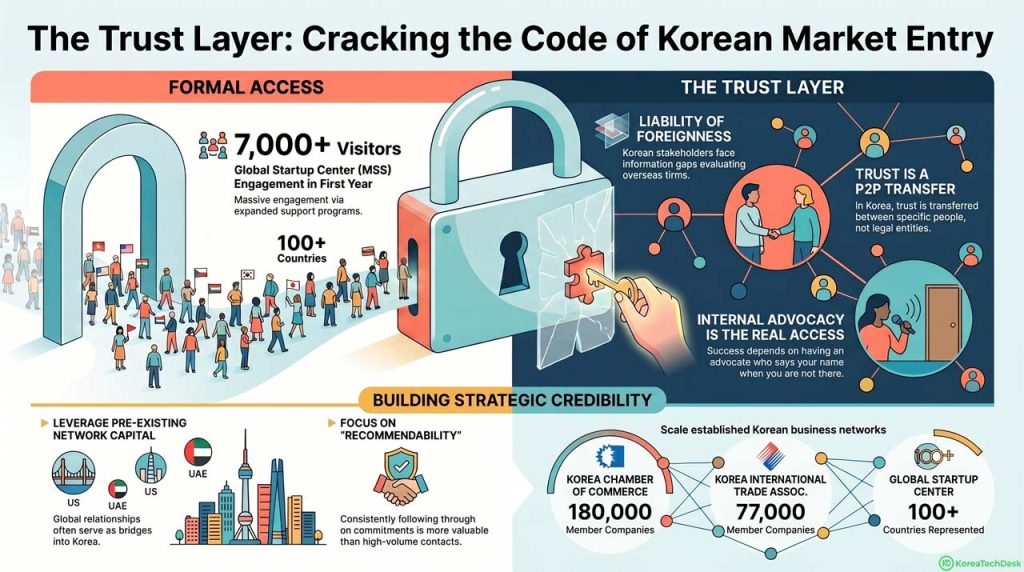
The Ministry of SMEs and Startups (MSS) announced that the Global Startup Center welcomed more than 7,000 visitors from over 100 countries during its first year of operation. The government has also expanded commercialization support, startup visa pathways, community programs, and networking initiatives designed specifically for foreign entrepreneurs.
As Korea positions itself as a more globally connected startup hub, its policy direction increasingly reflects an effort to attract and support international founders as part of its broader innovation strategy.
Still, easier access does not automatically translate into business opportunities.
That is because for many founders, the challenge begins after they enter the room.

Trust Often Functions as Korea’s Real Access Layer
Pidchayanin Chutipattana, CEO and Founder of ELKXA, works with international startups pursuing market entry into Korea and Korean organizations seeking cross-border collaboration.
Based on her experience supporting foreign companies navigating Korea’s startup ecosystem, she believes many founders misunderstand how business access develops after initial introductions.
“Access in Korea works through trust, and trust is transferred between people, not between companies.”
This perspective points to a distinction that many foreign founders overlook.
A startup may secure a meeting because its technology is compelling. But continuing the conversation often depends on whether someone inside the ecosystem is willing to associate their reputation with that company.
According to Chutipattana, foreign founders frequently focus on finding the right event, program, or potential customer. What they miss is the importance of building advocates who can provide context, validation, and credibility when discussions move behind closed doors.
“Most foreign founders think access is about getting into the right room. It’s not. It’s about having someone in that room who will say your name when you’re not there.”

Why Korean Decision-Makers View Foreign Companies Differently
Although similar relationship-driven dynamics exist in many countries, they can be especially noticeable in Korea, where business networks remain highly interconnected.
The U.S. International Trade Administration notes that maintaining strong local relationships remains an important factor for companies seeking long-term success in Korea. The agency also advises foreign businesses to establish a local presence and invest in ongoing relationship-building activities.
And part of them is actually for practical reasons.
Domestic companies are often easier to evaluate. They operate inside familiar legal, financial, and business environments. Decision-makers can gather information, verify references, and understand market reputations through existing networks.
Foreign startups face what researchers call a “liability of foreignness,” meaning they often operate at an information disadvantage.
Korean stakeholders may have limited visibility into the company’s track record, fewer reference points for evaluating its reputation, and less familiarity with how it operates outside Korea.
Now, this uncertainty does not necessarily prevent business relationships from forming, but it does make trusted introductions and credible advocates significantly more valuable.
“A Korean decision-maker choosing to work with a foreign company is putting their own judgment on the line internally,”
Chutipattana explained.
When viewed through that lens, trust becomes less about personal preference and more about risk management.
The Hidden Power of Network Capital
Many founders assume trust-building begins only after they arrive in Korea, but Chutipattana has observed that some of the companies that gain traction in the market often start with an advantage: relationships that were established long before Korea became an expansion target.
Foreign founders who studied, worked, or built businesses in markets such as the United States, the United Kingdom, or the United Arab Emirates sometimes developed relationships with Korean professionals overseas. Those connections later became valuable bridges when expansion discussions began.
The lesson is not that founders need a large Korean network before entering the country. Rather, trust tends to build gradually through repeated interactions, shared experiences, and mutual connections.
Relationships that formed over time, even in completely different contexts or countries, can later become valuable bridges into Korea, and business opportunities may emerge years after those connections were first made.

Korea’s Ecosystem Is Expanding, But Credibility Still Travels Through People
As more foreign founders enter Korea through government programs and startup initiatives, the country’s startup ecosystem has become increasingly international.
Government programs, startup hubs, accelerators, corporate innovation initiatives, and industry organizations have created more opportunities for foreign founders than ever before.
The Korea Chamber of Commerce and Industry represents approximately 180,000 member companies through 73 regional chambers. The Korea International Trade Association counts more than 77,000 member companies. These organizations reflect the scale and connectivity of Korea’s business landscape.
Yet networks alone do not create trust.
People do.
And for foreign startups, this means that market entry is not simply a process of collecting contacts. It is about building enough credibility that people feel comfortable introducing you to their own networks.
The Question Founders Should Be Asking
Many startups entering Korea spend considerable time evaluating market size, regulatory requirements, customer demand, and competitive positioning, and those factors remain essential.
However, Chutipattana believes founders should also ask a different question: Who is willing to advocate for your company when you are not present?
The answer can reveal more about a startup’s real standing than simply counting how many meetings it has held. Relationships may help create opportunities, but they cannot make up for a weak product in the long run. Likewise, having a strong product does not automatically earn trust.
In Korea’s startup ecosystem, both product quality and credibility matter. A strong product can attract attention, while trust often influences whether conversations and opportunities continue.
Trust Is Difficult to Measure, But Easy to Miss
Getting into Korea used to be the biggest challenge. Today, the harder part is being remembered for the right reasons.
International founders now have much easier access to accelerators, government programs, startup communities, and mentors than they did in the past. The doors are more open than ever.
But open doors do not automatically create trust.
The founders who gain traction often approach things differently. Instead of trying to collect as many introductions as possible, they focus on becoming the kind of company others feel confident recommending. They show up consistently, follow through on commitments, and invest in relationships that grow over time.
Because in Korea, some of the most important decisions happen in conversations you never hear.
The meeting may get you in the door. What people say after you leave often determines whether you’re invited back.
Key Takeaway
- Korea has expanded formal entry channels through startup programs, commercialization support, and international founder initiatives.
- Trust remains a critical business mechanism because Korean stakeholders often evaluate risk through relationships and reputation.
- Trust is often transferred between people rather than between companies, making personal credibility and relationships central to market access.
- Internal sponsorship matters. A trusted advocate can help a foreign startup gain credibility when commercial decisions move behind closed doors.
- Foreign startups face additional information gaps because Korean stakeholders often have fewer ways to verify overseas companies compared to domestic firms.
- Network capital can be built long before market entry. Relationships developed in third countries may later become valuable bridges into Korea.
- Product quality attracts attention, but credibility often determines who receives continued engagement and business opportunities.
– Stay Ahead in Korea’s Startup Scene –
Get real-time insights, funding updates, and policy shifts shaping Korea’s innovation ecosystem.
➡️ Follow KoreaTechDesk on LinkedIn, X (Twitter), Threads, Bluesky, Telegram, Facebook, and WhatsApp Channel.
🤝 Looking to connect with verified Korean companies building globally?
Explore curated company profiles and request direct introductions through beSUCCESS Connect.