
A foreign professional delivers fluent Korean during a meeting in Seoul. The grammar is correct, the pronunciation is polished, and the presentation appears successful. Yet weeks later, the project quietly stalls, communication becomes distant, and the relationship weakens without direct explanation. So, what happened?
Across workplaces in South Korea, many international professionals are discovering that language fluency alone apparently does not guarantee workplace integration or execution.
Korea’s Global Talent Push Is Growing Faster Than Workplace Adaptation
South Korea is actively expanding its global talent strategy as demographic pressure, labor shortages, and internationalization efforts accelerate across industries.
According to the Ministry of Justice, foreign nationals accounted for 5.44% of Korea’s total population in 2025, reaching 2.78 million residents. Among them, nearly 594,000 held employment-related visa status.
Statistics Korea separately reported that the number of employed foreign residents increased by 99,000 year-on-year in 2025, with the foreign employment rate reaching 65.5%.
At the same time, the Korean government is strengthening long-term international talent pipelines. The Ministry of Education’s “Study Korea 300K Project” aims to attract 300,000 international students by 2027, while programs such as K-Tech Pass are designed to attract highly skilled foreign professionals in advanced industries.
Korea’s startup ecosystem is also increasingly tied to this international talent strategy. A recent survey linked to the Korea SMEs and Startups Agency (KOSME), reported by Korea JoongAng Daily, found that 78.4% of surveyed SMEs expressed willingness to hire international employees.
Yet hiring foreign talent and integrating foreign talent inside Korean organizations are proving to be very different challenges.
Why Fluent Korean Still Fails Inside Korean Workplaces
For many foreign professionals, the biggest workplace friction in Korea begins after their language proficiency improves.
Jinseong Kim, founder of AI communication platform Noonchi.ai, believes the problem is often misunderstood as a simple language barrier, when—in fact—the deeper issue involves what she describes as “hidden social operating systems” inside Korean workplaces.

Before launching Noonchi.ai, Kim worked across enterprise sales, cybersecurity initiatives, community leadership programs, and AI-driven product development in Korea. These experiences have exposed her directly to recurring communication friction between Korean organizations and international professionals.
In an interview with KoreaTechDesk, Kim explained:
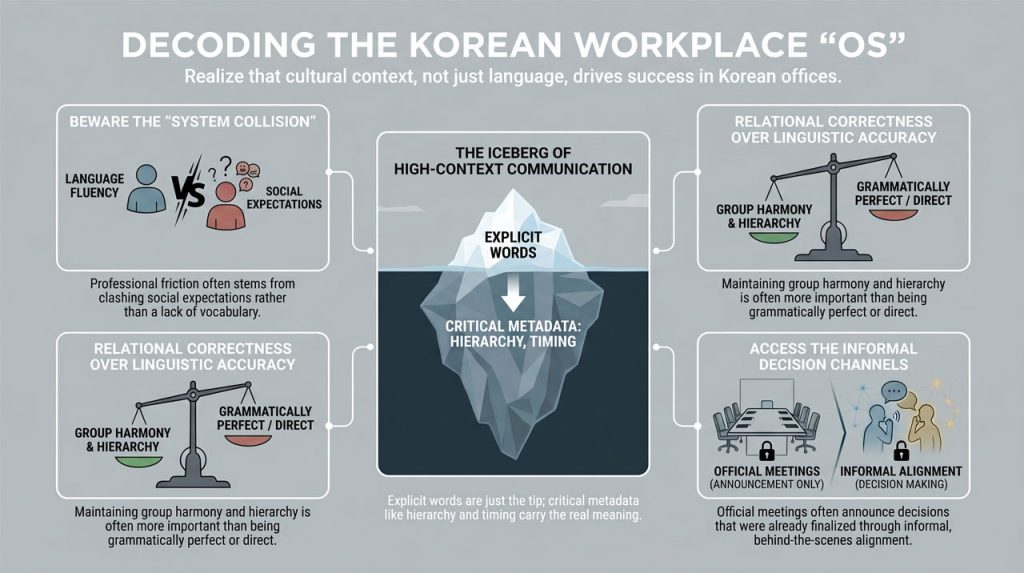
“The most common breaking point isn’t a lack of vocabulary. It’s a ‘System Collision’ — a clash between two fundamentally different social operating systems,”
According to Kim, many international professionals arrive with strong Korean speaking ability but still struggle to interpret the contextual signals that shape real workplace execution.
“Korea is a high-context society. The spoken word is just the tip of the iceberg.”
Kim elaborated her explanation.
“The linguistic layer may come through perfectly. But the critical metadata — hierarchy, intent, timing — is often lost in transmission.”
This gap becomes particularly visible in professional environments where indirect communication, hierarchy, and informal consensus mechanisms still influence decision-making. That is why, as KoreaTechDesk previously discussed, capability and language proficiency alone are just not enough for successful global talent integration within Korean teams.

The Hidden Workplace Logic in Korea Many Foreign Professionals Never See
One recurring challenge involves what happens outside formal meetings.
Kim explained that many international professionals assume official meetings are the primary place where decisions are made. In practice, important alignment may already happen through informal conversations before the meeting itself begins.
“In Korean organizations, official meetings are often an announcement of what has already been decided,”
Kim said.
“The real decision-making happens through informal channels.”
As a result, foreign professionals who focus only on formal communication channels may unintentionally become disconnected from strategic conversations even while performing well in visible workplace tasks.
Kim describes this phenomenon as “Contextual Data Loss,” where the explicit words are understood correctly, but the underlying meaning, relational signals, or organizational expectations remain unclear.
Research on Korean communication patterns has long identified similar characteristics. Academic studies on Korean high-context communication note that meaning is often shaped by relational status, implicit understanding, ambiguity, and social expectations rather than direct verbal expression alone.
This dynamic also extends into Korean honorific systems and workplace hierarchy. Korean communication frequently requires speakers to continuously adjust speech levels, tone, and indirectness depending on age, seniority, familiarity, and social setting.
Even advanced Korean learners may still struggle because the challenge is no longer grammar accuracy, but situational calibration.
Relational Correctness Often Matters More Than Linguistic Accuracy
Kim argues that many communication breakdowns occur because foreign professionals optimize for grammatical correctness while Korean workplace environments often prioritize relational correctness.
One example involves direct refusal.
A foreign employee may communicate clearly and efficiently in Korean while unintentionally sounding confrontational or dismissive within the local workplace context. The issue is not incorrect Korean. The issue is how the message interacts with hierarchy, timing, and group harmony expectations.
“Users almost always assume the problem is their linguistic interface.
They come to us asking, ‘How do I say X in Korean?’ But the real root cause is an inability to decode the logic of the Korean social OS.”
This is one reason why communication friction often persists even among professionals with high Korean proficiency scores or years of experience living in Korea.
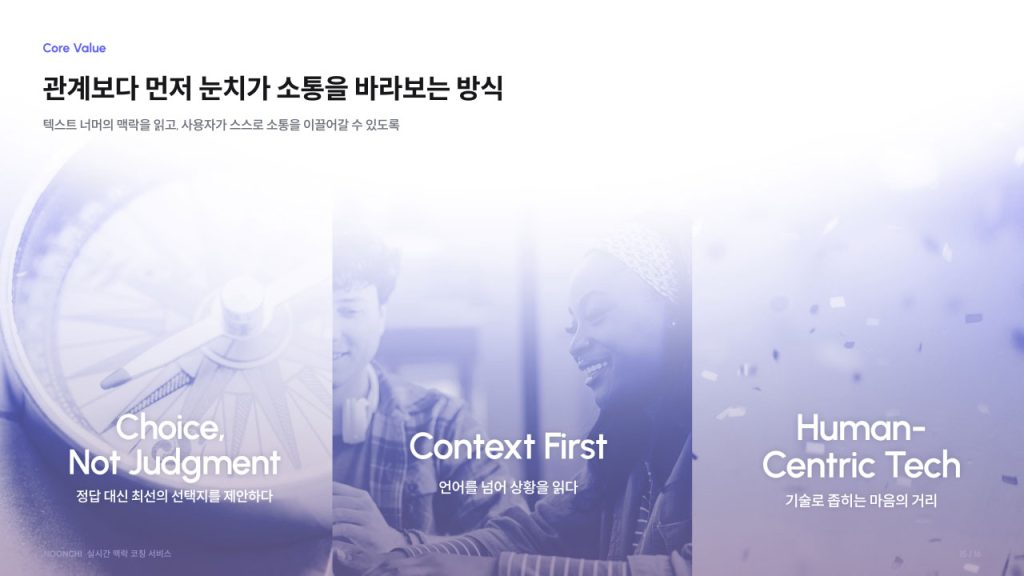
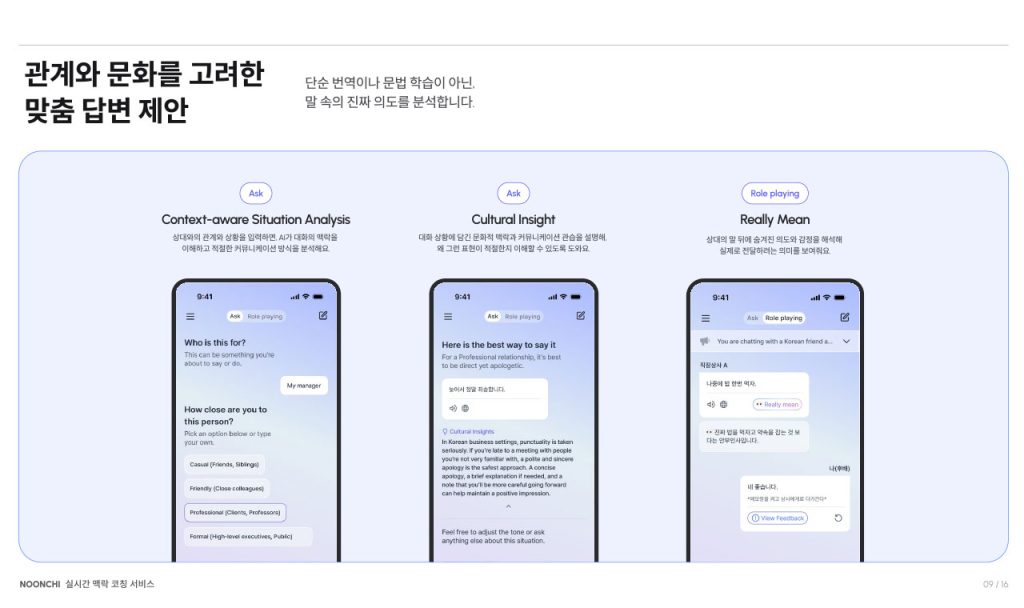
Kim said Noonchi.ai increasingly positions itself less as a translation tool and more as what she calls a “context decoder” designed to help users navigate relational dynamics behind Korean communication patterns.
Korea Internationalization Challenge Is Becoming an Organizational Challenge
Today, the issue is no longer limited to personal adaptation.
As Korea pushes to attract more global talent, communication systems inside organizations are becoming increasingly important to long-term retention, operational effectiveness, and cross-border collaboration.
Kim believes many organizations still underestimate how easily international professionals can become unintentionally excluded from informal decision-making structures.
“The intention is kindness,”
she said, referring to situations where foreign employees are excluded from Korean-language discussions for convenience.
“The outcome is strategic powerlessness.”
This creates what she describes as “Soft Exclusion,” where foreign professionals remain physically included in organizations while lacking access to the contextual loops that shape influence, trust, and execution.
The challenge is becoming more significant as Korea’s workforce internationalizes faster than many workplace communication systems evolve.

Global Talent Ambitions in Korea May Depend on Communication Transparency
Finally, Korea’s international talent strategy is increasingly tied to economic competitiveness, startup growth, and demographic sustainability. Yet attracting global professionals may ultimately require more than visa expansion, hiring incentives, or English documentation.
The deeper challenge may involve making Korean workplace expectations more visible and navigable without expecting international professionals to decode every unspoken rule alone.
Kim believes this shift requires organizations to become more intentional about explaining how communication, hierarchy, and decision-making actually function in practice.
“To become a true global hub, Korea must address what I’d call a crisis of cultural interoperability.”
As Korea continues to position itself as a global startup and innovation hub, the ability to translate not only language but also workplace context may become increasingly important for companies hoping to retain international talent beyond recruitment itself.
Key Takeaway
- South Korea’s foreign resident population reached 2.78 million in 2025, reflecting the country’s accelerating dependence on international talent.
- Many foreign professionals in Korea struggle even after achieving Korean language fluency because workplace execution often depends on hierarchy, contextual signaling, and informal consensus systems.
- Jinseong Kim, founder of Noonchi.ai, describes this challenge as “System Collision” between a foreign professional’s linguistic ability and the hidden “Korean Social OS.”
- The issue often involves “Contextual Data Loss,” where grammar is understood correctly but underlying meaning, intent, or relational signals are missed.
- Korean workplace communication frequently prioritizes relational correctness over grammatical correctness, especially in situations involving hierarchy, indirect communication, and group harmony.
- As Korea expands global talent policies and international hiring, organizational communication transparency may become a critical factor for long-term talent retention and workplace integration.
🤝 Looking to connect with verified Korean companies building globally?
Explore curated company profiles and request direct introductions through beSUCCESS Connect.
– Stay Ahead in Korea’s Startup Scene –
Get real-time insights, funding updates, and policy shifts shaping Korea’s innovation ecosystem.
➡️ Follow KoreaTechDesk on LinkedIn, X (Twitter), Threads, Bluesky, Telegram, Facebook, and WhatsApp Channel.