

Cross-border venture capital is often discussed through startup investments, acquisitions, and expansion plans. However, some investors are taking a quieter route into new markets. Instead of backing startups directly, they are first becoming limited partners in local venture funds. That approach may reveal something important about how Korea-Japan startup collaboration is evolving beneath the surface, where information, relationships, and trust often matter before capital moves at scale.
Korea-Japan Venture Capital Ties Are Expanding Beyond Startup Deals
Publicly, Korea and Japan have spent the past two years strengthening startup and venture cooperation through joint funds, investment summits, and founder exchange programs.
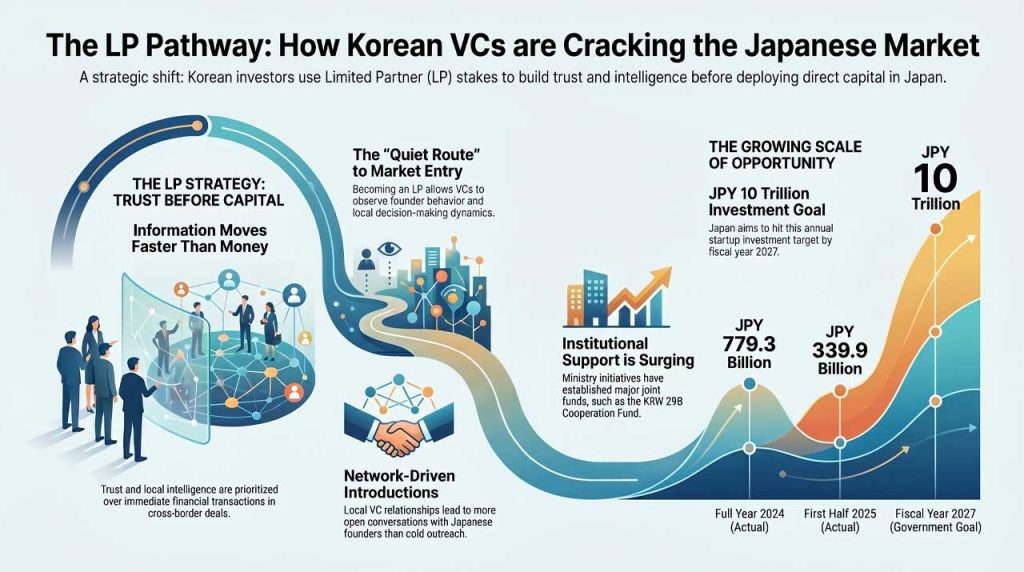
In February 2025, South Korea’s Ministry of SMEs and Startups (MSS) hosted the Korea-Japan Startup Investment Summit in Tokyo, where Korean and Japanese investors announced a KRW 29 billion Korea-Japan Cooperation Global Fund. The initiative followed an earlier USD 100 million Korea-Japan joint fund announced in 2024, reflecting growing interest in cross-border startup investment.

Those developments have largely focused on direct investment activity and startup collaboration. Yet beneath those public initiatives, another pattern has also been emerging.
Some investors are choosing to learn the market first before pursuing startup investments directly.
Korean Investors Are Studying Japan Before Deploying Deeper Capital
As discussions around Korea-Japan venture collaboration continue to expand, some investors appear to be taking a more gradual path into the Japanese market. Rather than immediately pursuing startup deals on their own, they are first seeking ways to better understand how the ecosystem operates from within.
Takahiro Kawanishi, a General Partner and Head of IR at ALPHA Inc. Japan, the firm lists a Korean venture capital investor among its limited partners. The Korean VC joined the fund while evaluating opportunities in Japan, offering a practical example of how some foreign investors are choosing to approach the market.
“We have a Korean VC as an LP in ALPHA,”
Kawanishi told KoreaTechDesk in an exclusive interview.
“That firm is actively exploring Japan as an investment market.”
The move stands out because it differs from the more visible strategy of investing directly in Japanese startups. By participating as an LP in a local venture fund, the investor can observe a wider range of companies, sectors, and investment activity while gaining exposure to the fund’s ongoing interactions with founders and the broader ecosystem.
And for many overseas investors, that perspective can be valuable. In markets where business relationships, founder networks, and local context often influence investment outcomes, fund participation may provide a deeper understanding of the landscape before larger amounts of capital are deployed directly.
“Japan can be difficult to understand from the outside. Business culture, investor networks, founder behavior, a lot of the important context doesn’t show up in market data,”
Kawanishi said.
Kawanishi’s perspective is shaped by an extensive experience on both sides of the LP-GP relationship. Before becoming a GP at ALPHA, he had spent years evaluating venture fund managers as an institutional investor, giving him firsthand insight into how investors assess unfamiliar markets.

Why Japan’s Startup Market Looks Different From Inside the Ecosystem
Japan’s startup ecosystem continues to attract attention from domestic and foreign investors.
According to Speeda and INITIAL, Japanese startups raised approximately JPY 779.3 billion (about USD 5.2 billion) in 2024, excluding debt financing. During the first half of 2025, startups raised another JPY 339.9 billion (about USD 2.3 billion) despite a more selective funding environment.
Government support has also expanded. Japan’s Startup Development Five-year Plan aims to increase startup investment to JPY 10 trillion (approximately USD 67 billion) by fiscal year 2027 while supporting the creation of more startups and unicorn companies.
Those figures help explain why foreign investors are paying closer attention to Japan.
However, Kawanishi argues that numbers alone do not provide the full picture.
An investor visiting Tokyo for a few meetings may learn about individual companies. Building conviction about an ecosystem requires something deeper: repeated exposure to founders, sectors, investment patterns, and local decision-making dynamics over time.
Through regular interactions with local venture funds, LPs gain visibility into trends that may not appear in market reports.
“The value of entering as an LP is not only about receiving information. It is also about developing a continuous view into the market while gradually building trust and relationships within the local ecosystem.”
That distinction may be particularly important for Korean investors. Korea’s venture ecosystem has matured rapidly over the past decade, creating pressure for some investors to explore opportunities beyond their home market. And Japan offers a different industrial base, different founder networks, and different market conditions.
But understanding those differences requires more than just capital.

Korea-Japan Venture Collaboration May Begin With Information, Not Checks
Cross-border capital discussions often focus on transactions, but Kawanishi believes LP participation can offer benefits that extend beyond market information.
Echoing to previous KoreaTechDesk discussion on Japan’s startup ecosystem, relationships remain an essential part of investor-founder interactions, and local venture funds can help create connections that may be difficult for foreign investors to establish independently.
As he explained,
“Compared to a situation where an overseas investor reaches out directly without any local connection, introductions through an existing VC relationship may lead to much more open conversations with founders and companies.”
In that sense, LP participation can become more than just financial allocation. It can serve as a long-term pathway into local networks, helping foreign investors build familiarity with founders, investors, and ecosystem participants before pursuing deeper activity in the market.
That idea also helps explain why fund-level cooperation has gained momentum alongside startup-level collaboration.
While startup investments create direct exposure to individual companies, LP participation allows investors to observe a broader cross-section of the ecosystem. They can evaluate founder quality, identify emerging sectors, understand local market behavior, and build relationships before deploying larger amounts of capital.
As Kawanishi puts it,
“Before capital can flow effectively, trust and information need to flow first.”
And this statement may as well capture an overlooked reality behind many successful cross-border investment relationships.

What This Means for Korean Startups Entering Japan
The same relationships that help investors understand Japan may also become valuable for startups entering the market. Kawanishi believes the greatest value of cross-border capital often comes from the networks that accompany it.
“Real opportunity comes from practical local networks and long-term relationship building.”.
That view helps explain why some investors are willing to spend years building market familiarity and local relationships before expanding their activity in a new ecosystem.
But at the same time, he cautioned against assuming that success in Korea automatically translates into success in Japan.
“I think one important thing for Korean startups to understand is that success in Korea does not automatically translate into success in Japan.”
He noted that Japanese investors often evaluate a company’s long-term commitment to the market.
“Beyond short-term fundraising, they tend to look at whether the company is serious about building a presence in Japan, for example, whether they are willing to build a local team, communicate with customers in Japanese, and invest time into long-term relationship building.”
That perspective helps explain why some investors choose to spend time understanding the ecosystem before deploying larger amounts of capital.
Market knowledge, local relationships, and trust are not only important for investors. They can also shape how effectively startups enter and grow within Japan.
Before Capital Moves, Trust and Information Move Faster
The Korea-Japan startup relationship is becoming easier to measure through new funds, investment summits, and cross-border deals. But what remains harder to measure is the flow of trust and information that happens before those transactions occur.
The Korean VC that joined ALPHA as an LP was not seeking immediate exposure to a single startup. It was gaining a closer view of the market itself, including founder behavior, investment activity, and local networks that are difficult to understand through public data alone.
That may be one of the more practical lessons emerging from the relationship between Korea and Japan’s venture ecosystems. Capital often receives the most attention, but information, trust, and local understanding frequently determine where that capital eventually goes.
Key Takeaway
- A VC choosing to enter Japan through an LP position in ALPHA signals that gaining market insight and local access may be a priority before deploying capital more aggressively.
- Japan’s startup ecosystem continues to attract attention, supported by government initiatives and hundreds of billions of yen in annual startup funding.
- LP participation provides long-term market visibility, helping investors understand founder behavior, sector trends, and local networks.
- Takahiro Kawanishi of ALPHA argues that trust and information often move before capital, particularly in cross-border venture relationships.
- Korea-Japan startup cooperation is expanding at both fund and startup levels, creating new opportunities for investors and founders.
- For Korean startups entering Japan, local understanding remains critical, even as cross-border capital connections become stronger.
– Stay Ahead in Korea’s Startup Scene –
Get real-time insights, funding updates, and policy shifts shaping Korea’s innovation ecosystem.
➡️ Follow KoreaTechDesk on LinkedIn, X (Twitter), Threads, Bluesky, Telegram, Facebook, and WhatsApp Channel.
🤝 Looking to connect with verified Korean companies building globally?
Explore curated company profiles and request direct introductions through beSUCCESS Connect.