
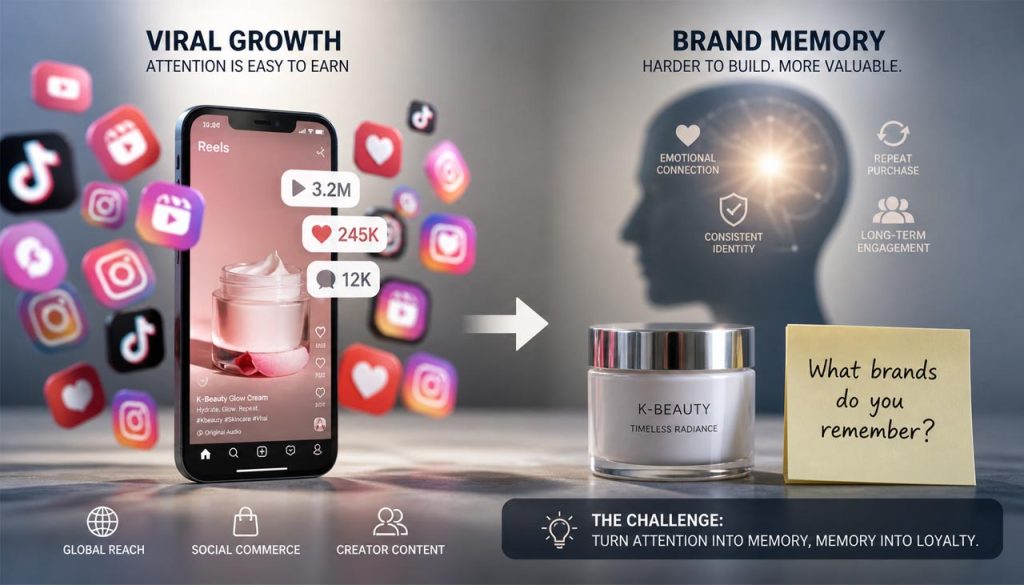
Global markets are no longer short on Korean brands. They are short on Korean brands that people remember. As K-beauty and consumer startups gain rapid visibility through social platforms, a new gap is emerging between attention and retention. The next phase of global expansion will depend on whether brands can move beyond viral moments and build identities that persist across markets, platforms, and repeated consumer decisions.
Viral Growth Has Been Solved. Brand Memory Has Not
Korean brands have become highly effective at capturing global attention. Short-form platforms, creator collaborations, and social commerce have enabled rapid visibility across markets, particularly in beauty, lifestyle, and consumer products.
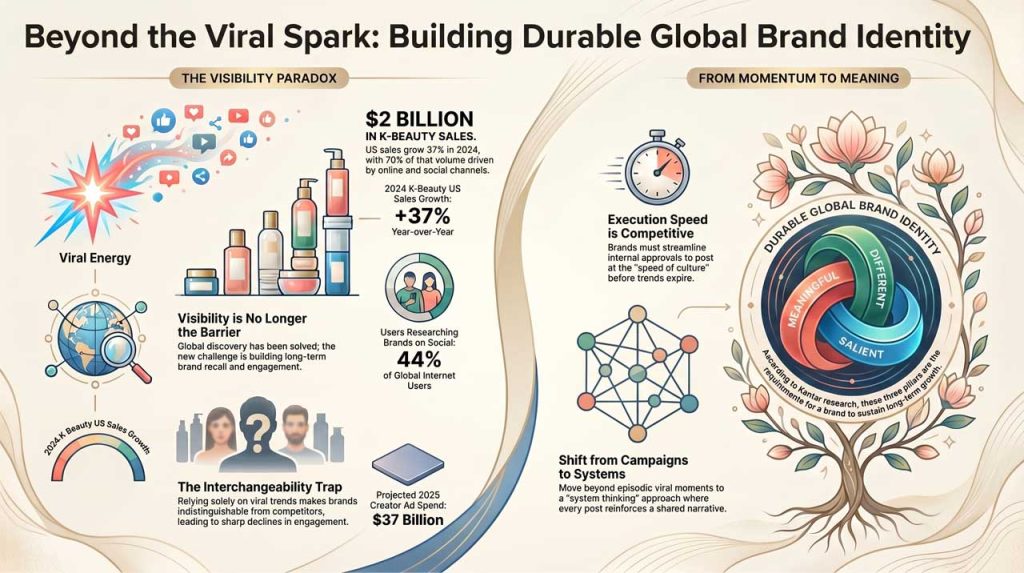
Data from NielsenIQ shows that K-beauty sales in the United States reached USD 2 billion in 2024, growing 37% year-on-year, with 70% share driven by online and social channels.
This confirms a structural shift, showing that global discovery is no longer the primary barrier. Korean brands are reaching audiences at scale.
Yet, the next stage of growth is revealing a different constraint: visibility may be increasing, but brand recall and long-term engagement are not always keeping pace.
So the challenge now is no longer how to be seen. It is how to be remembered.
When Attention Does Not Translate Into Recall
Social platforms have evolved into full consumer decision environments. Research from We Are Social indicates that 44% of global internet users now rely on social media to research brands before making a purchase decision.
This changes the role of content. Because now, every post, collaboration, or campaign contributes to how a brand is perceived and remembered over time.
However, in a high-speed environment driven by trends and formats, consistency often breaks down.
As discussion on the trust gap in K-beauty’s global expansion continues with KoreaTechDesk, Anna Lena Maerz, Founder and CEO of Seoul to Studio, described a recurring pattern across Korean brands expanding globally:
“Many brands chase short-term virality by jumping on every social media trend. While this gets views, it doesn’t build a recognizable brand. If a consumer can’t remember your name ten minutes later, you haven’t gained a customer.”
This reflects a deeper structural issue. Viral exposure can generate traffic, but without a stable identity, that traffic does not accumulate into brand memory.
Trend Participation Can Make Brands Interchangeable
The global beauty sector offers a clear signal of how quickly digital momentum can fade.
Analysis from Vogue Business shows that even well-established brands experience sharp declines in engagement when content formats become saturated.
For example, brands such as CeraVe and The Ordinary saw significant drops in top-performing social content between 2024 and 2025, as similar formats were widely replicated across competitors.
The implication is not that trend participation is ineffective. Rather, it becomes less differentiated over time.
When multiple brands adopt the same storytelling style, visual language, or creator format, the content may remain visible, but the brand itself becomes harder to distinguish.
In this environment, consumers may remember the trend, the product category, or the creator. They may not remember the brand.
Global Brands Are Built on Meaning, Not Momentum
Long-term brand strength depends on something more durable than visibility.
Research from Kantar, based on millions of consumer interviews across markets, shows that brands that are meaningful, different, and salient are significantly more likely to sustain long-term growth.
These brands are not defined by how often they appear, but by how clearly they are understood. They create consistent associations that persist across campaigns, platforms, and markets.
For Korean brands, this represents a shift in operating logic. Success is no longer defined only by how quickly a product or campaign gains traction. It is defined by whether that traction builds a recognizable identity that consumers can return to.
Internal Execution Speed Is Becoming a Competitive Factor
Now, the challenge is not only external. It also exists inside organizations.
Global social platforms operate at the speed of culture. Trends emerge, peak, and fade within days. Yet many companies still rely on centralized approval structures designed for slower, more controlled communication environments.
Anna Lena Maerz pointed to this constraint directly:
“Global social media moves at the speed of culture; if a creative team or agency requires multiple levels of corporate sign-off for a 15-second video, the trend has often expired before the content is even posted.”
This creates a structural mismatch, where brands struggle to keep pace with fast-moving cultural moments while also failing to maintain a consistent identity. Execution becomes even more uneven, and over time, both responsiveness and brand coherence begin to erode.
Industry analysis from Hootsuite supports this shift. Its 2026 social media trends report highlights how brands are increasingly investing in streamlined workflows, in-house content teams, and clearer governance structures to respond faster while maintaining strategic alignment.
Creator Ecosystems Need Identity to Scale
Creator marketing has become a central growth engine.
The Interactive Advertising Bureau projects that the creator economy will reach USD 37 billion in ad spend in 2025, growing significantly faster than the broader media market.
However, this growth also introduces complexity. Creator collaborations can amplify reach, but without a clear brand system, they risk producing fragmented messaging across channels.
Strong-performing brands increasingly treat creators not as isolated campaigns, but as part of a coordinated ecosystem that reinforces a consistent identity.
Examples from the K-beauty sector illustrate this shift. Brands such as Medicube have combined viral content with structured product positioning, creator education, and retail expansion to convert short-term visibility into sustained growth.
The key difference lies in accumulation. Each interaction builds on a shared narrative rather than resetting the brand story with every campaign.
From Viral Spikes to Repeatable Identity Systems
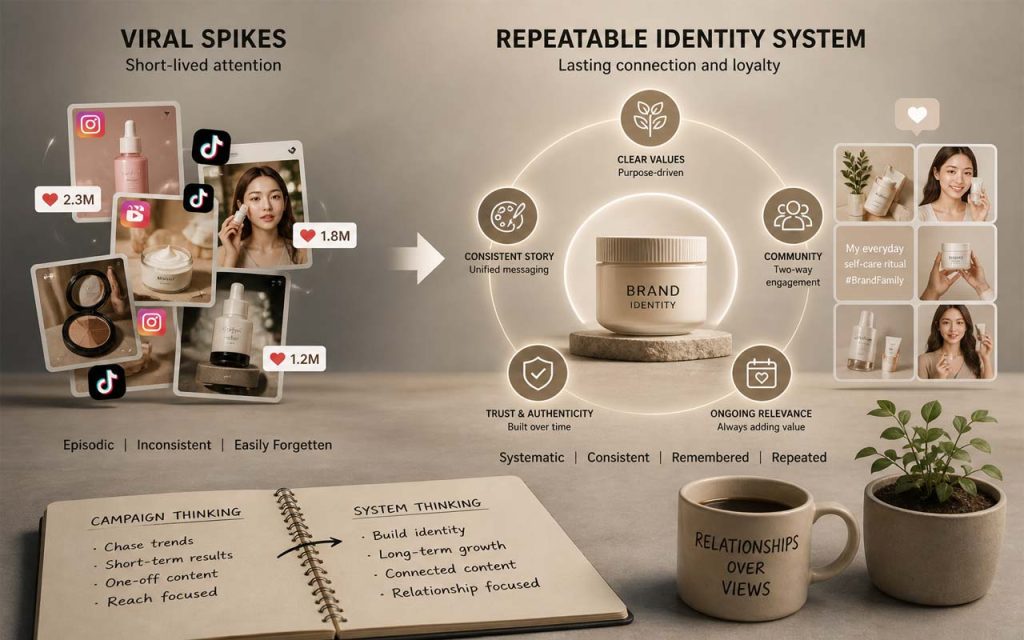
The next phase of Korean brand expansion will depend on how companies move beyond episodic success.
And this requires a shift from campaign thinking to system thinking.
Instead of asking how to generate the next viral moment, brands must ask how each piece of content contributes to a broader identity that remains consistent over time.
Anna Lena Maerz described this shift as a move toward deeper engagement:
“Scaling is about deepening the relationship with your audience, not just increasing your view count. To stand out, you must provide a reason for people to follow beyond just the product.”
This aligns with broader industry movement toward value-driven communities, where consumers engage with brands not only for products, but for ongoing relevance in their daily lives.
The Next Competitive Layer: Identity That Endures
Korean brands have already proven they can capture global attention. The challenge now is turning that attention into something that lasts.
Visibility alone does not guarantee that consumers will remember, prefer, or return to a brand. Without a clear and consistent identity, even strong initial traction can fade before it becomes meaningful growth.
A brand that is clearly understood can survive shifts in platform algorithms, content formats, and consumer trends. A brand that is not clearly defined must continuously fight for visibility without accumulating long-term value.
For founders, investors, and ecosystem operators, this changes how global expansion should be evaluated. Early traction is no longer enough. The key question becomes whether a brand is building something that consumers can remember, return to, and recommend.
Because in global markets shaped by constant content flow, the advantage will not come from being seen once.
It will come from being remembered repeatedly.
Key Takeaway
- Global visibility is no longer the main barrier for Korean brands, as social platforms and creator ecosystems have already enabled large-scale discovery.
- Viral content alone does not build brand memory, and repeated trend participation can make brands interchangeable.
- Consumers increasingly research brands through social media, making consistency across content critical for recall and retention.
- Strong global brands are built on clear identity, supported by research from Kantar on meaningful, different, and salient brand perception.
- Internal execution speed matters, as slow approval structures can prevent brands from participating effectively in fast-moving cultural environments.
- Creator marketing must be structured as a system, not isolated campaigns, to reinforce consistent brand identity.
- The next phase of Korean brand expansion depends on retention, where identity, not just visibility, determines long-term global growth.
🤝 Looking to connect with verified Korean companies building globally?
Explore curated company profiles and request direct introductions through beSUCCESS Connect.
– Stay Ahead in Korea’s Startup Scene –
Get real-time insights, funding updates, and policy shifts shaping Korea’s innovation ecosystem.
➡️ Follow KoreaTechDesk on LinkedIn, X (Twitter), Threads, Bluesky, Telegram, Facebook, and WhatsApp Channel.