
South Korea’s participation in Horizon Europe has opened a major pathway into Europe’s research and innovation ecosystem. Korean startups can now look beyond domestic programs and engage with European partners through one of the world’s most visible public R&D funding frameworks.
But visibility can create a strategic mistake.
For many Korean startups, the first question should not be how quickly they can enter Horizon Europe. It should be how they can build the European collaboration record that makes Horizon Europe realistic later.
That distinction matters. Horizon Europe may be the largest opportunity, but it is not always the right starting point. For startups entering Europe’s R&D funding landscape, programs such as Eurostars, Eureka Network Projects, CELTIC-NEXT, and ITEA may offer a more practical route into the system.
Horizon Europe Is the Destination, Not the First Door
Horizon Europe remains the European Union’s flagship research and innovation program. Its scale and policy importance naturally attract attention from governments, universities, research institutes, and technology companies.
Yet startups often need a different entry logic.
Erel Rosenberg, Co-CEO of i46, has worked on European funding programs and collaborations involving Korean partners. As discussion on EU funding projects for Korean startups continued with KoreaTechDesk, he explained that startups should not treat Horizon Europe as the immediate first move.
“Begin with Eureka Cluster projects, as they are generally easier to access and less competitive.”
This does not mean Horizon Europe is irrelevant for Korean startups. It means the path toward Horizon Europe may need to be built through earlier participation in smaller, more targeted European R&D programs.
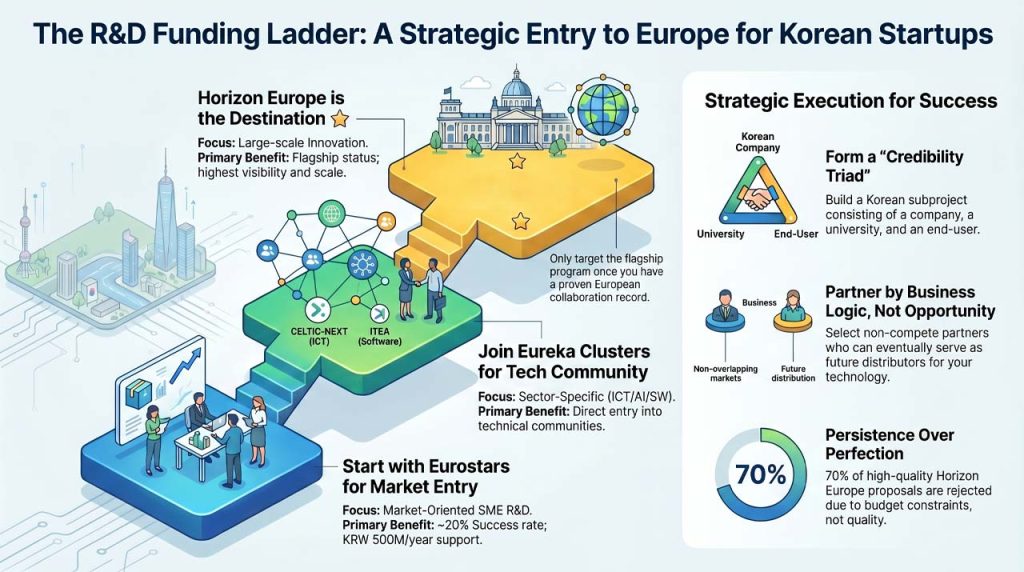
For founders, that changes the strategy. Instead of treating Horizon Europe as a single application target, Korean startups may need to view Europe as a funding ladder.
Eurostars Gives Korean Startups a More Practical First Step
Eurostars is one of the most relevant starting points for startup-led European R&D collaboration.
The program is managed through Eureka Network and is designed for innovative SMEs working on international R&D projects. Eurostars is structured as a market-driven R&D program for SMEs, with historical data indicating funding rates around the high-20% range, significantly higher than many large-scale EU instruments.
The program is designed to support international collaboration on technologies that can move toward commercialization within a defined timeframe, typically within two years after project completion.
For Korean startups, the program is especially relevant because Korea already participates through its national support structure.
In its 2026 Eurostars-3 Call 10 notice, the Korea Institute for Advancement of Technology (KIAT) described Eurostars as a market-oriented R&D program led by SMEs and mid-sized companies. KIAT also stated that Korean participants can receive support of up to KRW 500 million per year for up to three years, subject to program conditions and selection.
That makes Eurostars more than an alternative funding source. It can function as a first European collaboration record for startups that are not yet positioned for larger R&D consortia.
Rosenberg framed the practical starting point clearly.
“The Eurostars program is an excellent starting point.”
Partner Selection Must Begin with Business Logic
European R&D funding is often discussed through calls, deadlines, and application documents. But for startups, the more important first step is partner selection.
Rosenberg emphasized that startups should begin with a small, relevant partnership base.
“To begin, you must find one or two more European companies to collaborate with on a proposal centered on your core business.”
This advice is important because it shifts the process away from opportunistic networking. The goal is not to collect European contacts. It is to find partners whose commercial and technical interests overlap with the startup’s core business without creating direct competitive tension.
Rosenberg added another practical layer.
“Seek partners within your business domain who are not direct competitors, and leverage them as future distributors for your projects.”
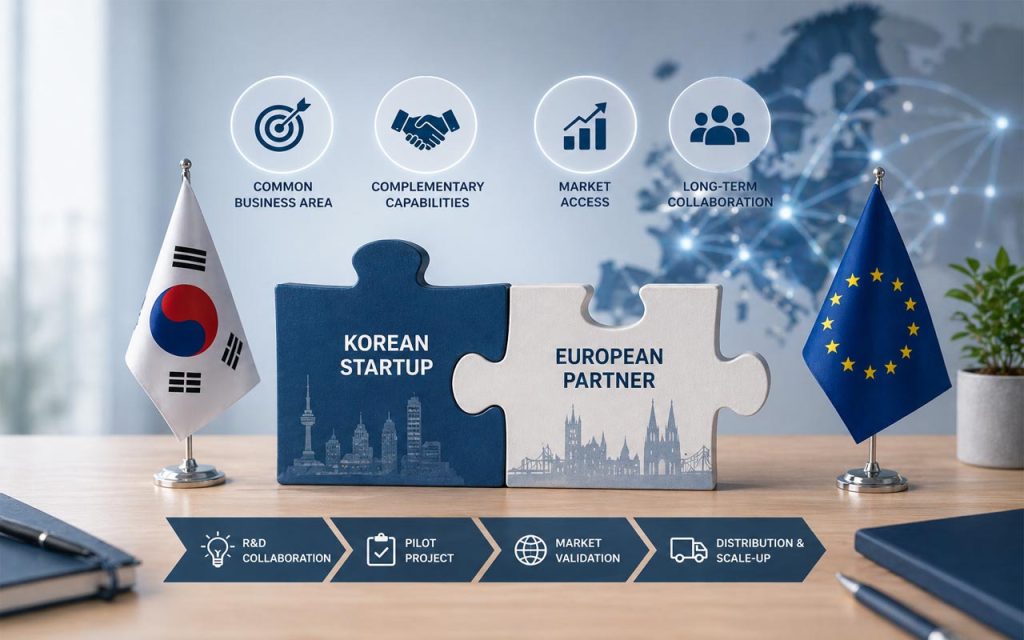
This point is especially relevant for Korean startups entering Europe. A well-chosen R&D partner can become more than a proposal participant. It can become a pilot collaborator, market validator, distributor, or reference partner for later funding applications.
The lesson is simple but often missed. In Europe, R&D partnership strategy should also be market entry strategy.
Eureka Clusters Offer Sector-Based Entry Into Europe
Now, Eurostars is not the only pathway. For startups working in sectors such as ICT, software, AI, industrial digitalization, communications, and advanced manufacturing, Eureka Clusters may offer another entry route.
Eureka describes its clusters as international, industry-led communities focused on strategic technology areas. These clusters help companies, SMEs, universities, and research organizations connect around shared technology priorities.
CELTIC-NEXT, for example, is positioned as a Eureka cluster for next-generation communications and advanced ICT services, including areas linked to 5G, 6G, and digital infrastructure.
Meanwhile, another program called ITEA focuses on software innovation and connects large companies, SMEs, startups, research organizations, and customer-side participants around business-oriented software applications.
Rosenberg pointed to this cluster route as another option.
“Alternatively, clusters like CELTIC or ITEA offer another avenue,” he said.
This matters because some startups do not only need funding. They need entry into a technical community where future partners, customers, and larger consortium actors already gather.
So for a Korean startup, the right cluster can become a bridge into the European R&D ecosystem before Horizon Europe becomes realistic.
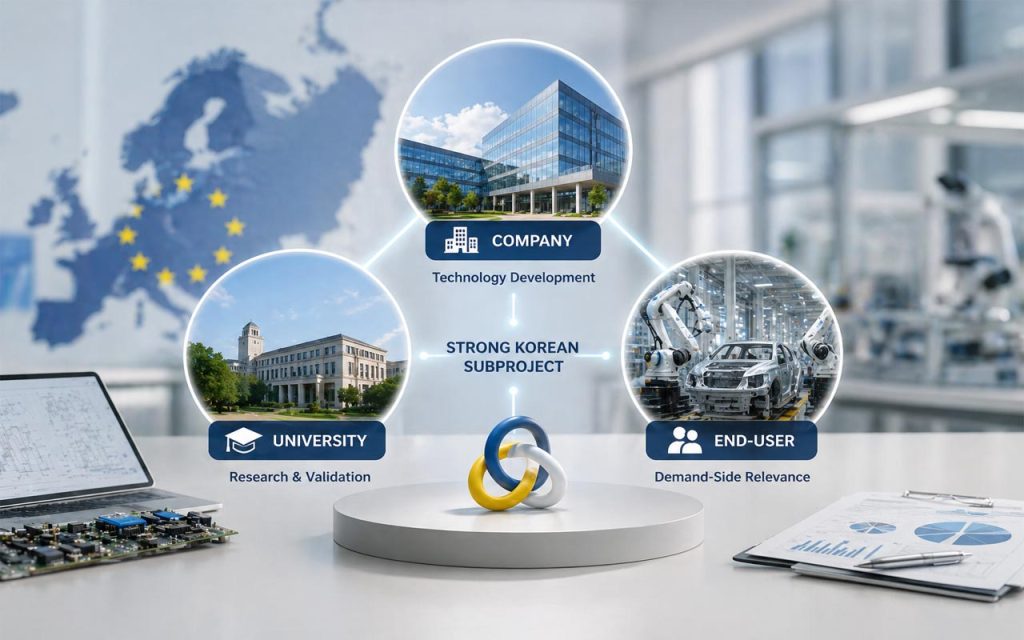
A Strong Korean Subproject Needs More Than One Startup
A common mistake in cross-border R&D is treating the startup as the only meaningful unit of participation. In practice, a stronger structure may involve a small domestic execution group before engaging European partners.
Rosenberg described one possible model.
“An optimal framework for such a subproject typically involves three entities: a company, a university, and an end-user.”
This structure is practical because it shows three different forms of credibility. The company develops the technology, the university or research institution strengthens validation, and the end-user provides demand-side relevance.
For Korean startups, this can be especially useful. A startup entering Europe alone may look commercially interesting but operationally thin. A startup entering with a university and an end-user can demonstrate technical depth, validation capacity, and real application context.
That combination is valuable in European R&D environments where collaboration quality matters as much as product ambition.
Eureka Can Build the Track Record Horizon Europe Requires
The strategic value of Eureka-linked projects is not limited to the immediate project. The deeper value lies in the collaboration history they create.
Korea already has a base inside the Eureka system. Korea became Eureka’s first non-European associate country in 2009, was promoted to partner country in 2018, and became a full member in 2022. A 2025 government briefing reported that Korea had supported KRW 250 billion across 250 Eureka projects since joining the network.
That history matters because it means Korean startups are not entering European R&D cooperation from zero. They can build on an existing Korea-Eureka channel that is already recognized by both sides.
Rosenberg described the transition logic directly.
“During the execution of your Eureka project, actively discuss and explore opportunities to transition into Horizon Europe participation with your partners.”
This is the core of the strategy. Horizon Europe should not be treated as the first transaction. It can become the next stage after a startup has already built European references, partner confidence, and project execution experience.
Resubmission Is Part of the European Funding Game
Even after startups build stronger partnerships, rejection remains part of the system.
The European Commission’s 2025 interim evaluation of Horizon Europe reported that the top 16% of applications were successful, while nearly seven in ten high-quality proposals were not funded because of budget constraints. That means rejection does not always indicate poor project quality.
Rosenberg made the same point from an operator’s perspective.
“Understand that most Horizon Europe proposals, even well-written ones, frequently fail during the initial evaluation.
Do not be discouraged; maintain your submission efforts and continue to resubmit.”
Now yes, it doesn’t mean that companies keep on resubmitting weak proposals. After all, persistence only works when the consortium, evidence, scope, and strategic fit improve across cycles.
So it’s crucial to note that startups should approach European R&D funding should as a long-term participation strategy. That is why a single rejection is not the end of the path if the company is building the right relationships and strengthening its project logic.
The Real Playbook Starts Before Horizon Europe
Now, the real playbook for Korean startups that are planning to enter European funding pathway actually starts long before Horizon Europe. And everything must begin with the right sequencing.
How? The first step is to identify the right instrument, not the biggest program. A startup with market-oriented R&D may find Eurostars more aligned than Horizon Europe. A company working in ICT, software, or industrial digitalization may need to begin with CELTIC-NEXT, ITEA, or another Eureka Cluster. A startup exploring early international R&D cooperation may consider alternative options from Eureka Network Projects.
The second step is to build partners around business logic. European collaborators should not be selected only because they are available. They should strengthen technical delivery, market access, validation, or future distribution.
The third step is to structure the Korean side properly. A company, university, and end-user model can give the project stronger execution credibility before it enters international collaboration.
Only after this foundation is built does Horizon Europe become a more realistic target.
From Funding Access to Strategic Entry
In the end, South Korea’s formal access to Horizon Europe is a major opportunity indeed. But with the program’s cost and barrier to shoulder, the smartest startup strategy may not be to just rush directly toward the largest program.
Europe’s R&D funding landscape is layered. Horizon Europe sits at the top of visibility, but programs such as Eurostars, CELTIC-NEXT, ITEA, and the other Eureka Network Projects can help startups build the collaboration base needed to participate more seriously later.
So, the practical question now is no longer only how to apply for EU R&D funding. It is how to enter the right part of the system at the right time.
Because while Horizon Europe may be the destination, the first step for many startups should be building the track record that gets them there.
Key Takeaways
- Horizon Europe should not automatically be the first EU funding target for Korean startups. It is better treated as a later-stage pathway after European collaboration experience is built.
- Eurostars can be a practical first step because it is designed for innovative SMEs and international R&D projects linked to commercialization.
- KIAT’s 2026 Eurostars-3 notice describes support for Korean participants of up to KRW 500 million per year for up to three years, subject to program rules and selection.
- Eureka Clusters such as CELTIC-NEXT and ITEA can help startups enter sector-specific European R&D communities in ICT, communications, software innovation, AI, and industrial digitalization.
- Partner-first strategy matters. Erel Rosenberg of i46 advised Korean startups to find one or two European companies in the same business domain that are not direct competitors.
- A stronger Korean subproject may include three entities: a company, a university or research institution, and an end-user.
- Eureka projects can build the collaboration track record that makes future Horizon Europe participation more realistic.
- Horizon Europe rejection is not always a quality signal. The European Commission’s 2025 interim evaluation found that nearly seven in ten high-quality proposals were not funded because of budget constraints.
- The best EU R&D funding pathway for Korean startups depends on sequence, fit, and partner quality, not simply the size or visibility of the program.
– Stay Ahead in Korea’s Startup Scene –
Get real-time insights, funding updates, and policy shifts shaping Korea’s innovation ecosystem.
➡️ Follow KoreaTechDesk on LinkedIn, X (Twitter), Threads, Bluesky, Telegram, Facebook, and WhatsApp Channel.
🤝 Looking to connect with verified Korean companies building globally?
Explore curated company profiles and request direct introductions through beSUCCESS Connect.