
The startup boom across Southeast Asia created a generation of companies focused on speed, market share, and fundraising momentum. Today, the conversation is changing. As investors become more selective and capital deployment becomes more disciplined, founders are increasingly being evaluated on something less visible than growth metrics: their ability to build organizations that can withstand scrutiny, scale responsibly, and operate beyond the founder’s direct control.
Southeast Asia’s Funding Environment Is Becoming More Demanding
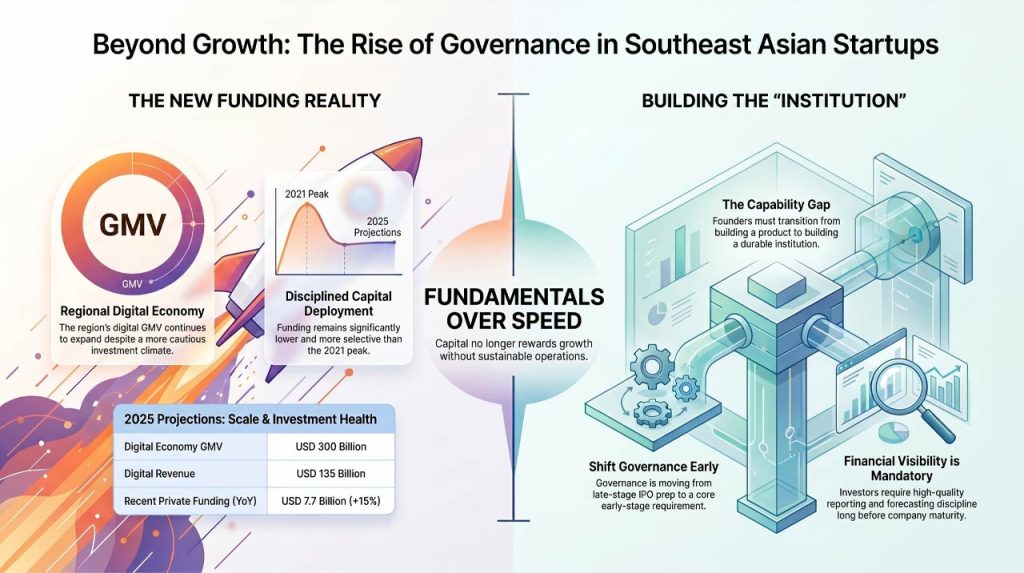
Southeast Asia’s digital economy continues to expand despite a more cautious investment climate. According to the 2025 e-Conomy SEA report by Google, Temasek, and Bain & Company, the region’s digital economy is expected to surpass USD 300 billion in gross merchandise value this year, while digital revenue is projected to reach USD 135 billion.
Yet funding conditions remain very different from the peak years of venture activity. Reuters reported that private funding into Southeast Asia’s digital economy reached USD 7.7 billion during the twelve months leading into mid-2025, representing a 15 percent increase year-on-year but remaining well below the levels seen during the funding surge of 2021.
That shift is changing what investors look for when evaluating startups.

KoreaTechDesk previously examined how Korean startups entering Southeast Asia often underestimate the operational realities of expanding across diverse ASEAN markets. Yet market understanding alone is no longer enough.
As the region’s startup ecosystem matures and capital becomes more selective, investors are increasingly evaluating how companies are managed, governed, and prepared for long-term scale.
Henry Maw, Founder and Chairman of X Venture Holdings, has worked across venture investment, corporate development, healthcare operations, and startup ecosystem development in Southeast Asia. According to Maw, investor expectations have evolved considerably over the past few years.
“Capital is no longer rewarding growth without fundamentals,”
he told KoreaTechDesk as discussion on Korean startups challenge in Southeast Asian market continues.
Governance Is Moving Earlier in the Startup Lifecycle
Historically, governance was often viewed as a concern for larger companies preparing for institutional funding rounds or public listings.
Today, that expectation is shifting.
A 2025 corporate governance framework developed by the Singapore Venture & Private Capital Association (SVCA), together with venture capital associations across Indonesia, Malaysia, Thailand, Vietnam, and the Philippines, argues that governance has become a critical issue for Southeast Asia’s private markets after several high-profile governance failures weakened investor confidence.
The report emphasizes stronger due diligence, board oversight, financial controls, risk monitoring, compliance systems, and accountability mechanisms across the startup ecosystem.
As Southeast Asia’s startup ecosystem matures, governance is becoming less of a boardroom discussion and more of a founder challenge. Investors are increasingly looking beyond growth metrics and asking whether companies are building the internal structures required to scale sustainably.
According to Maw, that transition is exposing a capability gap across many emerging startup ecosystems.
“One of the biggest founder capability gaps in emerging Southeast Asia is the difference between building a startup and building an institution.”
The distinction matters because many startups have now successfully built products, attract customers, and raise capital even before developing the internal systems required to support sustainable growth.

When Operational Complexity Outpaces Internal Systems
As companies expand, operational complexity often increases faster than founders anticipate.
New markets, larger teams, additional investors, regulatory obligations, and cross-border operations create management challenges that cannot be solved through product innovation alone.
According to Maw, this is where many startups begin encountering execution risks.
“One of the most common post-investment challenges is that many early-stage companies scale operational complexity faster than internal systems can mature.”
And the problem appears across multiple areas.
Financial forecasting may become less reliable. Reporting processes may remain informal. Decision-making can become concentrated around a single founder. Internal accountability structures may struggle to keep pace with company growth.
Maw noted that organizational dependency remains a recurring challenge in many emerging-market startups.
“Many startups in frontier markets remain heavily centralized around one individual decision-maker for too long.”
While founder-led decision-making can accelerate early execution, sustainable growth often requires stronger middle-management structures, clearer delegation, and more formal operating systems.
As KoreaTechDesk previously explored in its analysis of founder dependency during scaling, growth often becomes more difficult when organizational systems fail to mature alongside the business. Governance is increasingly becoming part of the solution to that challenge.
Financial Visibility Is Becoming an Investor Requirement
Investors are increasingly looking beyond revenue growth and market potential. And financial visibility has become a major focus.
The SVCA governance framework highlights practical governance tools that are becoming more common across Southeast Asia’s private markets, including risk committees, structured board reporting, stronger audit processes, enhanced financial reviews, and clearer oversight mechanisms.
These measures are designed to help investors identify operational risks earlier while improving startup readiness for future fundraising, acquisitions, or public-market opportunities.
Maw believes founders frequently underestimate the importance of financial discipline until external conditions become more difficult.
“In less mature ecosystems, founders sometimes operate with limited forecasting discipline, weak cash-flow management, or insufficient internal controls.”
During periods of abundant capital, those weaknesses may remain hidden. But then when funding cycles tighten, they become far more visible.
That reality is encouraging investors to place greater emphasis on reporting quality, financial controls, and execution accountability long before startups reach maturity.

Why Governance Matters for Korean Founders and Cross-Border Investors
The governance conversation carries growing relevance for Korea.
The Ministry of SMEs and Startups has accelerated efforts to strengthen Korea’s venture capital presence across Southeast Asia. Earlier this year, the ministry announced plans to expand its Singapore-based K-VCC initiative into a USD 300 million global fund platform by 2030, aimed at supporting cross-border investment and startup growth.
As Korean startups pursue regional expansion and Korean investors deploy more capital into ASEAN markets, governance standards become increasingly important for building investor confidence and long-term partnerships.
As cross-border startup activity between Korea and Southeast Asia increases, governance is becoming part of business credibility. Strong reporting structures, financial visibility, decision-making discipline, and organizational accountability help investors evaluate how prepared a company is for larger funding rounds, regional expansion, and long-term growth.
In unfamiliar markets, those internal indicators often become some of the most reliable measures of execution quality.
“The strongest founders are usually the ones who remain financially disciplined even during periods of growth and treat governance not as a compliance exercise, but as part of building a durable institution,”
Maw said.
The Next Competitive Advantage May Be Invisible
For years, startup success in Southeast Asia was often measured through growth metrics, fundraising momentum, and market expansion. Those indicators still matter, but they no longer tell the whole story.
As investors become more selective and companies face greater pressure to demonstrate sustainable execution, the conversation is expanding to include how businesses are managed behind the scenes. Governance, financial visibility, operational accountability, and organizational discipline are increasingly shaping investor confidence long before a company reaches its next funding round or expansion milestone.
In that environment, governance is becoming more than an internal management function. It is emerging as a competitive advantage for startups seeking to scale, attract capital, and build lasting positions in Southeast Asia’s evolving startup ecosystem.
Key Takeaway
- Southeast Asia’s startup ecosystem is becoming more selective, with investors placing greater emphasis on operational discipline and governance quality.
- Governance is moving earlier in the company lifecycle, no longer limited to late-stage startups preparing for IPOs or major funding rounds.
- Henry Maw of X Venture Holdings argues that founders must learn the difference between building a startup and building an institution.
- Operational complexity often grows faster than internal systems, creating risks around reporting, accountability, and decision-making.
- Financial visibility is becoming a core investor requirement, especially as funding markets remain more disciplined than during the 2021 funding boom.
- Korean startups and investors expanding into ASEAN face increasing pressure to demonstrate governance readiness alongside growth potential.
- Strong governance is evolving into a competitive advantage that supports scalability, investor confidence, and long-term sustainability across Southeast Asia’s startup ecosystem.
🤝 Looking to connect with verified Korean companies building globally?
Explore curated company profiles and request direct introductions through beSUCCESS Connect.
– Stay Ahead in Korea’s Startup Scene –
Get real-time insights, funding updates, and policy shifts shaping Korea’s innovation ecosystem.
➡️ Follow KoreaTechDesk on LinkedIn, X (Twitter), Threads, Bluesky, Telegram, Facebook, and WhatsApp Channel.