When innovation moves faster than protection, even the safest systems become vulnerabilities. The ransomware attack on Kyowon Group, one of Korea’s largest education-service conglomerates, signals not just another corporate breach but a wider credibility crisis. In a year when the nation aims to rebuild confidence after the Coupang and Upbit incidents, Korea’s digital economy faces a harder question: can growth survive without trust?
Kyowon Group Hit by Ransomware, Systems Paralyzed Across Subsidiaries
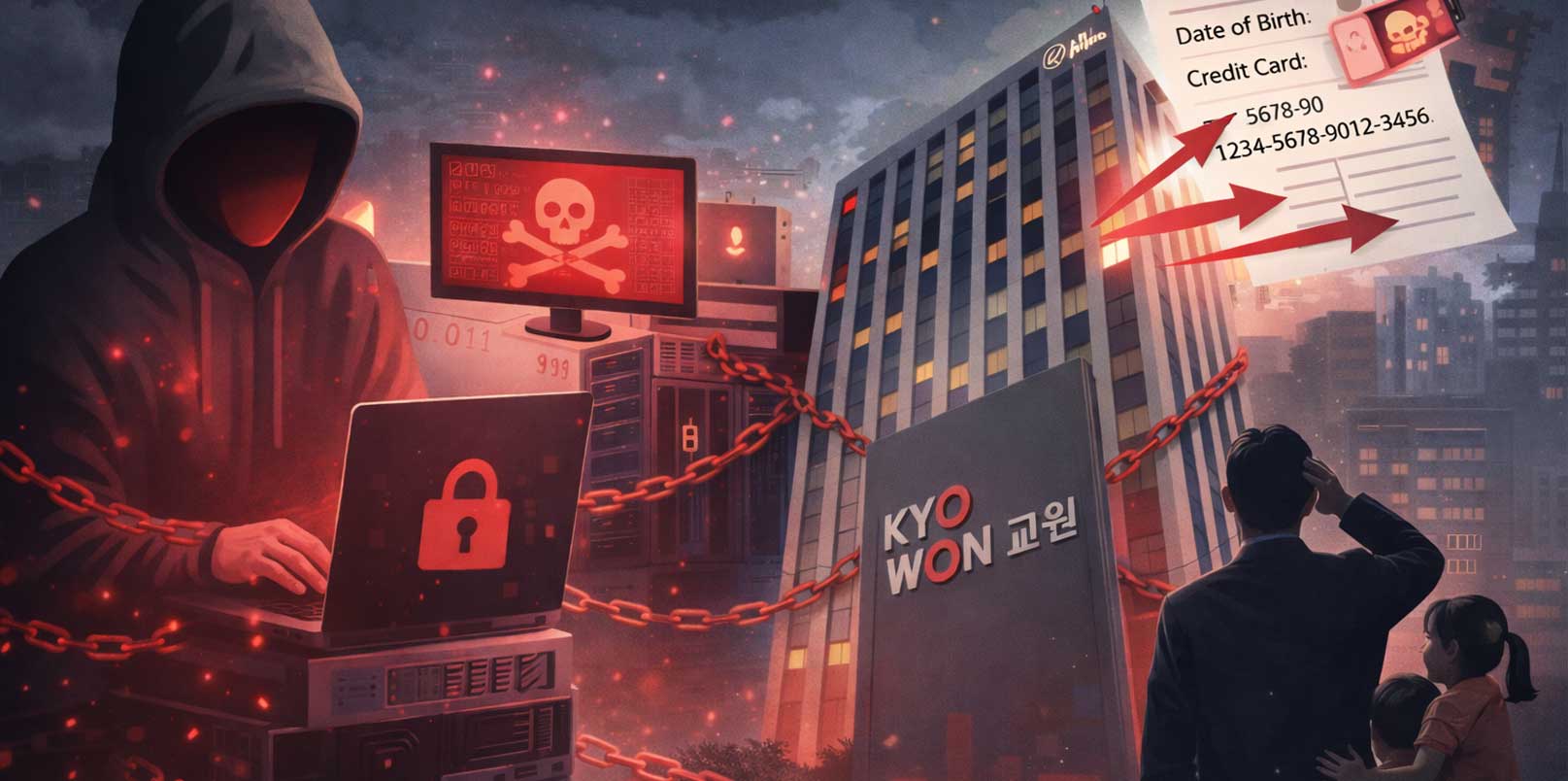
Kyowon Group confirmed that its entire IT network was compromised by a ransomware attack on January 10, 2026, causing system shutdowns across multiple subsidiaries including Kyowon, Kyowon Kumon, Red Pen, Kyowon Life, Kyowon Tour, and Kyowon Healthcare.
The company detected signs of intrusion early that morning and immediately disconnected affected servers to contain the breach. The Korea Internet & Security Agency (KISA) later classified the event as a group-wide ransomware infection initiated through an externally exposed server. The attack spread through internal networks linking multiple affiliates.
As of January 12, all official websites displayed a suspension notice reading: “Due to an unexpected disruption, web services are currently unavailable.”
Kyowon Group said it is restoring systems using backup data and conducting a forensic investigation with KISA and private cybersecurity firms. Authorities confirmed that the company has not yet reported any verified personal data leak, though tens of millions of records—including those of children, parents, and educators—remain under review.
A Breach That Cuts Across Generations and Industries
Kyowon’s case stands out for one reason: the nature of its data. The company operates education, life-care, travel, and healthcare services, holding highly personal records that range from children’s learning histories to parental payment details and travel information.
If confirmed, the exposure would become one of Korea’s largest education-related data incidents, affecting not only families but also financial partners linked to Kyowon’s payment infrastructure.
Industry analysts warn that the attack highlights the interconnected fragility of Korea’s service economy. Education, healthcare, and retail platforms now share overlapping datasets that can be exploited simultaneously. The breach, therefore, is not only about Kyowon—it represents the systemic exposure of an entire consumer-information ecosystem.
Ransomware Containment and Apology from Kyowon
In an official statement released January 12, Kyowon Group said:
“At approximately 8 AM on January 10, we detected signs of an external cyber intrusion suspected to be ransomware. We immediately reported the incident to KISA and relevant authorities and are working with external cybersecurity experts to analyze the cause and extent of the impact.”
The company added:
“We are still verifying whether any personal information has been compromised. Should any leakage be confirmed, we will notify affected customers transparently and implement all necessary protection measures.”
A Kyowon spokesperson later apologized, stating that experts are focused on data integrity and rapid restoration, adding that the group will take full responsibility for reinforcing preventive systems.
KISA’s Digital Threat Response Director, Lee Dong-geun, commented that the breach “does not appear to be spreading further,” though the restoration process may take time depending on system complexity.
Ransomware Becomes Korea’s New Corporate Epidemic
For most nations, ransomware is a technical event. In Korea, it has become a structural warning. The Kyowon attack follows a wave of high-profile data incidents that hit Korea’s largest corporations over the past year.
In late 2025, the Coupang data breach exposed more than 33 million user accounts, while Upbit lost KRW 44.5 billion in cryptocurrency to a coordinated external attack. The Shinhan Card internal data leak soon followed, revealing human-driven vulnerabilities within financial systems.
Together, these cases mark a pattern of governance fragility rather than technical incapacity. Even companies with advanced infrastructure and sizable IT budgets are failing at internal access control, key rotation, and response coordination—the foundational elements of digital trust.
The Kyowon breach extends this pattern into Korea’s education-tech and life-service sectors, sectors often overlooked in cybersecurity discussions but deeply intertwined with personal data.
The Kyowon Ransomware Incident: When Data Becomes Korea’s Credibility Test
For Korea’s startup and venture ecosystem, the Kyowon incident is more than a security failure. It underscores how digital trust now defines national competitiveness.
Korea’s strategy to position itself as a Global Venture House and top-three AI nation relies on the credibility of its data infrastructure. When educational and consumer-service data—among the most sensitive categories—are at risk, investors and international partners question the reliability of the broader ecosystem.
Cybersecurity in Korea has long been framed as a technical issue. The Kyowon case repositions it as an economic and reputational one. In a global market that increasingly ties investment decisions to governance maturity, Korea’s resilience will depend on whether it can institutionalize trust as infrastructure—through mandatory breach reporting, ecosystem-wide encryption standards, and consistent transparency obligations.
A Breach Beyond Data — A Reckoning for Digital Discipline
The Kyowon ransomware attack should not be remembered as an isolated event. It is part of a growing pattern that connects commerce, education, and finance through shared weaknesses in governance.
If Korea is to achieve its ambition as a Global Venture House, cybersecurity cannot remain an afterthought delegated to IT departments. It must become a national discipline—a public trust that binds startups, conglomerates, and regulators in a single standard of accountability.
Because in the age of AI and data-driven growth, Korea’s next economic risk is not capital—it is confidence.
– Stay Ahead in Korea’s Startup Scene –
Get real-time insights, funding updates, and policy shifts shaping Korea’s innovation ecosystem.
➡️ Follow KoreaTechDesk on LinkedIn, X (Twitter), Threads, Bluesky, Telegram, Facebook, and WhatsApp Channel.
🤝 Looking to connect with verified Korean companies building globally?
Explore curated company profiles and request direct introductions through beSUCCESS Connect.