
KoreaTechDesk | Korean Startup and Technology News

Sun, December 07, 2025

Sign in

Virtual Demo Day
Menu
  • Home
  • Startup News
    • AI & Big Data
    • AR & VR
    • Blockchain
    • Clean Technology
    • Content & Games
    • Cybersecurity
    • Enterprise & SaaS
    • FinTech
    • Gadgets & Electronics
    • Health & Bio
    • Manufacturing
    • Press Release
    • IoT
    • Marketplaces & E-commerce
    • Robotics
    • Transportation
    • Investments
    • Ecosystem & Lists
  • Governments
    • Artificial Intelligence Industry Cluster Agency
    • Daegu Technopark
    • GANGNAM-GU
    • Gyeonggido Business & Science Accelerator
    • Hwaseong Industry Promotion Agency
    • Invest Seoul
    • Korea Creative Content Agency
    • Korea Internet & Security Agency
    • Korea Information Security Industry Association
    • Korea Institute of Startup & Entrepreneurship Development
    • Korea Tourism Organization
    • Korea Trade-Investment Promotion Agency
    • Ministry of Culture, Sports and Tourism
    • Ministry of SMEs & Startups
    • National IT Industry Promotion Agency
    • Pangyo Techno Valley
    • Seoul Business Agency
    • Seoul FinTech Lab
    • South Gyeongsang Province
    • Seoul Metropolitan Government
  • Events
    • COMEUP
    • Korea Fintech Week
    • K-Content Expo
    • NextRise
    • Try Everything
  • Interviews
    • Investors’ interviews
    • Founders’ interviews
  • Programs
    • Asan Voyager
    • CAPA Global Program
    • Campus Town Program
    • SGSC Global Bootcamp
    • Gangnam-gu Global Roadshow
    • Global SaaS Marketplace Support Project
    • LAUNCHPAD
    • COMEUP STARS 120
    • K-Startup Grand Challenge
    • TIPS X beSUCCESS Global Project
    • SFL Global Program
    • KTO Global Showcase
    • Yonsei Univ Global Class
    • KOSME Global Program
  • Partner With Us
    • Press Release
    • Startup Scouting
    • Business Agencies
    • Global Mentorship Program
    • Investment Opportunities
    • K-Scouter Program
  • Lists
  • Home
  • Startup News
    • AI & Big Data
    • AR & VR
    • Blockchain
    • Clean Technology
    • Content & Games
    • Cybersecurity
    • Enterprise & SaaS
    • FinTech
    • Gadgets & Electronics
    • Health & Bio
    • Manufacturing
    • Press Release
    • IoT
    • Marketplaces & E-commerce
    • Robotics
    • Transportation
    • Investments
    • Ecosystem & Lists
  • Governments
    • Artificial Intelligence Industry Cluster Agency
    • Daegu Technopark
    • GANGNAM-GU
    • Gyeonggido Business & Science Accelerator
    • Hwaseong Industry Promotion Agency
    • Invest Seoul
    • Korea Creative Content Agency
    • Korea Internet & Security Agency
    • Korea Information Security Industry Association
    • Korea Institute of Startup & Entrepreneurship Development
    • Korea Tourism Organization
    • Korea Trade-Investment Promotion Agency
    • Ministry of Culture, Sports and Tourism
    • Ministry of SMEs & Startups
    • National IT Industry Promotion Agency
    • Pangyo Techno Valley
    • Seoul Business Agency
    • Seoul FinTech Lab
    • South Gyeongsang Province
    • Seoul Metropolitan Government
  • Events
    • COMEUP
    • Korea Fintech Week
    • K-Content Expo
    • NextRise
    • Try Everything
  • Interviews
    • Investors’ interviews
    • Founders’ interviews
  • Programs
    • Asan Voyager
    • CAPA Global Program
    • Campus Town Program
    • SGSC Global Bootcamp
    • Gangnam-gu Global Roadshow
    • Global SaaS Marketplace Support Project
    • LAUNCHPAD
    • COMEUP STARS 120
    • K-Startup Grand Challenge
    • TIPS X beSUCCESS Global Project
    • SFL Global Program
    • KTO Global Showcase
    • Yonsei Univ Global Class
    • KOSME Global Program
  • Partner With Us
    • Press Release
    • Startup Scouting
    • Business Agencies
    • Global Mentorship Program
    • Investment Opportunities
    • K-Scouter Program
  • Lists
Home Startup FinTech

The Trust Recession: How the 2025 Upbit Hack Risks Korea’s Virtual-Asset Comeback

by Zee Cindy
December 7, 2025
in FinTech
0

Global investors are once again watching South Korea’s fintech credibility being tested. The country that once promised to lead Asia’s virtual-asset recovery now faces a different reckoning — not over innovation, but trust. The Upbit hack didn’t just breach a digital exchange, but also reopened a deeper question that regulators, founders, and investors have long avoided: how safe is Korea’s digital finance, really?

The Upbit Hack Incident: A Shock to Korea’s Fintech Confidence

South Korea’s digital-finance ambitions face a severe test after a KRW 44.5 billion (USD 33 million) breach at Upbit, the nation’s largest cryptocurrency exchange.

The attack, carried out in under an hour on November 27, triggered investigations from the National Office of Investigation and renewed debate over how safe Korea’s fintech backbone truly is.

Police confirmed they have formally launched a criminal investigation, converting the case from a preliminary review into an official probe. The attack’s speed and scale—over 1 billion coins drained in 54 minutes—revived concerns that even Korea’s most advanced digital platforms remain vulnerable to increasingly sophisticated cyberattacks.

Authorities have yet to identify suspects, though the North Korean hacking group Lazarus, known for prior crypto-related incidents, is being examined as a possible source. The Financial Supervisory Service (FSS) and Korea Internet & Security Agency (KISA) have also conducted on-site inspections at Dunamu, Upbit’s operator.

A Legal and Regulatory Blind Spot Revealed from Upbit Hack 2025

The Upbit breach revealed a regulatory gap in South Korea’s financial system. Unlike traditional banks or e-finance companies covered under the Electronic Financial Transactions Act (EFTA), crypto exchanges are not legally obligated to compensate users unless negligence can be proven.

While Upbit had voluntarily reimbursed KRW 38.6 billion in user losses with corporate funds, the lack of statutory requirements has spurred backlash. Regulators and lawmakers are now advancing the “Phase 2 Virtual-Asset Legislation”, which would impose “no-fault compensation”—a rule that mandates exchanges to cover losses regardless of negligence, mirroring EFTA’s consumer-protection standards.

Between 2023 and September 2025, the five major KRW-based exchanges—Upbit, Bithumb, Coinone, Korbit, and Gopax—recorded 20 system failures affecting over 900 users.

Lawmakers argue this pattern shows that virtual-asset operators should face the same accountability standards as financial institutions handling public capital.

Therefore, the new legislative draft is expected to:

  • Enforce security and reliability obligations equivalent to those imposed on banks.
  • Require operators to submit annual IT-risk management plans to the Financial Services Commission (FSC).
  • Introduce fines up to 3% of annual revenue for major hacking or system failures.

An FSC official confirmed,

“If the EFTA amendment raises penalty ceilings, virtual-asset businesses will be aligned to that standard.”

A Crisis of Timing and Transparency

The sequence of events during the attack has intensified scrutiny. Hackers began transferring assets at 4:42 AM, and within 18 minutes, Upbit convened an emergency meeting and halted Solana-based transactions. By 8:55 AM all asset withdrawals were suspended.

Yet, regulatory notifications lagged by hours—the FSS was informed at 10:58 AM, KISA at 11:57 AM, police at 1:16 PM, and the FSC at 3:00 PM. Public disclosure came at 12:33 PM, shortly after Dunamu’s merger event with Naver Financial concluded.

Lawmakers have questioned whether the delay was intentional. Representative Kang Min-guk criticized,

“A leading exchange cannot lose over a billion coins and wait six hours to report. We must verify whether the fault lies in Solana’s structure or Upbit’s own transaction system.”

The FSS Governor Lee Chan-jin later acknowledged limited authority to impose sanctions, admitting,

“This is not something we can overlook, but current law restricts our ability to enforce penalties.”

Just as Korea reopens its virtual-asset market, the Upbit hack exposes how fragile fintech trust remains — a stress test for digital-finance credibility.
Financial Supervisory Service Governor Lee Chan-jin. | Photo by Yonhap

Upbit Hack & Coupang Data Breach: Public Trust on the Line

The Upbit case strikes at the heart of trust in Korea’s digital economy. Just months ago, the government had renewed its commitment to expanding blockchain and fintech innovation, signaling Korea’s rise to become a global virtual-asset hub after years of policy hesitation.

Now, investors and users alike face renewed uncertainty. The simultaneous exposure of Upbit (external breach) and Coupang (internal data leak) has deepened anxiety over the fragility of Korea’s digital governance, especially as both incidents unfolded within the same week.

KAIST Professor Yoon In-soo, a leading cybersecurity expert and former DEF CON champion, warned that the rise of AI-assisted hacking is transforming the threat landscape. He said,

“AI has broken the balance between attack and defense. Hackers now automate reconnaissance and code modification, making high-frequency attacks cheap and constant. The cost of failure has collapsed.”

Yoon contrasted Upbit’s external breach with Coupang’s insider-driven leak, calling the latter “harder to defend against” because trust-based systems crumble from within. He urged both government and industry to “restore basic security discipline before technology outpaces governance.”

The timing has deepened the public unease. The Upbit hack and the Coupang data leak occurred almost simultaneously, just as Korea marked the 30th anniversary of its venture investment system and reaffirmed plans to become a top-three AI nation and top-four global venture hub.
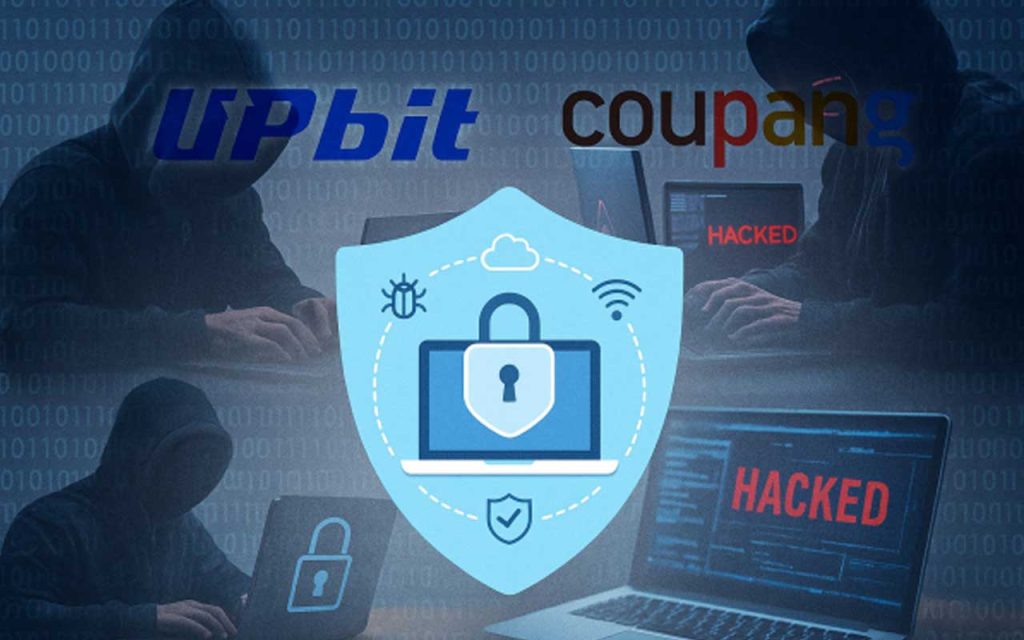
Just as Korea reopens its virtual-asset market, the Upbit hack exposes how fragile fintech trust remains — a stress test for digital-finance credibility.
Upbit and Coupang cybersecurity cases. | Photo by Shin A Ilbo

For founders and investors, the contrast feels tragic — moments after celebrating a new national vision for innovation, two of its largest digital platforms exposed the vulnerabilities beneath that confidence.

Rebuilding trust will not be a short process. Restoring confidence among stakeholders will require time, transparency, and consistent policy execution that proves Korea’s digital economy can be both ambitious and secure.

Policy, Accountability, and Global Perception

The Upbit hack may accelerate Korea’s transition from innovation expansion to governance reform. The government’s Phase 2 legislation is designed to align digital-asset operations with financial-grade compliance, but without trust, legislative fixes may not suffice.

And so, this case offers a clear lesson for Korea’s startup and fintech ecosystem: Innovation capital cannot sustain itself without regulatory predictability and institutional credibility.

A thriving digital-asset market demands not only technological sophistication but also transparent governance and accountability equal to traditional finance.

As for global investors, the incident serves as both warning and opportunity. Korea’s swift reimbursement response and pending legislative overhaul demonstrate an ecosystem moving toward maturity—but its recovery depends on restoring confidence that digital finance in Korea can operate securely, responsibly, and transparently.

The Path Forward for Korea’s Virtual Asset Market

South Korea’s virtual-asset market is at a crossroads. The Upbit breach exposed the systemic risk of fragmented regulation and delayed response. The Phase 2 Virtual-Asset Bill has now represented more than just legislative housekeeping, but also the country’s chance to rebuild credibility in its fintech promise.

If Korea succeeds in coupling innovation with institutional trust, this crisis would not mark a setback, but a turning point in establishing a globally credible, regulation-backed digital economy.

– Stay Ahead in Korea’s Startup Scene –
Get real-time insights, funding updates, and policy shifts shaping Korea’s innovation ecosystem.
➡️ Follow KoreaTechDesk on LinkedIn, X (Twitter), Threads, Bluesky, Telegram, Facebook, and WhatsApp Channel.

Tags: Blockchainblockchain innovationBlockchain InvestmentsBlockchain platformBlockchain startupsblockchain technologyCRYPTO FINANCECrypto investmentCrypto tokensCryptocurrenciesCryptocurrencyCryptocurrency tradingcryptocurrency walletsCybersecuritycybersecurity measurescybersecurity protocolscybersecurity solutionsDunamuFintechFintech InnovationFinTech sectorInnovationInvestmentKorean Cryptocurrency ExchangeKorean StartupKorean StartupsLazarusSouth Korea fintechUpbitUpbit Hack 2025Venture Capitalvirtual assetVirtual asset managementVirtual Asset regulationvirtual asset trading
Previous Post

Beyond Budgets: Korea’s Startup Ecosystem Needs Predictability, Not Just Policy

Next Post

Korea’s National Growth Fund Targets SK Hynix’s Yongin Cluster: Redefining Industrial Investment with $11B Deep-Tech Mandate

Next Post

Korea’s National Growth Fund Targets SK Hynix’s Yongin Cluster: Redefining Industrial Investment with $11B Deep-Tech Mandate

MOST READ ARTICLE OF THE WEEK

1.
$33M Upbit Hack Revives Cybersecurity Concerns as Korea Aims to Build a Safer Global Fintech Ecosystem
1 Dec 2025
2.
Korea Strengthens Financial-Regulatory Alliance to Channel Pension Capital into Venture Growth
1 Dec 2025
3.
Coupang Data Breach Exposes Korea’s Weakest Link: Internal Tech Governance in the AI Era
2 Dec 2025
4.
Korea Extends Venture Investment Period, But ‘No Prior Funding’ Rule May Limit Real Impact
2 Dec 2025
5.
Greener Lab Tops SLUSH 2025, Showcasing Korea’s Deep Tech Leadership in Europe’s Climate Innovation Frontier
2 Dec 2025
Register for Event

[the_ad id=”18508″]

List Article

1.
6 Reasons Why Seoul Is Poised to Become a Top 5 Global Economic Hub by 2030
20 Aug 2024
2.
Top Co-working Spaces for Startups & Companies to Explore in South Korea
3 Apr 2024
3.
Top Accelerators in South Korea Shaping Startup Success
29 Nov 2023
4.
Top Korean Venture Capital Firms Backing Startup Success
26 Oct 2023
5.
Top Apps for Seamless Korean to English Translation
14 Aug 2023

Similar Articles

FinTech

Lucentblock Becomes First Test Case for Korea’s New Venture Investment Rules

More
FinTech

Inside Korea’s Next Fintech Pivot: What Naver – Dunamu Merger Could Mean for Stablecoin Policy and Global Expansion

More
FinTech

Korea’s Digital Finance at a Crossroads: Stablecoins, IPOs, and the Dunamu – Naver Question

More

Topics

Menu
  • AI & Big Data
  • AR & VR
  • Blockchain
  • Clean Technology
  • Content & Games
  • Cybersecurity
  • Enterprise & SaaS
  • FinTech
  • Gadgets & Electronics
  • Health & Bio
  • IoT

Program

Menu
  • Asan Voyager
  • CAPA Global Program
  • SGSC Global Bootcamp
  • LAUNCHPAD
  • COMEUP STARS 120
  • K-Startup Grand Challenge
  • TIPS X beSUCCESS Global Project
  • SFL Global Program
  • KTO Global Showcase
  • Yonsei Univ Global Class
  • KOSME Global Program

About

Menu
  • About Us
  • all articles
  • Terms of Use
  • Privacy
  • Cookie-policy
  • twitter

Subscribe and be informed first hand about actual Korean startup news.

All the day’s headlines and highlights, direct to you every morning.

Contact us : [email protected]

Topics

Menu
  • AI & Big Data
  • AR & VR
  • Blockchain
  • Clean Technology
  • Content & Games
  • Cybersecurity
  • Enterprise & SaaS
  • FinTech
  • Gadgets & Electronics
  • Health & Bio
  • IoT

Program

Menu
  • Asan Voyager
  • CAPA Global Program
  • SGSC Global Bootcamp
  • LAUNCHPAD
  • COMEUP STARS 120
  • K-Startup Grand Challenge
  • TIPS X beSUCCESS Global Project
  • SFL Global Program
  • KTO Global Showcase
  • Yonsei Univ Global Class
  • KOSME Global Program

About

Menu
  • About Us
  • all articles
  • Terms of Use
  • Privacy
  • Cookie-policy
  • twitter

Subscribe and be informed first hand about actual Korean startup news.

All the day’s headlines and highlights, direct to you every morning.

© 2023 Koreantech News & Media Korea Zrt. All rights reserved.

Our Spring Sale Has Started

You can see how this popup was set up in our step-by-step guide: https://wppopupmaker.com/guides/auto-opening-announcement-popups/

Our Spring Sale Has Started

You can see how this popup was set up in our step-by-step guide: https://wppopupmaker.com/guides/auto-opening-announcement-popups/

We hope you enjoy our content, May you please give us Feedback regarding our website!

Single Post Feedback

dgdfgfdgdf

What you think about Koreatechdesk, Share your idea with us!

feedback popup

Invitation submission has been closed

Insert/edit link

Enter the destination URL

Or link to existing content

    No search term specified. Showing recent items. Search or use up and down arrow keys to select an item.