South Korea has chosen who gets to run the next layer of its tokenized securities market (STO). The decision is not only about who won licenses. It signals how Korea now treats sandbox pioneers once a market becomes financial infrastructure. For founders and investors watching Korea as a regulated-fintech base, the Lucentblock outcome clarifies a new reality: distribution power is consolidating inside institution-led venues.
STO Exchange Licenses: NXT and KDX Win Preliminary Approval, Lucentblock Fails
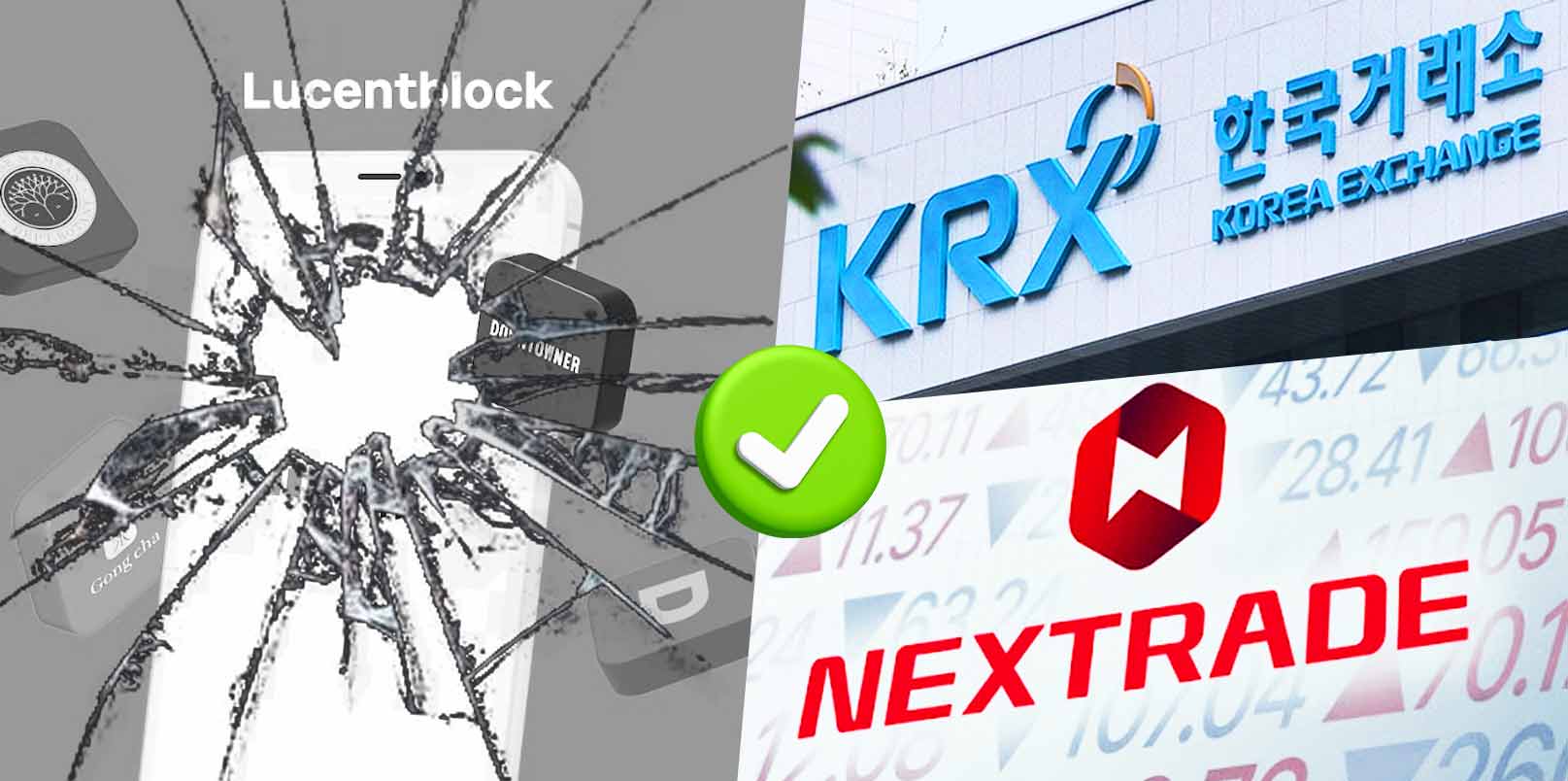
On February 13, the Financial Services Commission (FSC) approved preliminary licenses for two consortia to operate a fractional investment over-the-counter market that will handle distribution of trust beneficiary securities linked to fractional investment products.
The two selected groups were the NXT consortium, led by alternative trading platform NexTrade (NXT), and the KDX consortium, led by the Korea Exchange and partners. Multiple reports confirm Lucentblock was not selected.
The FSC disclosed external evaluation scores. NXT ranked first with 750 points, KDX second with 725, and Lucentblock third with 653. Authorities said the largest point gaps were tied to capital strength, business plans, and conflict-of-interest controls.
The NXT consortium received conditional approval. The FSC stated that if the Fair Trade Commission (FTC) opens an administrative investigation under competition law tied to the technology misappropriation allegation raised by Lucentblock, the final authorization review for NXT will be suspended.
Both approved consortia must satisfy preliminary conditions and apply for final authorization within the timeline disclosed by regulators. Officials also emphasized that preliminary approval does not guarantee final approval.
Why This Licensing Round Is Different from the Sandbox Era
Regulators drew a clear line between sandbox-era distribution and a full market-grade trading venue.
Officials described the sandbox channel as limited and temporary, mainly tied to distribution of a firm’s own issued products under special permission. The new OTC market is framed as a broader venue intended to support trading across multiple fractional investment securities, with higher requirements for stability, staffing, systems, and investor protection.
In briefing remarks reported by multiple outlets, Ko Young-ho, director at the FSC’s capital markets bureau, said the agency would explain the decision in unusually detailed terms, stressing transparency around criteria and scoring.
The FSC also said the current approval relates to trust beneficiary securities. It added that handling token securities formats more broadly will depend on how the token securities legal and licensing framework is finalized later.
Stakeholder Statements and What They Reveal
The FSC said Lucentblock’s lower score reflected weaknesses across key requirements. Ko Young-ho was quoted describing Lucentblock’s capital level as meaningfully lower than peers and its funding and contingency plans as less convincing in feasibility.
On the technology theft allegation, the FSC said evaluators believed business cooperation appeared to have occurred but concluded there was insufficient objective basis to treat it as a scoring factor. At the same time, the FSC attached the FTC-triggered condition to NXT, acknowledging another authority could reach a different view.
Lucentblock also pushed back publicly. In reporting on the same day, CEO Heo Se-young rejected the regulator’s interpretation of governance concerns tied to a 51% shareholding block, arguing the second-largest shareholder group is an officially recognized investment vehicle made up of outside investors.
Ecosystem voices criticized the outcome in strong terms. Investor and startup community reactions included concerns that excluding a long-running sandbox operator sends a discouraging signal to fintech entrepreneurship, particularly in regulated markets.
Korea’s Post-Sandbox Rulebook Just Got Clearer
This outcome matters beyond one company because it resets incentives for regulated innovation in Korea.
Sandbox Graduation No Longer Implies Distribution Privilege
Even firms that built operational history under innovative financial service programs can be forced into a narrower role once regulators define a market as core infrastructure. In this decision, distribution power shifts to licensed venues led by exchange-scale operators and financial consortia.
Distribution Becomes a Gatekeeping Layer Shaping Startup Survival
Regulators stated that if Lucentblock applies for an issuance license, it can maintain operations for a period. Yet once licensed OTC venues fully launch, Lucentblock must stop operating its own distribution channel, and its products will need to trade through approved venues. That structural dependence changes bargaining power for issuers.
Investor Protection Now Being Enforced Through Infrastructure Standards
Authorities justified the scoring emphasis on capital adequacy, internal rules, legal understanding, and conflict management systems. For global investors, this looks like Korea prioritizing operational resilience over pioneer advantage as it formalizes tokenized finance.
Visible and Measurable Downside Risks
One Korean market report estimated that roughly 45,000 investors hold about KRW 25 billion in assets tied to Lucentblock-related products, and that a failure to secure an issuance path could trigger structured wind-down steps handled by partner securities firms and trustees under previously submitted plans.
That makes Korea’s “exit mechanics” part of the investment thesis for regulated-fintech deals.
Korea is Sending Vague Message to Global Entrants
The system is showing stronger formalization and rule clarity, which institutions and large partners often want. At the same time, founders may read the decision as a warning that early compliance and market-building do not guarantee a protected route to scale once incumbents enter.
What Global Founders and Investors Should Watch Next
The next signal will not come from another press conference. It will come from execution.
Watch how quickly NXT and KDX convert preliminary approval into final authorization, and how regulators treat any FTC action that triggers the suspension clause attached to NXT. That condition is now a live governance test.
For Lucentblock, the near-term decision is strategic: pursue the issuance track and negotiate distribution access later, or accept wind-down mechanics that move investor protection duties to securities firms and trustees. The market impact is immediate because distribution is now controlled by licensed venues, not by sandbox pioneers.
For global readers, the actionable takeaway is simple: Korea’s regulated-fintech opportunity remains real, but the path to scale now runs through institutional market infrastructure. Any entry strategy needs a plan for that dependency early, not after the sandbox phase ends.
Key Takeaway on Korea’s STO Exchange License Decision
- The FSC approved preliminary licenses for two fractional investment OTC market operators: NXT consortium and KDX consortium.
- Lucentblock was not selected, based on disclosed evaluation scores and cited weaknesses in capital strength, business plans, and conflict-of-interest controls.
- NXT received conditional approval: if the FTC opens an investigation tied to the technology misappropriation allegation, NXT’s final review can be paused.
- Regulators framed the new OTC market as fundamentally different from sandbox-era limited distribution channels, with higher infrastructure and investor protection requirements.
- Lucentblock’s practical path forward centers on an issuance license, with future distribution expected to occur through licensed venues, not its own channel.
🤝 Looking to connect with verified Korean companies building globally?
Explore curated company profiles and request direct introductions through beSUCCESS Connect.
– Stay Ahead in Korea’s Startup Scene –
Get real-time insights, funding updates, and policy shifts shaping Korea’s innovation ecosystem.
➡️ Follow KoreaTechDesk on LinkedIn, X (Twitter), Threads, Bluesky, Telegram, Facebook, and WhatsApp Channel.