KoreaTechDesk | Korean Startup and Technology News

Wed, January 14, 2026

Sign in

Virtual Demo Day
Menu
  • Home
  • Startup News
    • AI & Big Data
    • AR & VR
    • Blockchain
    • Clean Technology
    • Content & Games
    • Cybersecurity
    • Enterprise & SaaS
    • FinTech
    • Gadgets & Electronics
    • Health & Bio
    • Manufacturing
    • Press Release
    • IoT
    • Marketplaces & E-commerce
    • Robotics
    • Transportation
    • Investments
    • Ecosystem & Lists
  • Governments
    • Artificial Intelligence Industry Cluster Agency
    • Daegu Technopark
    • GANGNAM-GU
    • Gyeonggido Business & Science Accelerator
    • Hwaseong Industry Promotion Agency
    • Invest Seoul
    • Korea Creative Content Agency
    • Korea Internet & Security Agency
    • Korea Information Security Industry Association
    • Korea Institute of Startup & Entrepreneurship Development
    • Korea Tourism Organization
    • Korea Trade-Investment Promotion Agency
    • Ministry of Culture, Sports and Tourism
    • Ministry of SMEs & Startups
    • National IT Industry Promotion Agency
    • Pangyo Techno Valley
    • Seoul Business Agency
    • Seoul FinTech Lab
    • South Gyeongsang Province
    • Seoul Metropolitan Government
  • Events
    • COMEUP
    • Korea Fintech Week
    • K-Content Expo
    • NextRise
    • Try Everything
  • Interviews
    • Investors’ interviews
    • Founders’ interviews
  • Programs
    • Asan Voyager
    • CAPA Global Program
    • Campus Town Program
    • SGSC Global Bootcamp
    • Gangnam-gu Global Roadshow
    • Global SaaS Marketplace Support Project
    • LAUNCHPAD
    • COMEUP STARS 120
    • K-Startup Grand Challenge
    • TIPS X beSUCCESS Global Project
    • SFL Global Program
    • KTO Global Showcase
    • Yonsei Univ Global Class
    • KOSME Global Program
  • Partner With Us
    • Press Release
    • Startup Scouting
    • Business Agencies
    • Global Mentorship Program
    • Investment Opportunities
    • K-Scouter Program
  • Lists
  • Home
  • Startup News
    • AI & Big Data
    • AR & VR
    • Blockchain
    • Clean Technology
    • Content & Games
    • Cybersecurity
    • Enterprise & SaaS
    • FinTech
    • Gadgets & Electronics
    • Health & Bio
    • Manufacturing
    • Press Release
    • IoT
    • Marketplaces & E-commerce
    • Robotics
    • Transportation
    • Investments
    • Ecosystem & Lists
  • Governments
    • Artificial Intelligence Industry Cluster Agency
    • Daegu Technopark
    • GANGNAM-GU
    • Gyeonggido Business & Science Accelerator
    • Hwaseong Industry Promotion Agency
    • Invest Seoul
    • Korea Creative Content Agency
    • Korea Internet & Security Agency
    • Korea Information Security Industry Association
    • Korea Institute of Startup & Entrepreneurship Development
    • Korea Tourism Organization
    • Korea Trade-Investment Promotion Agency
    • Ministry of Culture, Sports and Tourism
    • Ministry of SMEs & Startups
    • National IT Industry Promotion Agency
    • Pangyo Techno Valley
    • Seoul Business Agency
    • Seoul FinTech Lab
    • South Gyeongsang Province
    • Seoul Metropolitan Government
  • Events
    • COMEUP
    • Korea Fintech Week
    • K-Content Expo
    • NextRise
    • Try Everything
  • Interviews
    • Investors’ interviews
    • Founders’ interviews
  • Programs
    • Asan Voyager
    • CAPA Global Program
    • Campus Town Program
    • SGSC Global Bootcamp
    • Gangnam-gu Global Roadshow
    • Global SaaS Marketplace Support Project
    • LAUNCHPAD
    • COMEUP STARS 120
    • K-Startup Grand Challenge
    • TIPS X beSUCCESS Global Project
    • SFL Global Program
    • KTO Global Showcase
    • Yonsei Univ Global Class
    • KOSME Global Program
  • Partner With Us
    • Press Release
    • Startup Scouting
    • Business Agencies
    • Global Mentorship Program
    • Investment Opportunities
    • K-Scouter Program
  • Lists
Home Startup FinTech

The Sandbox Worked. The System Didn’t: The Fallout of Lucentblock and Korea’s Policy Maturity

by Daehyun Song
January 10, 2026
in FinTech
0

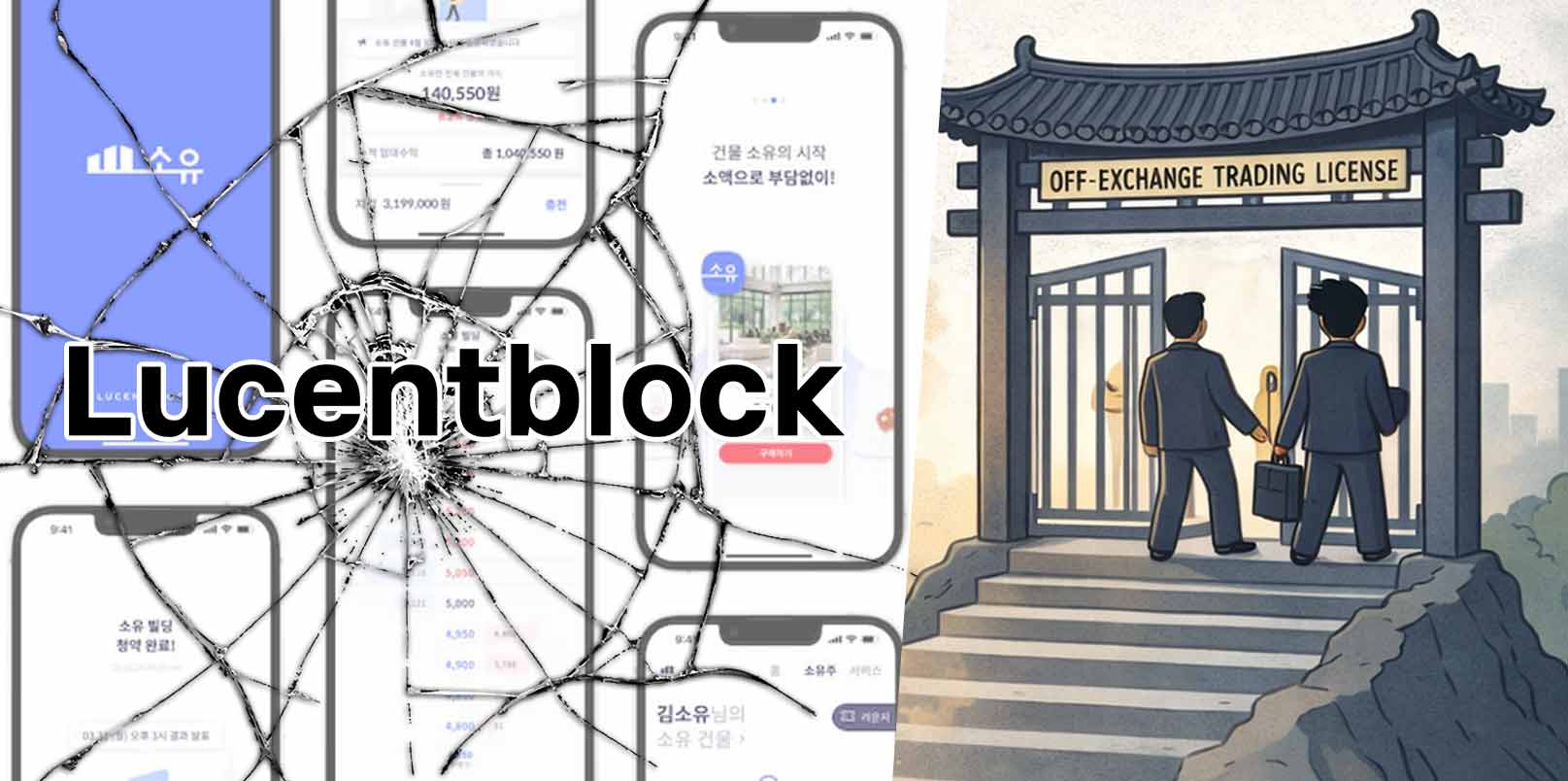
Korea’s sandbox once symbolized how innovation could coexist with regulation. Now, one of its earliest success stories, Lucentblock, stands as the clearest warning of what happens when a system built for experimentation meets a bureaucracy built for control. The company that validated tokenized real estate investment is being squeezed out by the very structure it helped create.

Lucentblock Challenges Korea’s STO Licensing Process Amid Fairness Concerns

Lucentblock, operator of the fractional investment platform SoU, has accused Korea’s Financial Services Commission (FSC) of overseeing an unfair licensing process for new Security Token Offering (STO) trading platforms.

The company released an official statement on January 9 claiming that the procedure—presented as the “institutionalization of the financial regulatory sandbox”—turned into a competitive approval race designed for large institutions rather than innovators.

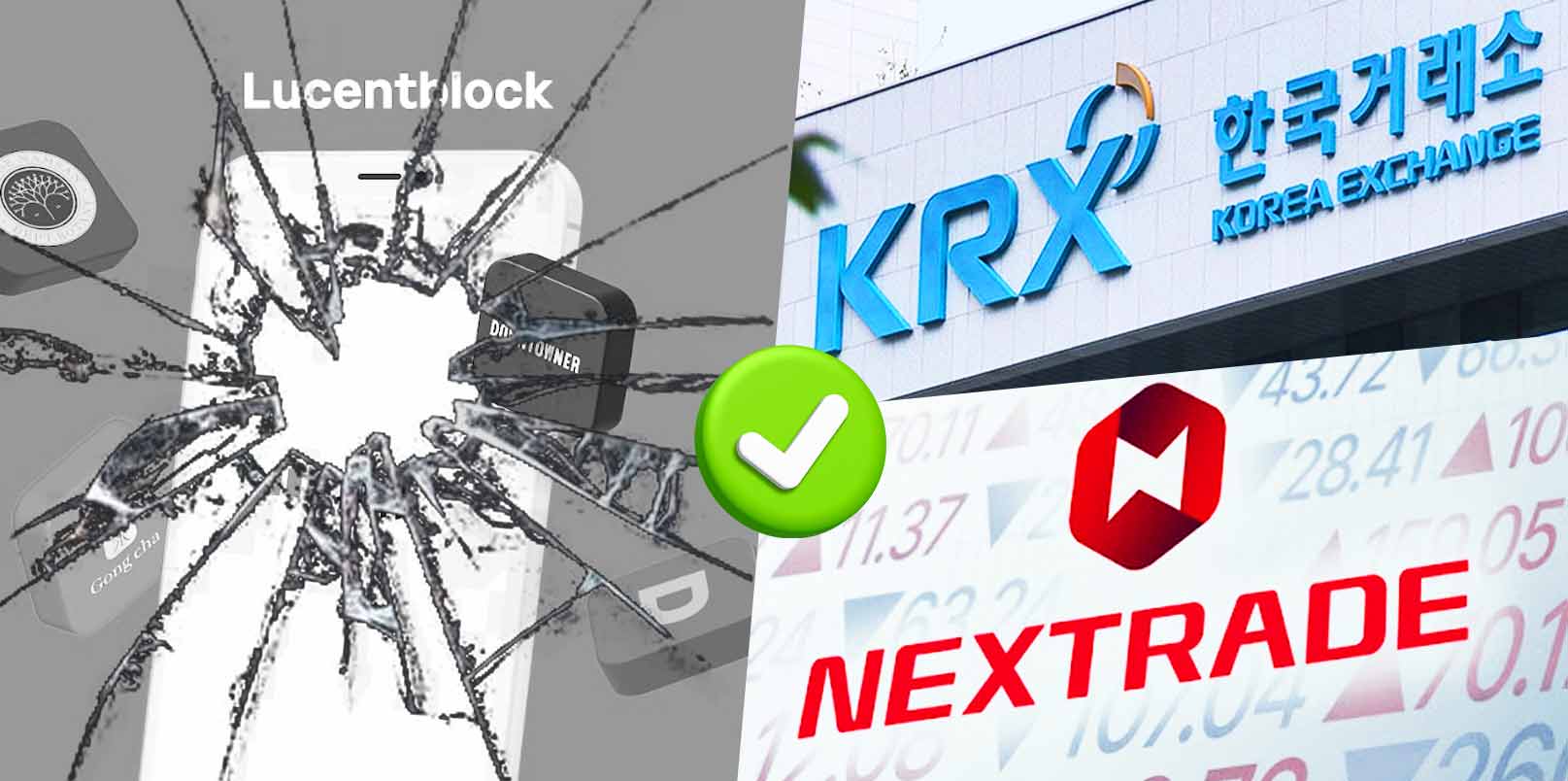
The FSC is reviewing preliminary licenses for two consortia: the Korea Exchange–KOSCOM (KDX) and NextTrade–Musicow (NXT) partnerships. Lucentblock, which pioneered STO operations through the sandbox since 2018, was reportedly facing near-disqualification process.

Lucentblock stated that it had “quietly advanced through regulatory uncertainty, gathered 500,000 users, and issued over KRW 30 billion in tokenized assets,” making it one of the only startups among 758 sandbox participants to continue its primary business without exit or acquisition.

The company argued that its operational record and data “proved the market viability of STOs,” yet “technical and stability scores favored institutions with no actual service record.”
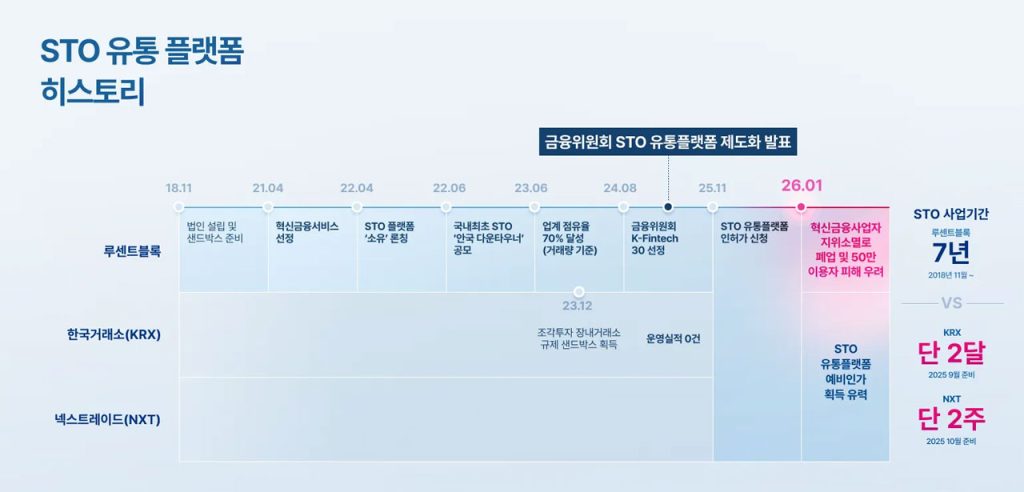
Korea proved innovation could thrive under a sandbox. But the fall of LucentBlock shows what happens when bold ideas graduate into a system unready to protect them.
STO distribution platform timeline. While Lucentblock has pioneered the market for 7 years, Korea Exchange entered the licensing competition after 2 months, and NexTrade after 2 weeks. (Image by: Lucentblock)

It also alleged that NexTrade accessed Lucentblock’s confidential data under a signed NDA for potential consortium talks—then filed its own license application in the same business domain within weeks.

Why This Licensing Round Signals a Shift in Korea’s Innovation Ecosystem

This issue may look like just an ordinary dispute. But underneath, it actually exposes a deeper contradiction in Korea’s innovation framework: the country’s most successful experiment in regulatory innovation may now be outgrowing its institutional capacity to protect the very innovators it nurtured.

The FSC had originally described this licensing phase as a bridge from “sandbox pilot service” to formal institutional adoption. Yet by introducing competition favoring existing financial infrastructure, the process inadvertently sidelined startups that bore the early risk.

This pattern echoes concerns already raised in the National Assembly last year, when lawmakers criticized quasi-public institutions for entering the same markets as startups they once regulated.

The Lucentblock case is now seen as the first systemic test of whether Korea’s “Third Venture Boom” policies truly safeguard private innovators against public power.

The Friction Between Policy Design and Market Execution

At the heart of the controversy lies a persistent tension between policy ambition and institutional execution. Korea’s sandbox created a path for experimentation but failed to establish clear graduation rules—what happens after innovation proves viable.

Lucentblock spent seven years building the foundation for STO distribution while public institutions watched from the sidelines. When the market became attractive enough for formalization, the advantage shifted to those with pre-existing infrastructure, not those with demonstrated resilience.

This mismatch is not just procedural. It points to how Korea’s innovation systems still combine regulation of risk with regulation of access. The former is necessary; the latter can smother entrepreneurship.

When sandbox graduates are treated as ordinary applicants competing against the institutions that once observed them, the experiment ceases to be innovation—it becomes extraction.

What Institutionalization Enables—and What It Still Fails to Protect

Formal licensing of STO platforms will give Korea a stable framework for digital securities trading, boosting investor trust and cross-border compatibility. Yet the process also cements a structural hierarchy: infrastructure-rich institutions at the top, innovators at the margins.

Lucentblock’s exclusion demonstrates how “institutionalization” can translate into consolidation rather than maturity. The Special Act on Financial Innovation Support was meant to offer “exclusive operational rights” to verified innovators for up to two years. In practice, no such protection has materialized.

Even if the FSC eventually approves sandbox pioneers for future rounds, the signal has already been sent: regulatory patience is temporary, but institutional privilege is permanent. That message undermines confidence for startups evaluating Korea’s policy reliability and deters venture investors who depend on predictable governance frameworks.

In an ironic twist of timing, the government recently announced a plan to increase the maximum fine for technology theft from KRW 2 billion to KRW 5 billion. The move signals an intent to strengthen protection for startup IP and innovation assets.

Yet Lucentblock’s case will inevitably serve as the first real measure of whether such penalties can be enforced with equal weight when allegations involve entities with institutional influence. For policymakers, this alignment of timing is less coincidence than confrontation—a moment to prove that Korea’s tightening laws are more than symbolic.

The Global View: Korea’s Innovation Governance Faces a Credibility Test

To global founders and investors, Korea’s sandbox once stood as a model for state-backed innovation. Its fast-track pilots in fintech, mobility, and deep tech inspired similar frameworks across Asia. But Lucentblock’s situation suggests a turning point: the sandbox accelerated innovation but failed to define ownership of its outcomes.

Moreover, this is not the first time Korea’s sandbox experiment has reached a critical breaking point. Just months earlier, one of the country’s first sandbox pioneers, Charzin, filed for court receivership after years of operating under government-led pilot programs. Its collapse revealed how early innovators often struggle once regulatory protection ends.

In contrast, markets like Singapore and the UK treat sandbox results as formal assets—data and IP that carry weight in subsequent licensing and investment. Korea’s lack of transition safeguards makes it harder for startups to scale or secure global partners once the pilot phase ends.

For investors, this undermines the appeal of Korea’s startup ecosystem as a reliable environment for regulated innovation. For policymakers, it raises a harder question: can a nation champion deep-tech entrepreneurship if its most compliant pioneers feel disposable?

If Lucentblock now follows the same downward path as Charzin, it will mark another sandbox pioneer falling after proving market viability—sending an unmistakable signal to investors and founders alike that Korea’s sandbox framework may be losing credibility as a safe bridge between experimentation and scale.

The Uncomfortable Lesson of Lucentblock

Lucentblock’s fall from sandbox pioneer to policy casualty is not an isolated event—it’s a mirror reflecting Korea’s innovation fatigue. The sandbox may have worked. It proved Korea could regulate for progress.

What didn’t work is the system’s ability to protect that progress once real power, money, and institutional politics entered the frame.

If Korea wants its Third Venture Boom to endure, it must confront the quiet contradiction now visible in its financial innovation model: that a country celebrated for designing sandboxes has not yet learned how to let its innovators out safely.

– Stay Ahead in Korea’s Startup Scene –
Get real-time insights, funding updates, and policy shifts shaping Korea’s innovation ecosystem.
➡️ Follow KoreaTechDesk on LinkedIn, X (Twitter), Threads, Bluesky, Telegram, Facebook, and WhatsApp Channel.

Tags: Crypto investmentCrypto tokensCryptocurrenciesCryptocurrency TrendsDigital Assetsdigital financeFinancial Services Commission (FSC)Fintechfintech companyfintech growthFinTech InvestmentFinTech sectoFSCInnovationinnovation challengesInnovation ConcernsInnovation ecosysteminnovation policiesKorea ExchangeKorea STO MarketLucentBlockNextTrade (NXT)rFinTech Startupssandboxstartup protection policySTOSTO ecosystemSTO Markettoken securities (STO) Koreavirtual assetVirtual asset management
Previous Post

Korea’s Deep-Tech Shift Is Further Unfolding — And CES 2026 Was the Proof

Next Post

Can Korea’s ‘All-in-One Pack Production’ Finally Bridge the Gap Between Policy Vision and Startup Survival?

Next Post

Can Korea’s ‘All-in-One Pack Production’ Finally Bridge the Gap Between Policy Vision and Startup Survival?

MOST READ ARTICLE OF THE WEEK

1.
2026 Venture Investment Reform: Korea Pushes ‘Four Venture Powerhouses’ Agenda to Unlock Private Capital
7 Jan 2026
2.
Mid-Sized Firms Call for Deeper Market Access as Korea – China Summit Reopens Economic Dialogue
7 Jan 2026
3.
Can Deep Tech Fix What Policy Funding Broke? Korea’s New R&D Model Aims to Rebuild Trust in Innovation
8 Jan 2026
4.
After the Applause: How Korea’s AI Basic Act Became a Stress Test for Its Governance Model
8 Jan 2026
5.
The Trust Deficit: Why Korea – China Startup Cooperation Depends on Institutional Credibility, Not Capital
8 Jan 2026
Register for Event

[the_ad id=”18508″]

List Article

1.
6 Reasons Why Seoul Is Poised to Become a Top 5 Global Economic Hub by 2030
20 Aug 2024
2.
Top Co-working Spaces for Startups & Companies to Explore in South Korea
3 Apr 2024
3.
Top Accelerators in South Korea Shaping Startup Success
29 Nov 2023
4.
Top Korean Venture Capital Firms Backing Startup Success
26 Oct 2023
5.
Top Apps for Seamless Korean to English Translation
14 Aug 2023

Similar Articles

FinTech

The Trust Recession: How the 2025 Upbit Hack Risks Korea’s Virtual-Asset Comeback

More
FinTech

Lucentblock Becomes First Test Case for Korea’s New Venture Investment Rules

More
FinTech

Inside Korea’s Next Fintech Pivot: What Naver – Dunamu Merger Could Mean for Stablecoin Policy and Global Expansion

More

Topics

Menu
  • AI & Big Data
  • AR & VR
  • Blockchain
  • Clean Technology
  • Content & Games
  • Cybersecurity
  • Enterprise & SaaS
  • FinTech
  • Gadgets & Electronics
  • Health & Bio
  • IoT

Program

Menu
  • Asan Voyager
  • CAPA Global Program
  • SGSC Global Bootcamp
  • LAUNCHPAD
  • COMEUP STARS 120
  • K-Startup Grand Challenge
  • TIPS X beSUCCESS Global Project
  • SFL Global Program
  • KTO Global Showcase
  • Yonsei Univ Global Class
  • KOSME Global Program

About

Menu
  • About Us
  • all articles
  • Terms of Use
  • Privacy
  • Cookie-policy
  • twitter

Subscribe and be informed first hand about actual Korean startup news.

All the day’s headlines and highlights, direct to you every morning.

Contact us : [email protected]

Topics

Menu
  • AI & Big Data
  • AR & VR
  • Blockchain
  • Clean Technology
  • Content & Games
  • Cybersecurity
  • Enterprise & SaaS
  • FinTech
  • Gadgets & Electronics
  • Health & Bio
  • IoT

Program

Menu
  • Asan Voyager
  • CAPA Global Program
  • SGSC Global Bootcamp
  • LAUNCHPAD
  • COMEUP STARS 120
  • K-Startup Grand Challenge
  • TIPS X beSUCCESS Global Project
  • SFL Global Program
  • KTO Global Showcase
  • Yonsei Univ Global Class
  • KOSME Global Program

About

Menu
  • About Us
  • all articles
  • Terms of Use
  • Privacy
  • Cookie-policy
  • twitter

Subscribe and be informed first hand about actual Korean startup news.

All the day’s headlines and highlights, direct to you every morning.

© 2023 Koreantech News & Media Korea Zrt. All rights reserved.

Our Spring Sale Has Started

You can see how this popup was set up in our step-by-step guide: https://wppopupmaker.com/guides/auto-opening-announcement-popups/

Our Spring Sale Has Started

You can see how this popup was set up in our step-by-step guide: https://wppopupmaker.com/guides/auto-opening-announcement-popups/

We hope you enjoy our content, May you please give us Feedback regarding our website!

Single Post Feedback

dgdfgfdgdf

What you think about Koreatechdesk, Share your idea with us!

feedback popup

Invitation submission has been closed

Insert/edit link

Enter the destination URL

Or link to existing content

    No search term specified. Showing recent items. Search or use up and down arrow keys to select an item.