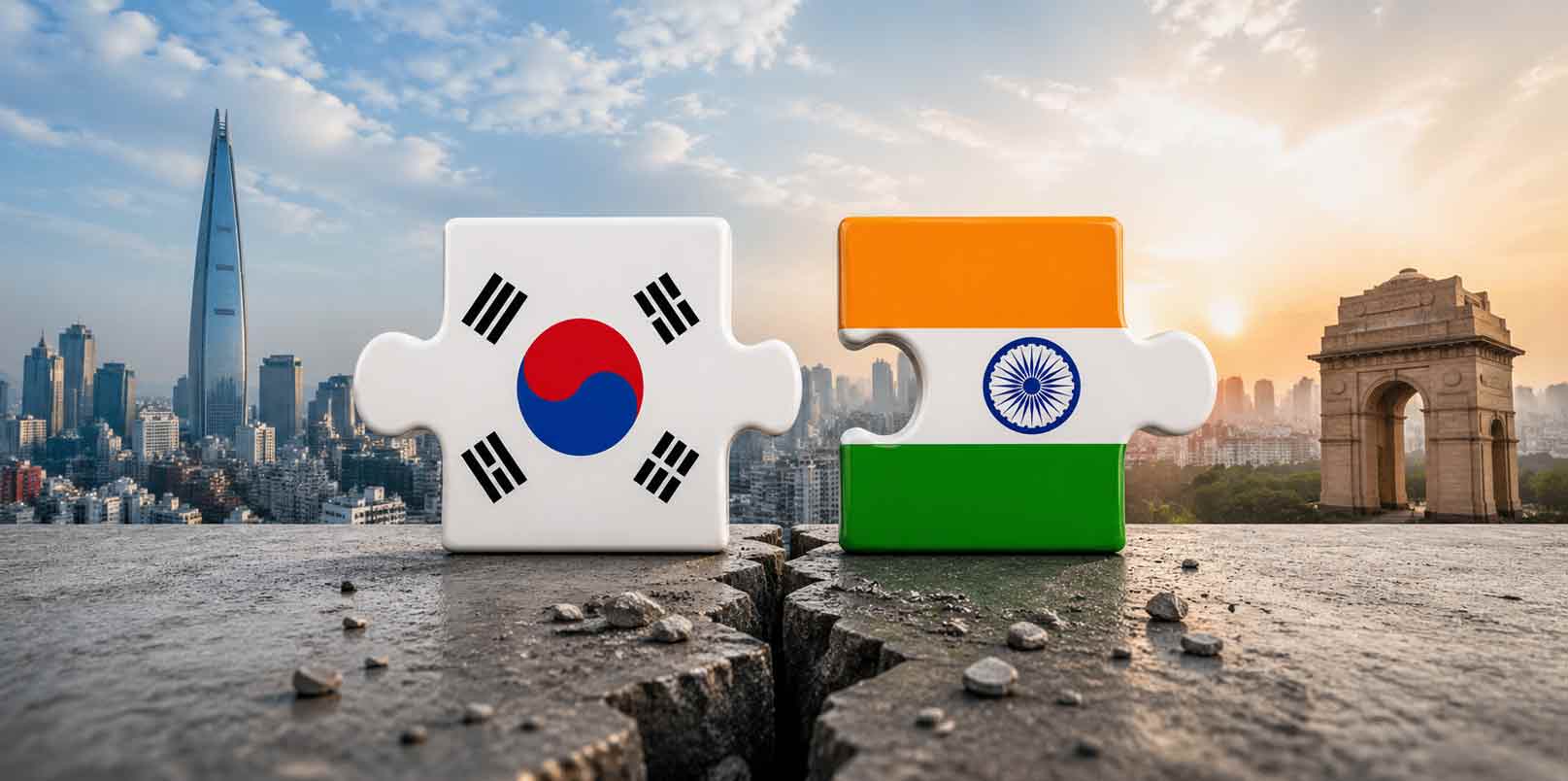
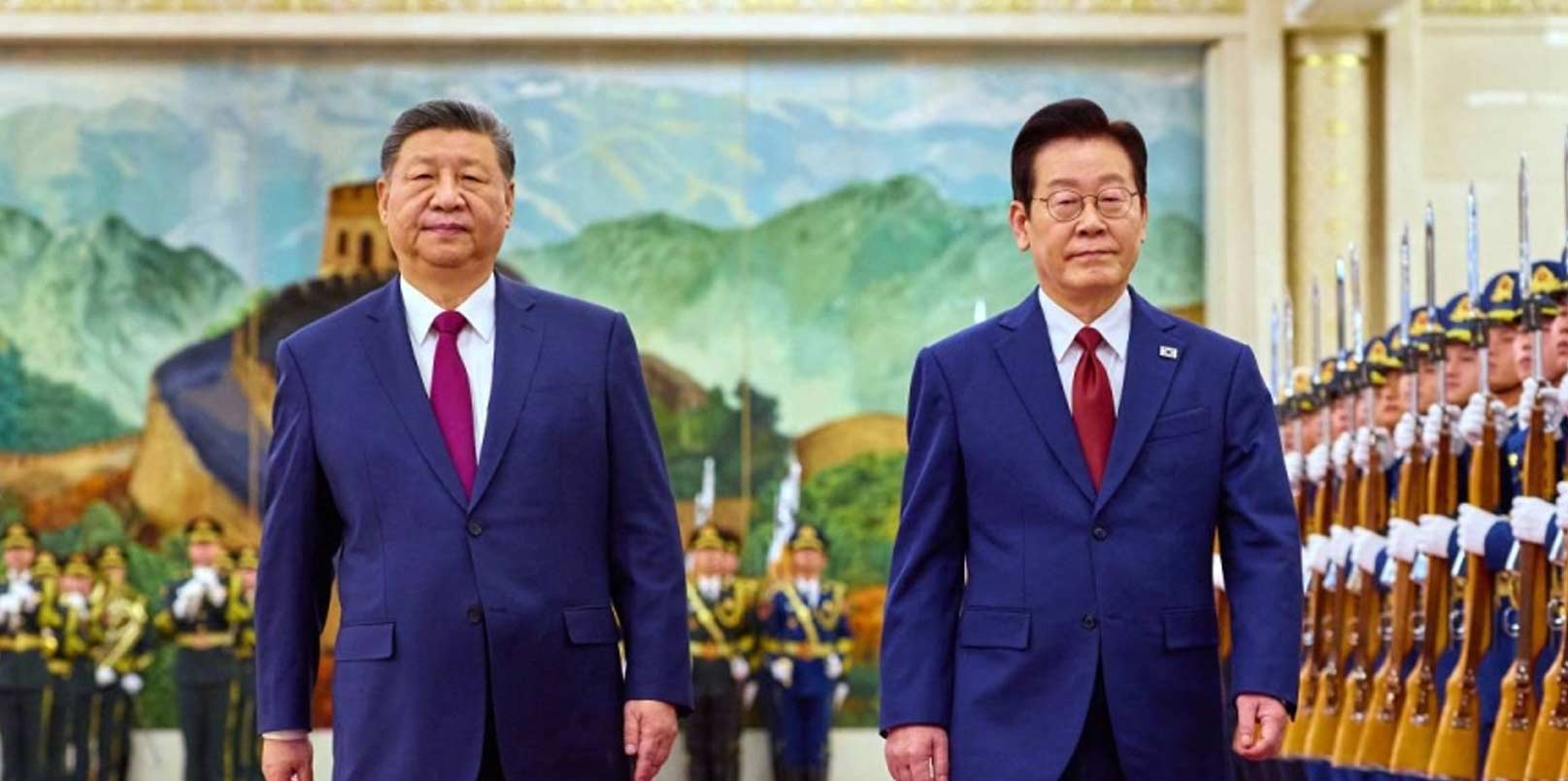
When Korea’s top tech leaders shook hands in Beijing and its startup founders met their Chinese counterparts in Shanghai, it became the grand unveiling of a new economic language—one written not in trade hierarchies or industrial dependence, but in shared innovation. The question now is whether Korea can thrive in this new grammar of equality.
A Subtle Shift Becomes Structural Between Korea and China
For the first time in years, Seoul and Beijing are no longer speaking in the language of dependency. Korea is no longer the supplier of technology, nor China merely the consumer of it.
President Lee Jae-myung’s remarks at Beijing’s Diaoyutai State Guesthouse set a new tone:
“Let us write a new story together—on the firm foundation of manufacturing, blending it with the color and narrative of services and content.”
The reference to Byeokrando, the 900-year-old Goryeo-Song trading port, was strategic and deliberate. Back then, Korea exported Goryeo paper, a key material for knowledge and culture. Today, that symbol evolved: manufacturing remains Korea’s base, but the creative economy and digital services are its new ink.
This move then sends a powerful message to China and the entire global audience: South Korea is seeking for cooperation, not hierarchy.
Two Stages, Two Messages: From Boardrooms to Builders
Lee’s state visit unfolded in two distinct economic moments.
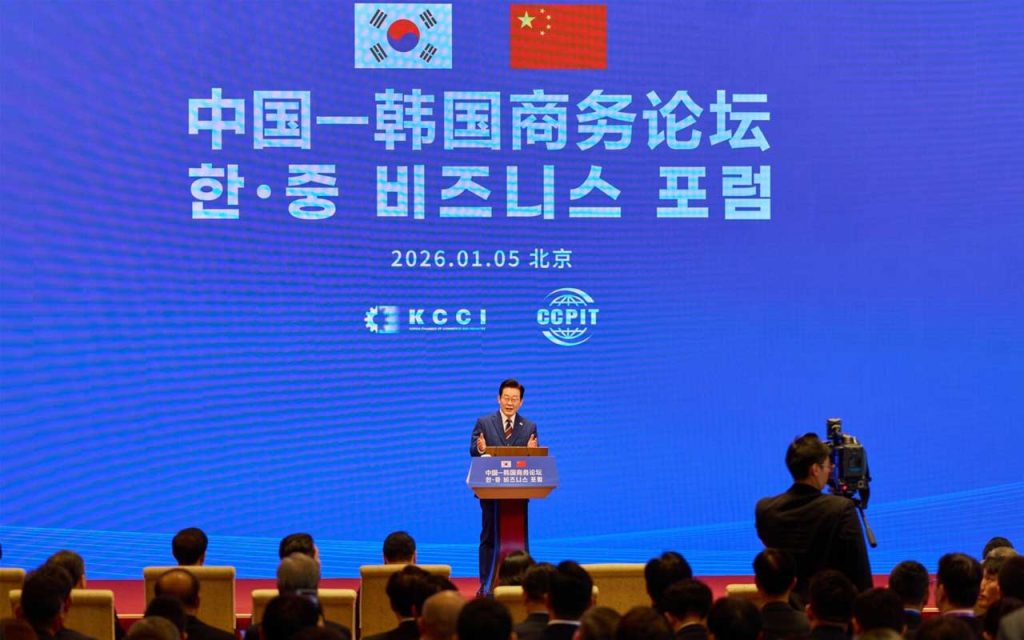
The Korea-China Business Forum on January 5 in Beijing brought together Korea’s top conglomerate heads—Samsung, SK, Hyundai, and LG—alongside China’s economic leadership, including Vice Premier He Lifeng. Thirty-two MOUs were signed, centering on semiconductors, batteries, and EVs. It was a display of scale and continuity—industries that define Korea’s economic present.
Two days later in Shanghai, the Korea-China Venture and Startup Summit revealed a different story. The stage was shared not by chaebol leaders, but by startup founders and investors. AI, robotics, and biotechnology dominated the conversation—sectors without predetermined winners. Roughly 400 participants attended, including top-level government officials, venture capital leaders, and emerging founders from both sides.
President Lee Jae-myung opened the summit by invoking Joseon scholar Park Je-ga, who once studied Qing innovations to accelerate Korea’s modernization:
“Innovation belongs to no single nation. Just as Park Je-ga engaged with Qing scholars, our startup ecosystems must connect organically to create shared growth.”
From Industrial Divide to Shared Layers of Innovation
The summit’s guest list illustrated what experts now call “intra-industry complementarity.”
Chinese firms like MiniMax, an AI model developer rivaling OpenAI, and BrainCo, a pioneer in brain-computer interfaces, shared the spotlight with Korean startups such as Lunit, known globally for its FDA-approved AI cancer diagnostics, Mind AI, and CNSE, active in China’s market.
The attendance and participation of these startups showcase significant symbolism: as they were not rivals but specialists in different layers of the same ecosystem. China brought scale, data, and deployment speed; Korea offered precision, vertical expertise, and global compliance experience.
Presidential briefings confirmed that MiniMax’s CEO emphasized “the importance of innovation-driven partnerships,” while CMB International’s CEO discussed “venture investment collaboration through China’s global fund network.” The discussion extended beyond technology—into cross-border venture capital alignment.
China Acknowledges a Shift Korea Is Still Processing
Chinese outlets like The Paper, Sohu, and Xinhua framed this shift as historic. Zhan Debin of Shanghai University’s Korea Research Center noted,
“The industrial complementarity between Korea and China is evolving from cross-industry to within-industry collaboration.”
Xinhua quoted Seoul’s own phrasing:
“The Korea-China economic relationship is moving from vertical cooperation to horizontal and equal partnership.”
Sohu went further, interpreting Lee’s language of “horizontal cooperation” and “equal collaboration” as symbolic of a deeper psychological transition—Korea’s acknowledgment that technological parity has arrived.
In Beijing’s logic, the “giver and receiver” model has ended. Korea, once a technology exporter, now recognizes that China’s capabilities in AI, mobility, and advanced manufacturing rival its own—and, in some fields, outpace them.
Korea’s Quiet Self-Realization
Not only that, but the shift has also gained special attention at home. At a recent forum hosted by the Korea Institute for Industrial Economics and Trade, local experts admitted that China has already surpassed Korea in traditional industries such as steel and petrochemicals, as well as future ones like autonomous driving, batteries, and robotics.
KOTRA’s Global Research Institute Director Hong Chang-pyo reflected on the turning point:
“In 2015, during FTA negotiations, Korean tech firms believed the gap was unbridgeable. Now, China’s real strength is its complete industrial ecosystem and self-contained value chain. It’s unclear how long Korea’s semiconductor leadership can last.”
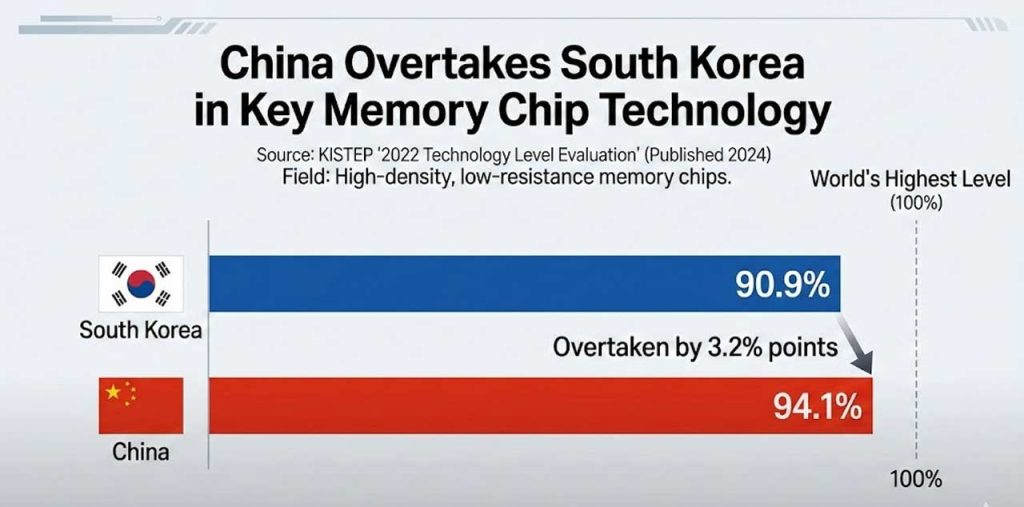
Data from the Korea Institute of Science and Technology Evaluation and Planning (KISTEP) supports this reality. In 2024, China’s semiconductor technology scored 94.1 out of 100, surpassing Korea’s 90.9 in high-density, low-resistance memory chips—a reversal that would have been unthinkable a decade ago.
A New Grammar of Cooperation Emerges Between Korea and China
The evolving relationship between Korea and China no longer fits the old hierarchical model. Beijing’s Tencent News summarized the new logic succinctly:
“This visit signals a return to the track of ‘business first, disputes later.’”
The metaphorical distance between Byeokrando and Shanghai—900 years apart—now marks a full circle of cooperation: from paper to code, from trade goods to algorithms. The new grammar is one of shared authorship, not instruction.
And so, this strikes a delicate balance because Korea’s innovation strategy must now walk a line between global competitiveness and coexistence with its largest neighbor. The question is no longer who leads, but how two advanced ecosystems can co-create value within the same technological landscape.
Korea – China Partnership: A Shared Horizon, Not a Dividing Line
The sight of MiniMax and Lunit seated side by side at the Shanghai summit captured a quiet truth—Korea and China are no longer operating in separate worlds. Their startups, investors, and policymakers are learning to navigate the same horizon, sometimes competing, often collaborating.
That is why global investors can now see this a clear signal that Asia’s innovation future is no longer defined by a single pole. Korea’s equal-footing turn with China may be the first draft of a broader regional blueprint—one that replaces vertical dependency with horizontal resilience.
From Byeokrando to Shanghai, a thousand years of commerce and learning have come full circle. The question now is not if the grammar of Korea-China cooperation has changed—but how quickly the rest of the world learns to read it.
– Stay Ahead in Korea’s Startup Scene –
Get real-time insights, funding updates, and policy shifts shaping Korea’s innovation ecosystem.
➡️ Follow KoreaTechDesk on LinkedIn, X (Twitter), Threads, Bluesky, Telegram, Facebook, and WhatsApp Channel.
🤝 Looking to connect with verified Korean companies building globally?
Explore curated company profiles and request direct introductions through beSUCCESS Connect.