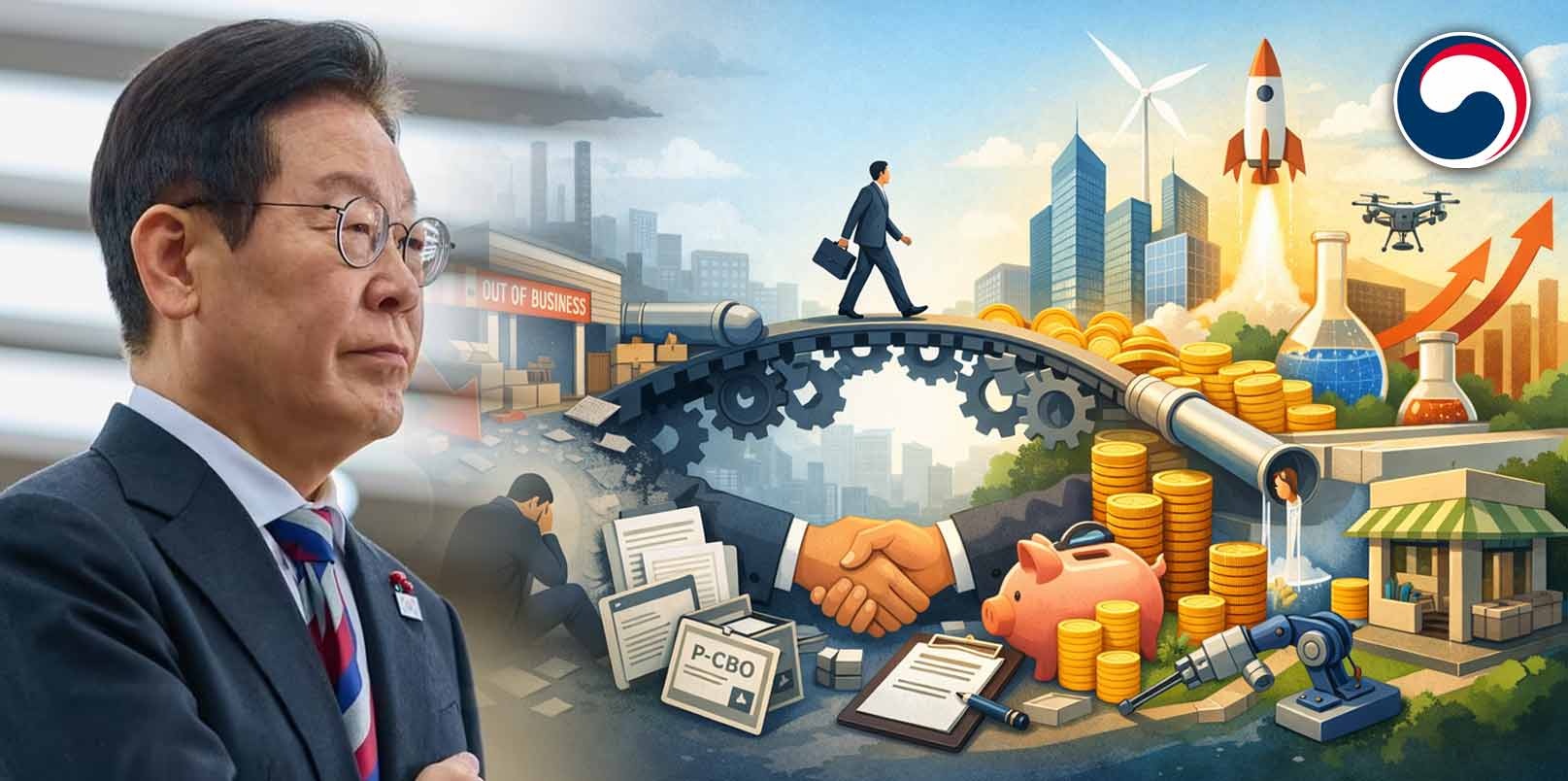
Korea is re-engineering the way its venture ecosystem deals with failure. The government’s 2026 Economic Growth Strategy positions entrepreneurship not as a one-shot endeavor but as a cycle of creation, collapse, and comeback. By extending the national Fund of Funds and expanding its re-challenge capital pool to KRW 1 trillion by 2030, the policy signals a deeper shift: Korea wants to make second chances part of its startup DNA.
Government Expands Fund of Funds and Re-Challenge Capital
The policy roadmap previously announced by the Ministry of SMEs and Startups has now been officially integrated under Korea’s 2026 Economic Growth Strategy.
The Korean government announced that the Fund of Funds, a key driver of public venture capital, will extend its lifespan and expand fiscal reinvestment from KRW 1 trillion to KRW 1.6 trillion in 2026.
A new “National Account” will also be established to allow pension and retirement funds to participate, while a risk-sharing framework for Fund of Funds losses will be introduced by the third quarter.
The Re-Challenge Fund, designed to help entrepreneurs rebuild after business failure, will expand from KRW 150 billion (2021–2025) to KRW 1 trillion by 2030, marking the largest public re-start capital pool in Korea’s venture history.
Currently, ten government ministries contribute to nineteen Fund of Funds accounts, which collectively underpin most of Korea’s policy venture capital. The new account system is expected to broaden private co-investment and reduce concentration risks across sectors.
Building a “Re-Challenge” System Where Failure Becomes an Asset
The government aims to institutionalize what it calls a “re-challenge ecosystem”, ensuring founders can recover from failure without being shut out of future capital or policy support.
At the crisis management stage, KRW 200 billion in restructuring assistance will be allocated to companies facing operational distress. During the business closure phase, joint liability limits will be expanded to include technology finance companies and venture investment associations, easing burdens on founders.
P-CBOs (Primary Collateralized Bond Obligations) issued by SMEs will be exempted from joint guarantees, and existing liabilities will be phased out upon maturity.
At the re-launch phase, capital access will be broadened through new guarantees, loans, and fund mechanisms. A Re-Challenge Special Guarantee will support entrepreneurs who failed to repay technology guarantees, and rehabilitation financing will expand to companies still undergoing restructuring, not just those that have completed it.
Kim Jae-hoon, Director of the Economic Policy Bureau at the Ministry of Economy and Finance, said the reforms are designed to make Korea’s venture landscape more cyclical and resilient:
“We will significantly expand support for venture creation so that a new wave of startups emerges and new success stories are written.”
Shifting Small Business Policy from Emergency Relief to Structural Strength
The 2026 strategy also redefines the government’s approach to small business competitiveness, shifting the focus from emergency relief to sustainable restructuring.
This transition revolves around three pillars:
- “Everyday R&D” to enhance practical innovation,
- Scaling through collective capacity, and
- Crisis and recovery support for small business owners.
Under Everyday R&D, the government will fund initiatives that directly improve small business productivity — such as developing regional signature recipes, AI-assisted cooking and marketing, and AI-based commercial district analytics. The emphasis moves away from research-heavy projects to practical development (“D”) that small businesses can apply immediately.
To accelerate collaboration, 80 small business cooperatives will receive up to KRW 300 million each for joint product development, process improvement, and sales expansion.
By 2030, the government plans to establish 17 glocal anchor commercial districts and 50 local base business zones, combining culture, industry, and tourism to drive regional economies. It will also nurture 10,000 local founders and 1,000 local entrepreneurs annually, starting with two Local Startup Towns opening this year as community innovation hubs.
Data-Driven Monitoring and Recovery Incentives for Small Business Owners
Approximately three million small business borrowers will be monitored through a real-time risk detection system that tracks sales and credit data, enabling early intervention. The first phase of proactive alerts and support will begin in June 2026.
For those closing their businesses, a new low-interest relocation support loan of up to KRW 6 million (one-year term) will help cover dismantling and relocation costs through a “loan-first, reimbursement-later” structure.
At the recovery stage, entrepreneurs who demonstrate consistent repayment under the New Start Fund will receive additional debt reductions or interest rate discounts, and a Re-Challenge Credit Card Program will be launched to support re-entering founders.
Director Kim underscored this year’s strategic focus:
“Last year we prioritized emergency measures like debt forgiveness and consumption vouchers. This year, we are focusing on strengthening domestic demand and building fundamental competitiveness through Everyday R&D.”
Why This Matters: Korea’s Policy Maturity and the Global Venture Context
The new policies highlight a philosophical and structural evolution in Korea’s approach to innovation and entrepreneurship. Instead of treating failure as an endpoint, the government is embedding it into the venture lifecycle.
Globally, advanced ecosystems such as the U.S. and Israel have long normalized failure as a step toward eventual success. Korea’s policy shift — blending capital reform, tax incentives, and re-start financing — signals an effort to bridge that cultural and structural gap.
For investors and partners, this also reshapes risk perception in Korea’s venture market. By expanding the Fund of Funds and lowering re-entry barriers, the government is implicitly creating a safety net for high-risk innovation — a move that could increase early-stage participation and foster deeper private-public capital alignment.
Can Korea Turn Policy Resilience into Ecosystem Resilience?
With its 2026 Econoomic Growth Strategy for venture investment, South Korea is sending a powerful message to founders and investors that resilience is now infrastructure. As the country expanded its re-challenge capital, provided stronger fund mechanisms, and conducted small business R&D reform, Korea is attempting to hardwire second chances into its innovation economy.
But still, whether this transformation delivers results will depend on execution and trust — whether founders truly feel the system allows them to fail, recover, and build again.
If the new framework holds, Korea’s next generation of startups may not only be more global but also more enduring — shaped by the belief that failure, properly supported, can be the foundation of growth.
🤝 Looking to connect with verified Korean companies building globally?
Explore curated company profiles and request direct introductions through beSUCCESS Connect.
– Stay Ahead in Korea’s Startup Scene –
Get real-time insights, funding updates, and policy shifts shaping Korea’s innovation ecosystem.
➡️ Follow KoreaTechDesk on LinkedIn, X (Twitter), Threads, Bluesky, Telegram, Facebook, and WhatsApp Channel.